Cho Seulki, Lee Tae Sup, Song In Ho, Kim A-Ram, Lee Yoon-Jin, Kim Haejung, Hwang Haein, Jeong Mun Sik, Kang Seung Goo, Hong Hyo Jeong
Department of Functional Genomics, University of Science & Technology, Daejeon, Republic of Korea.
Institute of Bioscience and Biotechnology, Kangwon National University, Chuncheon, Republic of Korea.
PLoS One. 2017 Feb 6;12(2):e0170078. doi: 10.1371/journal.pone.0170078. eCollection 2017.
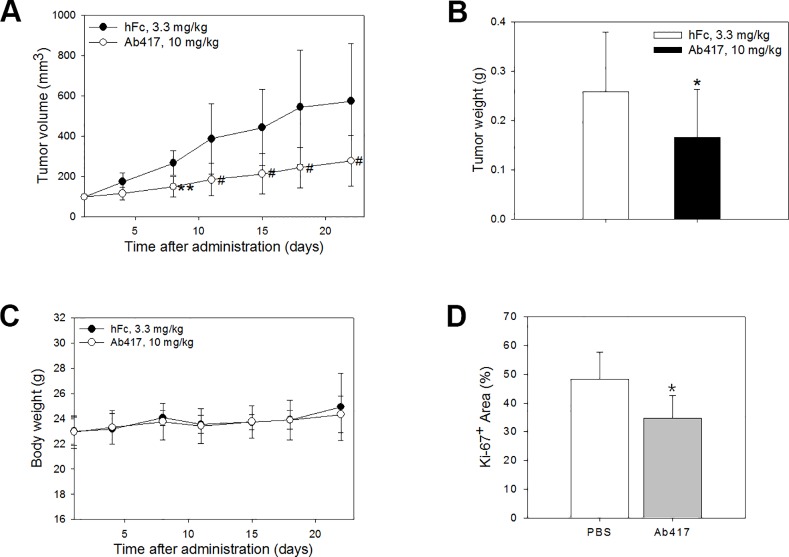
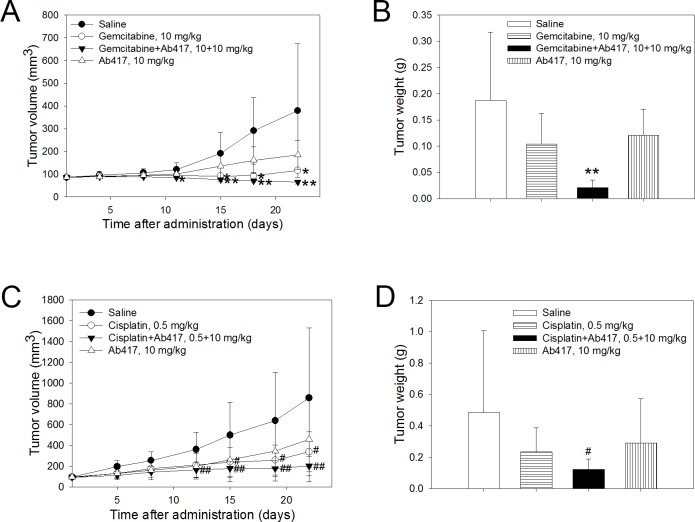
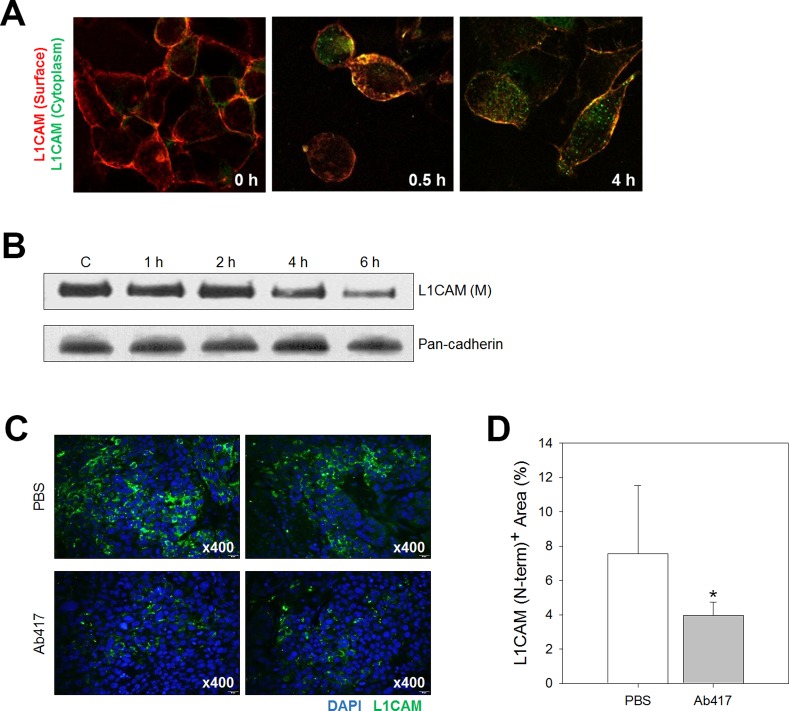
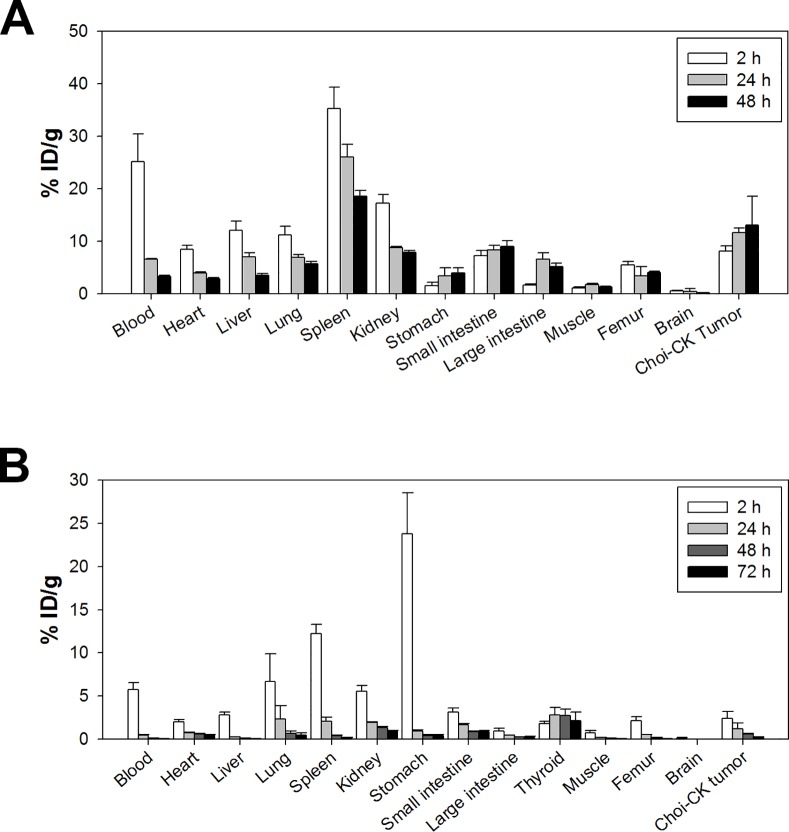
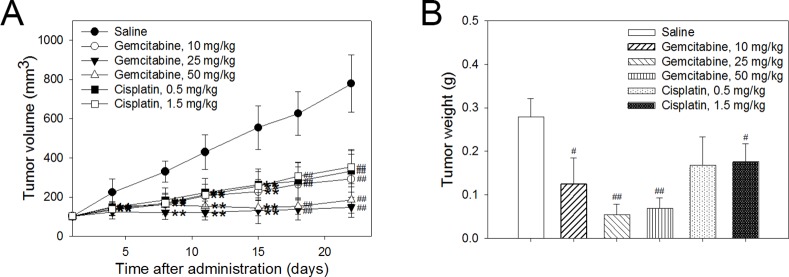
Cholangiocarcinoma has a poor prognosis and is refractory to conventional chemotherapy and radiation therapy. Improving survival of patients with advanced cholangiocarcinoma urgently requires the development of new effective targeted therapies in combination with chemotherapy. We previously developed a human monoclonal antibody (mAb) Ab417 that binds to both the human and mouse L1 cell adhesion molecule (L1CAM) with high affinities. In the present study, we observed that Ab417 exhibited tumor targeting ability in biodistribution studies and dose-dependent tumor growth inhibition in an intrahepatic cholangiocarcinoma (Choi-CK) xenograft mouse model. Regarding the mechanism of action, Ab417 was internalized into the tumor cells and thereby down-regulated membrane L1CAM, and inhibited tumor growth by reducing tumor cell proliferation in vivo. Gemcitabine inhibited the tumor growth in a dose-dependent manner in the Choi-CK xenograft model. However, cisplatin inhibited the tumor growth moderately and not in a dose-dependent way, suggesting that the tumors may have developed resistance to apoptosis induced by cisplatin. Combined treatment with Ab417 and gemcitabine or cisplatin exerted enhanced tumor growth inhibition compared to treatment with antibody or drug alone. The results suggest that Ab417 in combination with chemotherapy may have potential as a new therapeutic regimen for cholangiocarcinoma. Our study is the first to show an enhanced therapeutic effect of a therapeutic antibody targeting L1CAM in combination with chemotherapy in cholangiocarcinoma models.
胆管癌预后较差,对传统化疗和放疗均不敏感。提高晚期胆管癌患者的生存率迫切需要开发新的有效的靶向治疗方法并联合化疗。我们之前研发了一种人源单克隆抗体(mAb)Ab417,它能以高亲和力与人及小鼠的L1细胞黏附分子(L1CAM)结合。在本研究中,我们观察到在生物分布研究中Ab417具有肿瘤靶向能力,并且在肝内胆管癌(Choi-CK)异种移植小鼠模型中具有剂量依赖性的肿瘤生长抑制作用。关于作用机制,Ab417被内化进入肿瘤细胞,从而下调细胞膜上的L1CAM,并通过在体内减少肿瘤细胞增殖来抑制肿瘤生长。吉西他滨在Choi-CK异种移植模型中以剂量依赖性方式抑制肿瘤生长。然而,顺铂对肿瘤生长的抑制作用中等且不呈剂量依赖性,这表明肿瘤可能已对顺铂诱导的凋亡产生耐药性。与单独使用抗体或药物治疗相比,Ab417与吉西他滨或顺铂联合治疗具有更强的肿瘤生长抑制作用。结果表明,Ab417联合化疗可能具有作为胆管癌新治疗方案的潜力。我们的研究首次表明在胆管癌模型中,靶向L1CAM的治疗性抗体联合化疗具有增强的治疗效果。