Departamento de Bioquímica y Biología Molecular, Universidad de Salamanca, 37007 Salamanca, Spain.
Instituto de Investigación Biomédica de Salamanca (IBSAL), 37007 Salamanca, Spain.
Int J Mol Sci. 2024 Jan 11;25(2):921. doi: 10.3390/ijms25020921.
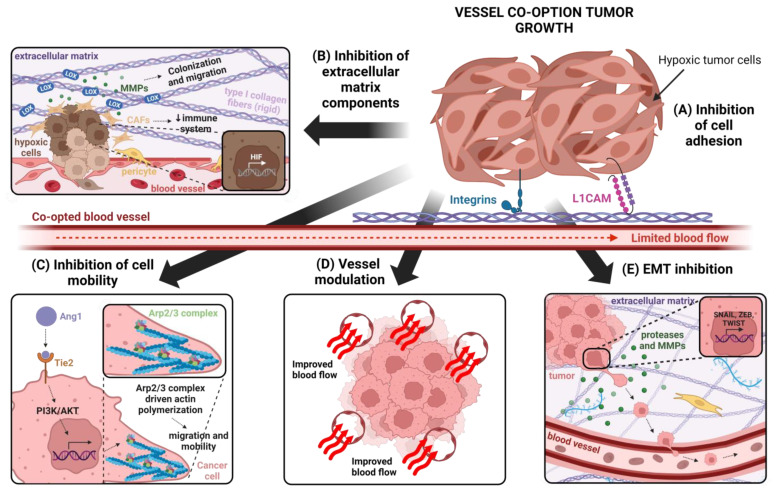
Vessel co-option (VCO) is a non-angiogenic mechanism of vascularization that has been associated to anti-angiogenic therapy. In VCO, cancer cells hijack the pre-existing blood vessels and use them to obtain oxygen and nutrients and invade adjacent tissue. Multiple primary tumors and metastases undergo VCO in highly vascularized tissues such as the lungs, liver or brain. VCO has been associated with a worse prognosis. The cellular and molecular mechanisms that undergo VCO are poorly understood. Recent studies have demonstrated that co-opted vessels show a quiescent phenotype in contrast to angiogenic tumor blood vessels. On the other hand, it is believed that during VCO, cancer cells are adhered to basement membrane from pre-existing blood vessels by using integrins, show enhanced motility and a mesenchymal phenotype. Other components of the tumor microenvironment (TME) such as extracellular matrix, immune cells or extracellular vesicles play important roles in vessel co-option maintenance. There are no strategies to inhibit VCO, and thus, to eliminate resistance to anti-angiogenic therapy. This review summarizes all the molecular mechanisms involved in vessel co-option analyzing the possible therapeutic strategies to inhibit this process.
血管生成拟态(VCO)是一种非血管生成的血管生成机制,与抗血管生成治疗有关。在 VCO 中,癌细胞劫持预先存在的血管,并利用它们获取氧气和营养物质,侵袭邻近组织。多个原发性肿瘤和转移瘤在高度血管化的组织中(如肺、肝或脑)发生 VCO。VCO 与预后较差有关。VCO 所经历的细胞和分子机制尚不清楚。最近的研究表明,与血管生成的肿瘤血管相比,被劫持的血管表现出静止表型。另一方面,据信在 VCO 期间,癌细胞通过整合素附着在预先存在的血管的基底膜上,表现出增强的运动性和间充质表型。肿瘤微环境(TME)的其他成分,如细胞外基质、免疫细胞或细胞外囊泡,在血管生成拟态的维持中发挥重要作用。目前尚无抑制 VCO 的策略,因此无法消除对抗血管生成治疗的耐药性。这篇综述总结了参与血管生成拟态的所有分子机制,分析了抑制这一过程的可能治疗策略。