Qu Fang, Weschler Louise B, Sun Yuexia, Sundell Jan
China Meteorological Administration Training Centre, China Meteorological Administration, Beijing, China.
Department of Building Science, Tsinghua University, Beijing, China.
PLoS One. 2017 Feb 6;12(2):e0171438. doi: 10.1371/journal.pone.0171438. eCollection 2017.
To compare the proportion of Beijing children who have ever had pneumonia (%Pneumonia) to those in other locations, and to estimate by how much national vaccine coverage with Pneumococcal Conjugate Vaccine (PCV) and Haemophilus Influenzae Type b (Hib) could reduce Beijing %Pneumonia.
%Pneumonia was obtained for each age group from 1 to 8 years inclusive from 5,876 responses to a cross-sectional questionnaire. Literature searches were conducted for world-wide reports of %Pneumonia. Previous vaccine trials conducted worldwide were used to estimate the pneumococcal (S. pneumoniae) and Hib (H. influenzae) burdens and %Pneumonia as well as the potential for PCV and Hib vaccines to reduce Beijing children's %Pneumonia.
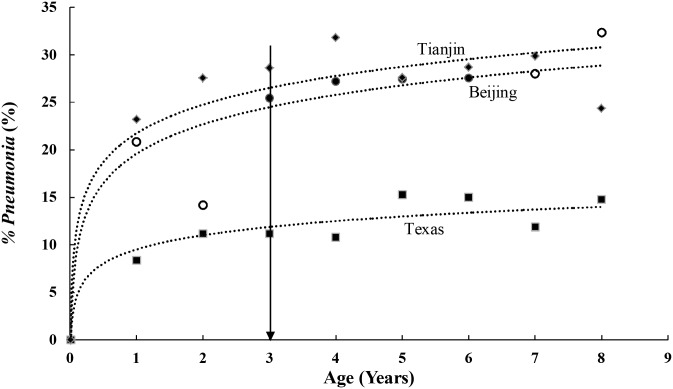
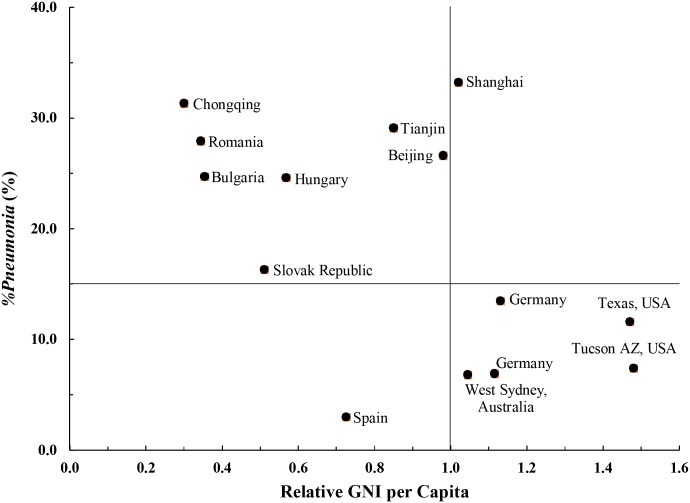
The majority of pneumonia cases occurred by the age of three. The cumulative %Pneumonia for 3-8 year-old Beijing children, 26.9%, was only slightly higher than the 25.4% for the discrete 3 year-old age group, similar to trends for Tianjin (China) and Texas (USA). Beijing's %Pneumonia is disproportionally high relative to its Gross National Income (GNI) per capita, and markedly higher than %Pneumonia in the US and other high GNI per capita countries. Chinese diagnostic guidelines recommend chest X-ray confirmation while most other countries discourage it in favor of clinical diagnosis. Literature review shows that chest X-ray confirmation returns far fewer pneumonia diagnoses than clinical diagnosis. Accordingly, Beijing's %Pneumonia is likely higher than indicated by raw numbers. Vaccine trials suggest that national PCV and Hib vaccination could reduce Beijing's %Pneumonia from 26.9% to 19.7% and 24.9% respectively.
National PCV and Hib vaccination programs would substantially reduce Beijing children's pneumonia incidence.
比较北京儿童曾经患肺炎的比例(%肺炎)与其他地区儿童,并估计全国肺炎球菌结合疫苗(PCV)和b型流感嗜血杆菌(Hib)疫苗接种覆盖率能使北京儿童的%肺炎降低多少。
通过对5876份横断面调查问卷的回复,获取了1至8岁各年龄组的%肺炎数据。对全球范围内关于%肺炎的报告进行了文献检索。利用此前在全球开展的疫苗试验,估算肺炎球菌(肺炎链球菌)和Hib(流感嗜血杆菌)的疾病负担、%肺炎,以及PCV和Hib疫苗降低北京儿童%肺炎的潜力。
大多数肺炎病例发生在三岁之前。北京3至8岁儿童的累积%肺炎为26.9%,仅略高于3岁这一单独年龄组的25.4%,与中国天津和美国得克萨斯州的趋势相似。相对于人均国民总收入(GNI),北京的%肺炎比例过高,且明显高于美国及其他高人均GNI国家的%肺炎。中国的诊断指南建议通过胸部X光进行确诊,而大多数其他国家则不提倡这样做,更倾向于临床诊断。文献综述表明,与临床诊断相比,通过胸部X光确诊的肺炎病例要少得多。因此,北京的%肺炎实际情况可能比原始数据显示的更高。疫苗试验表明,全国性的PCV和Hib疫苗接种可分别将北京的%肺炎从26.9%降至19.7%和24.9%。
全国性的PCV和Hib疫苗接种计划将大幅降低北京儿童的肺炎发病率。