Che Datian, Zhou Hua, He Jinchun, Wu Bin
Medical Decision and Economic Group, Department of Pharmacy, Renji Hospital, affiliated with the School of Medicine, Shanghai Jiaotong University, Shanghai, China.
BMC Health Serv Res. 2014 Feb 7;14:56. doi: 10.1186/1472-6963-14-56.
The purpose of this study was to compare, from a Chinese societal perspective, the projected health benefits, costs, and cost-effectiveness of adding pneumococcal conjugate heptavalent vaccine (PCV-7) to the routine compulsory child immunization schedule.
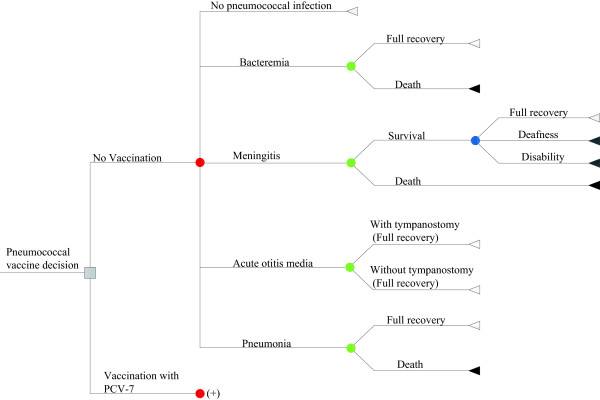
A decision-tree model, with data and assumptions adapted for relevance to China, was developed to project the health outcomes of PCV-7 vaccination (compared with no vaccination) over a 5-year period as well as a lifetime. The vaccinated birth cohort included 16,000,000 children in China. A 2 + 1 dose schedule at US$136.51 per vaccine dose was used in the base-case analysis. One-way sensitivity analysis was used to test the robustness of the model. The impact of a net indirect effect (herd immunity) was evaluated. Outcomes are presented in terms of the saved disease burden, costs, quality-adjusted life years (QALYs) and incremental cost-effectiveness ratio.
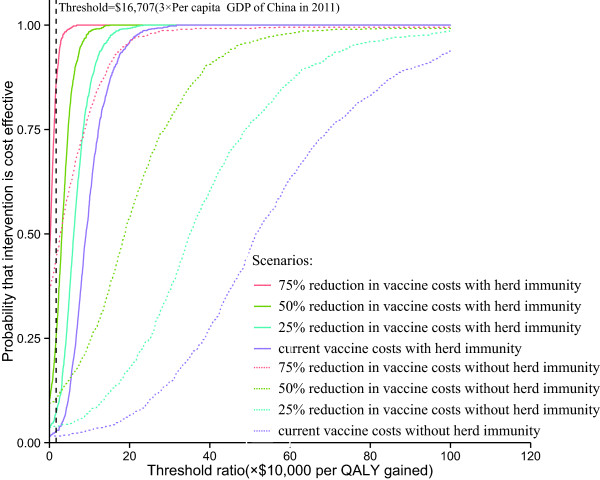
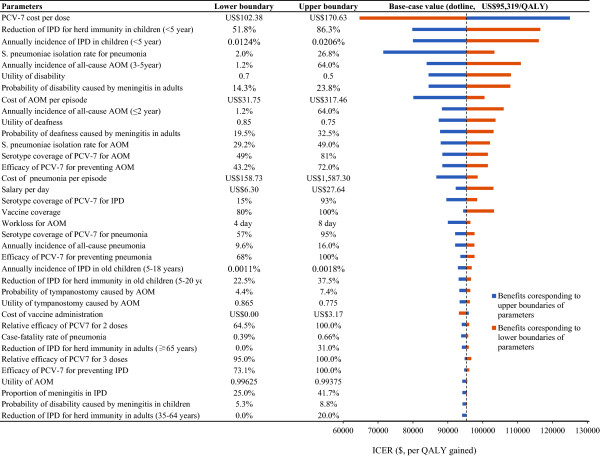
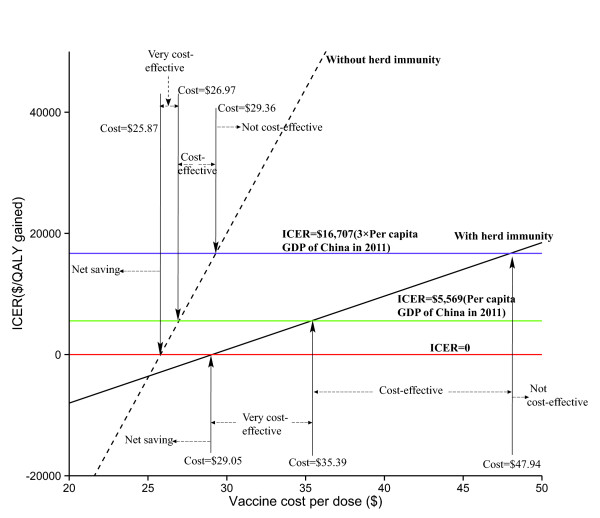
In a Chinese birth cohort, a PCV-7 vaccination program would reduce the number of pneumococcus-related infections by at least 32% and would prevent 2,682 deaths in the first 5 years of life, saving $1,190 million in total costs and gaining an additional 9,895 QALYs (discounted by 3%). The incremental cost per QALY was estimated to be $530,354. When herd immunity was taken into account, the cost per QALY was estimated to be $95,319. The robustness of the model was influenced mainly by the PCV-7 cost per dose, effectiveness herd immunity and incidence of pneumococcal diseases. With and without herd immunity, the break-even costs in China were $29.05 and $25.87, respectively.
Compulsory routine infant vaccination with PCV-7 is projected to substantially reduce pneumococcal disease morbidity, mortality, and related costs in China. However, a universal vaccination program with PCV-7 is not cost-effective at the willingness-to-pay threshold that is currently recommended for China by the World Health Organization.
本研究旨在从中国社会的角度,比较在儿童常规强制免疫计划中添加七价肺炎球菌结合疫苗(PCV-7)预计带来的健康效益、成本及成本效益。
构建了一个决策树模型,采用适合中国国情的数据和假设,以预测PCV-7疫苗接种(与未接种相比)在5年及终生期间的健康结果。接种疫苗的出生队列包括中国的1600万儿童。基础案例分析采用每剂136.51美元的2+1剂量方案。采用单向敏感性分析来检验模型的稳健性。评估了净间接效应(群体免疫)的影响。结果以节省的疾病负担、成本、质量调整生命年(QALY)和增量成本效益比来呈现。
在中国出生队列中,PCV-7疫苗接种计划将使肺炎球菌相关感染数量至少减少32%,并在生命的前5年预防2682例死亡,节省总成本11.9亿美元,并额外获得9895个QALY(按3%贴现)。每QALY的增量成本估计为530354美元。考虑群体免疫时,每QALY的成本估计为95319美元。模型的稳健性主要受PCV-7每剂成本、群体免疫效果和肺炎球菌疾病发病率的影响。无论有无群体免疫,中国的收支平衡成本分别为29.05美元和25.87美元。
预计在中国实施PCV-7常规婴儿强制接种将大幅降低肺炎球菌疾病的发病率、死亡率及相关成本。然而,按照世界卫生组织目前为中国推荐的支付意愿阈值,PCV-7普遍接种计划不具有成本效益。