Baddack-Werncke Uta, Busch-Dienstfertig Melanie, González-Rodríguez Sara, Maddila Santhosh Chandar, Grobe Jenny, Lipp Martin, Stein Christoph, Müller Gerd
Department of Tumor Genetics and Immunogenetics, Max-Delbrück-Center of Molecular Medicine (MDC), Robert-Rössle-Strasse 10, 13125, Berlin, Germany.
Current address: DLR project management agency, Department for Health Research, Heinrich-Konen-Str. 1, 53227, Bonn, Germany.
J Neuroinflammation. 2017 Feb 6;14(1):30. doi: 10.1186/s12974-017-0804-y.
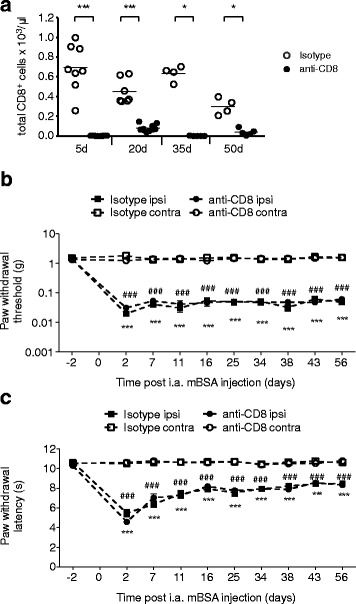
This study examined the development of chronic pain, a cardinal symptom of rheumatoid arthritis (RA), in mice with antigen- and collagen-induced arthritis (ACIA). Since the role of CD8 T cells in arthritis is controversial, we investigated the consequences of CD8-depletion on arthritis development and opioid modulation of pain in this novel model of chronic autoimmune arthritis.
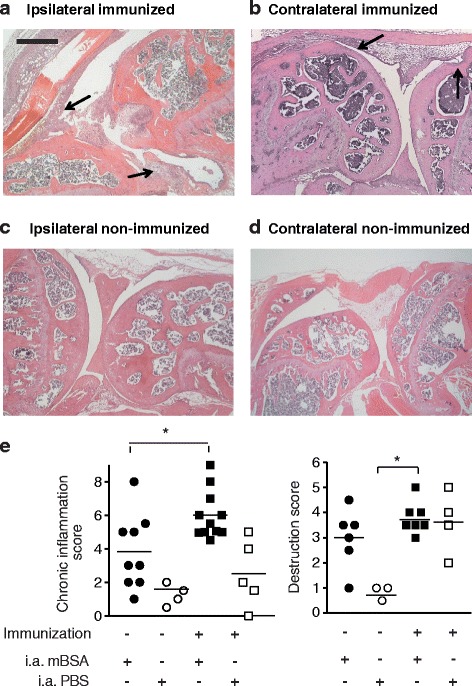
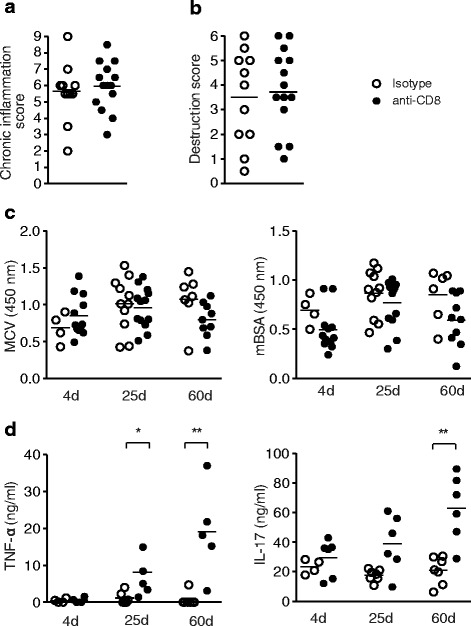
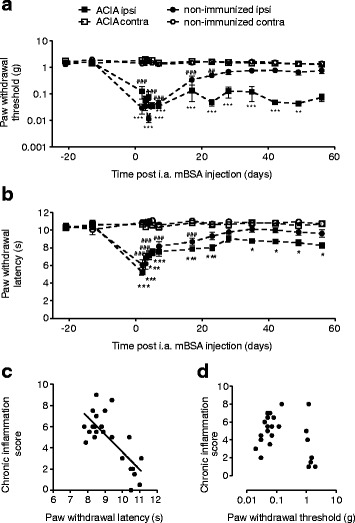
Disease severity in control and CD8-depleted animals was determined by histological assessment of knee-joint sections and measurement of autoantibody formation. Pain was evaluated by measuring mechanical allodynia and thermal hyperalgesia in von Frey and Hargreaves tests, respectively. The production and release of endogenous opioids and inflammatory cytokines was assessed in immunoassays.
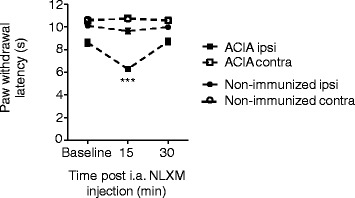
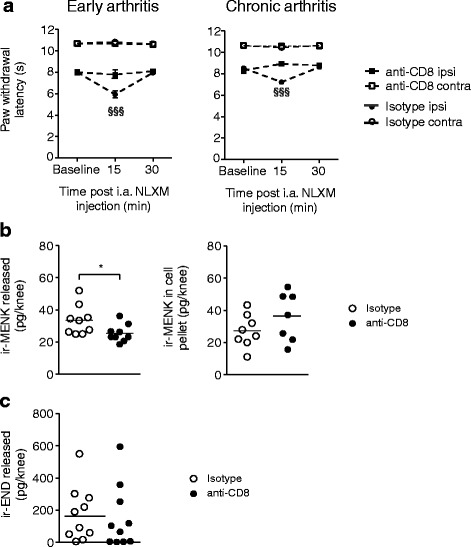
In ACIA, mice display persistent mechanical allodynia and thermal hyperalgesia for more than 2 months after induction of arthritis. The blockade of peripheral opioid receptors with naloxone-methiodide (NLXM) transiently increased thermal hyperalgesia, indicating that endogenous opioid peptides were released in the arthritic joint to inhibit pain. CD8 T cell depletion did not affect autoantibody formation or severity of joint inflammation, but serum levels of the pro-inflammatory cytokines TNFα and IL-17 were increased. The release of opioid peptides from explanted arthritic knee cells and the NLXM effect were significantly reduced in the absence of CD8 T cells.
We have successfully modeled the development of chronic pain, a hallmark of RA, in ACIA. Furthermore, we detected a yet unknown protective role of CD8 T cells in chronic ACIA since pro-inflammatory cytokines rose and opioid peptide release decreased in the absence of these cells.
本研究在抗原和胶原诱导性关节炎(ACIA)小鼠中检测了类风湿关节炎(RA)的主要症状——慢性疼痛的发展情况。由于CD8 T细胞在关节炎中的作用存在争议,我们在这种新型慢性自身免疫性关节炎模型中研究了CD8细胞耗竭对关节炎发展及疼痛的阿片类药物调节的影响。
通过膝关节切片的组织学评估和自身抗体形成的测量来确定对照动物和CD8细胞耗竭动物的疾病严重程度。分别通过在von Frey试验和热辐射甩尾试验中测量机械性异常性疼痛和热痛觉过敏来评估疼痛。通过免疫测定评估内源性阿片类物质和炎性细胞因子的产生和释放。
在ACIA中,小鼠在关节炎诱导后2个多月表现出持续的机械性异常性疼痛和热痛觉过敏。用甲基碘化纳洛酮(NLXM)阻断外周阿片受体可短暂增加热痛觉过敏,表明内源性阿片肽在关节炎关节中释放以抑制疼痛。CD8 T细胞耗竭不影响自身抗体形成或关节炎症的严重程度,但促炎细胞因子TNFα和IL-17的血清水平升高。在没有CD8 T细胞的情况下,从移植的关节炎膝关节细胞中释放的阿片肽和NLXM效应显著降低。
我们在ACIA中成功模拟了RA的标志性特征——慢性疼痛的发展。此外,我们检测到CD8 T细胞在慢性ACIA中有一个未知的保护作用,因为在没有这些细胞的情况下促炎细胞因子升高而阿片肽释放减少。