Nagra N S, Zargar N, Smith R D J, Carr A J
NDORMS, University of Oxford, Botnar Research Centre, Nuffield Orthopaedic Centre, Windmill Road, Headington, Oxford, UK and, Oxford University Clinical Academic Graduate School, Medical Sciences Divisional Office, Level 3, John Radcliffe Hospital, Oxford, UK
University of Oxford, Botnar Research Centre, Nuffield Orthopaedic Centre, Windmill Road, Headington, Oxford, UK.
Bone Joint Res. 2017 Feb;6(2):82-89. doi: 10.1302/2046-3758.62.BJR-2016-0225.R1.
All-suture anchors are increasingly used in rotator cuff repair procedures. Potential benefits include decreased bone damage. However, there is limited published evidence for the relative strength of fixation for all-suture anchors compared with traditional anchors.
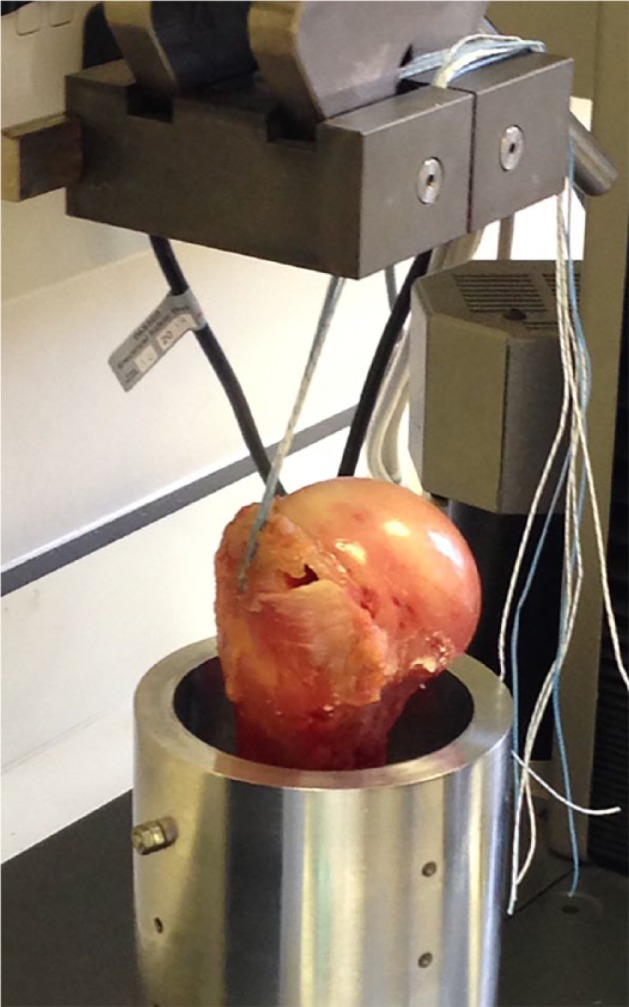
A total of four commercially available all-suture anchors, the 'Y-Knot' (ConMed), Q-FIX (Smith & Nephew), ICONIX (Stryker) and JuggerKnot (Zimmer Biomet) and a traditional anchor control TWINFIX Ultra PK Suture Anchor (Smith & Nephew) were tested in cadaveric human humeral head rotator cuff repair models (n = 24). This construct underwent cyclic loading applied by a mechanical testing rig (Zwick/Roell). Ultimate load to failure, gap formation at 50, 100, 150 and 200 cycles, and failure mechanism were recorded. Significance was set at p < 0.05.
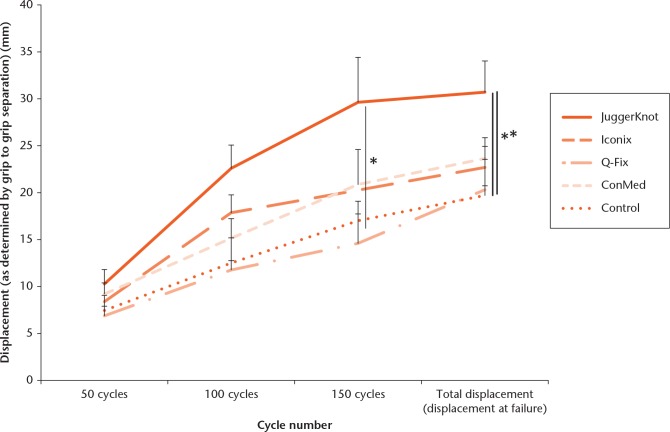
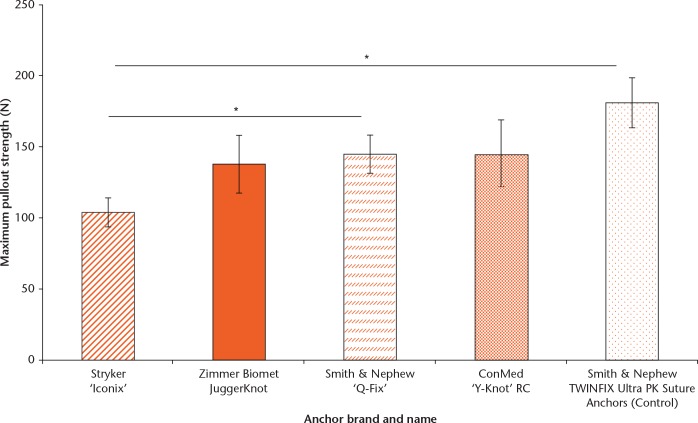
Overall, mean maximum tensile strength values were significantly higher for the traditional anchor (181.0 N, standard error (se) 17.6) compared with the all-suture anchors (mean 133.1 N se 16.7) (p = 0.04). The JuggerKnot anchor had greatest displacement at 50, 100 and 150 cycles, and at failure, reaching statistical significance over the control at 100 and 150 cycles (22.6 mm se 2.5 versus 12.5 mm se 0.3; and 29.6 mm se 4.8 versus 17.0 mm se 0.7). Every all-suture anchor tested showed substantial (> 5 mm) displacement between 50 and 100 cycles (6.2 to 14.3).All-suture anchors predominantly failed due to anchor pull-out (95% versus 25% of traditional anchors), whereas a higher proportion of traditional anchors failed secondary to suture breakage.
We demonstrate decreased failure load, increased total displacement, and variable failure mechanisms in all-suture anchors, compared with traditional anchors designed for rotator cuff repair. These findings will aid the surgeon's choice of implant, in the context of the clinical scenario.Cite this article: N. S. Nagra, N. Zargar, R. D. J. Smith, A. J. Carr. Mechanical properties of all-suture anchors for rotator cuff repair. Bone Joint Res 2017;6:82-89. DOI: 10.1302/2046-3758.62.BJR-2016-0225.R1.
全缝线锚钉在肩袖修复手术中的应用日益广泛。其潜在益处包括减少骨损伤。然而,与传统锚钉相比,关于全缝线锚钉固定相对强度的已发表证据有限。
在尸体人肱骨头肩袖修复模型(n = 24)中测试了四种市售全缝线锚钉,即“Y-Knot”(康美)、Q-FIX(施乐辉)、ICONIX(史赛克)和JuggerKnot(捷迈邦美),以及一个传统锚钉对照TWINFIX Ultra PK缝线锚钉(施乐辉)。该结构通过机械测试装置(Zwick/Roell)进行循环加载。记录破坏时的极限载荷、50、100、150和200次循环时的间隙形成情况以及破坏机制。显著性设定为p < 0.05。
总体而言,传统锚钉的平均最大拉伸强度值(181.0 N,标准误差(se)17.6)显著高于全缝线锚钉(平均133.1 N,se 16.7)(p = 0.04)。JuggerKnot锚钉在50、100和150次循环时以及破坏时的位移最大,在100和150次循环时与对照相比达到统计学显著性(22.6 mm,se 2.5对12.5 mm,se 0.3;以及29.6 mm,se 4.8对17.0 mm,se 0.7)。每个测试的全缝线锚钉在50至100次循环之间均显示出显著(> 5 mm)位移(6.2至14.3)。全缝线锚钉主要因锚钉拔出而失效(95%,而传统锚钉为25%),而较高比例的传统锚钉因缝线断裂继发失效。
我们证明,与用于肩袖修复的传统锚钉相比,全缝线锚钉的破坏载荷降低、总位移增加且破坏机制多样。这些发现将有助于外科医生在临床情况下选择植入物。引用本文:N. S. Nagra、N. Zargar、R. D. J. Smith、A. J. Carr。肩袖修复全缝线锚钉的力学性能。《骨与关节研究》2017;6:82 - 89。DOI:10.1302/2046 - 3758.62.BJR - 2016 - 0225.R1。