Vengeliene Valentina, Bespalov Anton, Roßmanith Martin, Horschitz Sandra, Berger Stefan, Relo Ana L, Noori Hamid R, Schneider Peggy, Enkel Thomas, Bartsch Dusan, Schneider Miriam, Behl Berthold, Hansson Anita C, Schloss Patrick, Spanagel Rainer
Institute of Psychopharmacology, Central Institute of Mental Health, Medical Faculty Mannheim, Heidelberg University, 68159 Mannheim, Germany.
Department of Neuroscience Research, AbbVie Deutschland GmbH & Co KG, 67061 Ludwigshafen, Germany.
Dis Model Mech. 2017 Apr 1;10(4):451-461. doi: 10.1242/dmm.027623. Epub 2017 Feb 6.
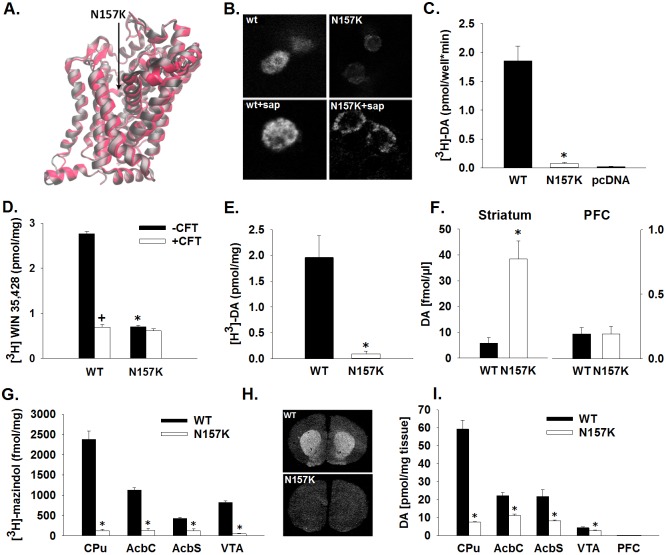
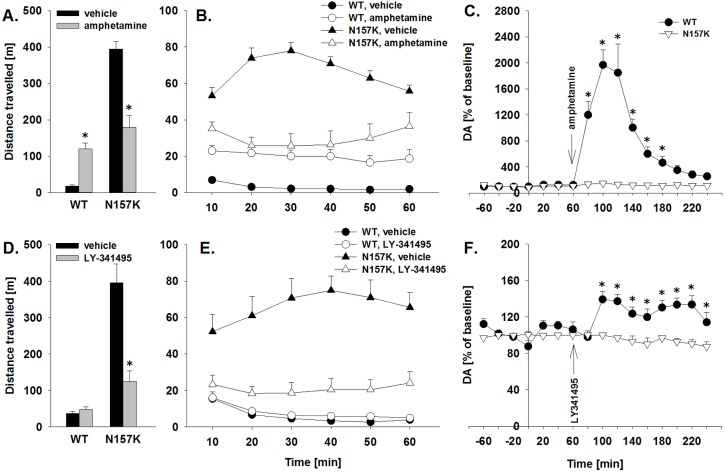
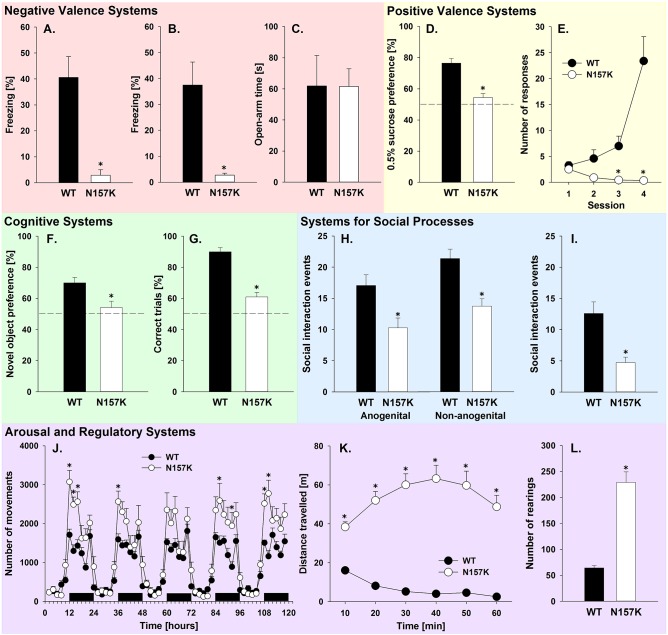
The research domain criteria (RDoC) matrix has been developed to reorient psychiatric research towards measurable behavioral dimensions and underlying mechanisms. Here, we used a new genetic rat model with a loss-of-function point mutation in the dopamine transporter (DAT) gene (_N157K) to systematically study the RDoC matrix. First, we examined the impact of the _N157K mutation on monoaminergic signaling. We then performed behavioral tests representing each of the five RDoC domains: negative and positive valence systems, cognitive, social and arousal/regulatory systems. The use of RDoC may be particularly helpful for drug development. We studied the effects of a novel pharmacological approach metabotropic glutamate receptor mGluR2/3 antagonism, in DAT mutants in a comparative way with standard medications. Loss of DAT functionality in mutant rats not only elevated subcortical extracellular dopamine concentration but also altered the balance of monoaminergic transmission. DAT mutant rats showed deficits in all five RDoC domains. Thus, mutant rats failed to show conditioned fear responses, were anhedonic, were unable to learn stimulus-reward associations, showed impaired cognition and social behavior, and were hyperactive. Hyperactivity in mutant rats was reduced by amphetamine and atomoxetine, which are well-established medications to reduce hyperactivity in humans. The mGluR2/3 antagonist LY341495 also normalized hyperactivity in DAT mutant rats without affecting extracellular dopamine levels. We systematically characterized an altered dopamine system within the context of the RDoC matrix and studied mGluR2/3 antagonism as a new pharmacological strategy to treat mental disorders with underlying subcortical dopaminergic hyperactivity.
研究领域标准(RDoC)矩阵已被开发出来,以使精神病学研究重新转向可测量的行为维度和潜在机制。在此,我们使用了一种新的基因大鼠模型,该模型在多巴胺转运体(DAT)基因(_N157K)中存在功能丧失点突变,以系统地研究RDoC矩阵。首先,我们研究了_N157K突变对单胺能信号传导的影响。然后,我们进行了代表五个RDoC领域的行为测试:负性和正性效价系统、认知、社交和觉醒/调节系统。RDoC的应用可能对药物开发特别有帮助。我们以比较的方式研究了一种新型药理学方法——代谢型谷氨酸受体mGluR2/3拮抗作用,对DAT突变体的影响,并与标准药物进行了比较。突变大鼠中DAT功能的丧失不仅提高了皮质下细胞外多巴胺浓度,还改变了单胺能传递的平衡。DAT突变大鼠在所有五个RDoC领域均表现出缺陷。因此,突变大鼠未能表现出条件性恐惧反应,出现快感缺失,无法学习刺激-奖励关联,表现出认知和社交行为受损,并且多动。突变大鼠的多动通过苯丙胺和托莫西汀得以减轻,这两种药物是公认的可减轻人类多动的药物。mGluR2/3拮抗剂LY341495也使DAT突变大鼠的多动恢复正常,而不影响细胞外多巴胺水平。我们在RDoC矩阵的背景下系统地描述了多巴胺系统的改变,并研究了mGluR2/3拮抗作用作为一种治疗伴有皮质下多巴胺能功能亢进的精神障碍的新药理学策略。