Romay Gustavo, Bragard Claude
Applied Microbiology - Phytopathology, Earth and Life Institute, Université catholique de Louvain Louvain-la-Neuve, Belgium.
Front Microbiol. 2017 Jan 23;8:47. doi: 10.3389/fmicb.2017.00047. eCollection 2017.
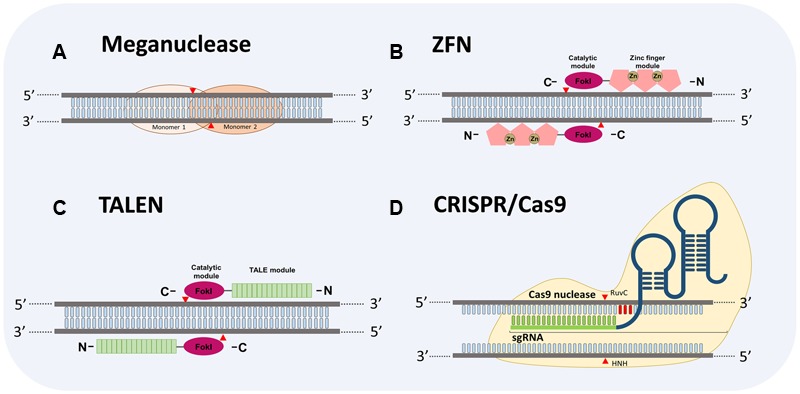
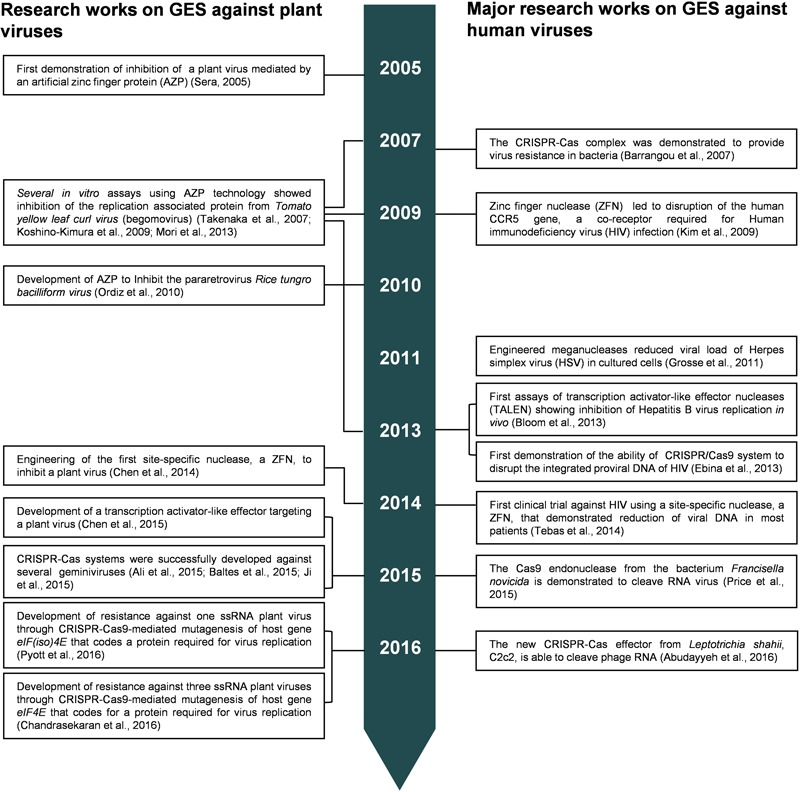
Plant-virus interactions based-studies have contributed to increase our understanding on plant resistance mechanisms, providing new tools for crop improvement. In the last two decades, RNA interference, a post-transcriptional gene silencing approach, has been used to induce antiviral defenses in plants with the help of genetic engineering technologies. More recently, the new genome editing systems (GES) are revolutionizing the scope of tools available to confer virus resistance in plants. The most explored GES are zinc finger nucleases, transcription activator-like effector nucleases, and clustered regularly interspaced short palindromic repeats/Cas9 endonuclease. GES are engineered to target and introduce mutations, which can be deleterious, via double-strand breaks at specific DNA sequences by the error-prone non-homologous recombination end-joining pathway. Although GES have been engineered to target DNA, recent discoveries of GES targeting ssRNA molecules, including virus genomes, pave the way for further studies programming plant defense against RNA viruses. Most of plant virus species have an RNA genome and at least 784 species have positive ssRNA. Here, we provide a summary of the latest progress in plant antiviral defenses mediated by GES. In addition, we also discuss briefly the GES perspectives in light of the rebooted debate on genetic modified organisms (GMOs) and the current regulatory frame for agricultural products involving the use of such engineering technologies.
基于植物 - 病毒相互作用的研究有助于增进我们对植物抗性机制的理解,为作物改良提供了新工具。在过去二十年中,RNA干扰作为一种转录后基因沉默方法,已借助基因工程技术用于诱导植物的抗病毒防御。最近,新的基因组编辑系统(GES)正在彻底改变赋予植物病毒抗性的可用工具范围。研究最多的GES是锌指核酸酶、转录激活样效应物核酸酶和成簇规律间隔短回文重复序列/Cas9核酸酶。GES经过工程改造,可通过易错的非同源重组末端连接途径在特定DNA序列处产生双链断裂,从而靶向并引入可能有害的突变。尽管GES已被设计用于靶向DNA,但最近发现GES可靶向包括病毒基因组在内的单链RNA分子,为进一步研究调控植物对RNA病毒的防御铺平了道路。大多数植物病毒物种具有RNA基因组,至少784种具有正链单链RNA。在此,我们总结了由GES介导的植物抗病毒防御的最新进展。此外,鉴于对转基因生物(GMO)的重新辩论以及涉及此类工程技术的农产品当前监管框架,我们还简要讨论了GES的前景。