Tao Geru, Shi Tuanyuan, Tang Xinming, Duszynski Donald W, Wang Yunzhou, Li Chao, Suo Jingxia, Tian Xiuling, Liu Xianyong, Suo Xun
State Key Laboratory of Agrobiotechnology, China Agricultural University, Beijing, China; National Animal Protozoa Laboratory & College of Veterinary Medicine, China Agricultural University, Beijing, China.
Department of Animal Parasitology, Institute of Animal Husbandry and Veterinary Medicine, Zhejiang Academy of Agricultural Science , Hangzhou , China.
Front Immunol. 2017 Jan 23;8:2. doi: 10.3389/fimmu.2017.00002. eCollection 2017.
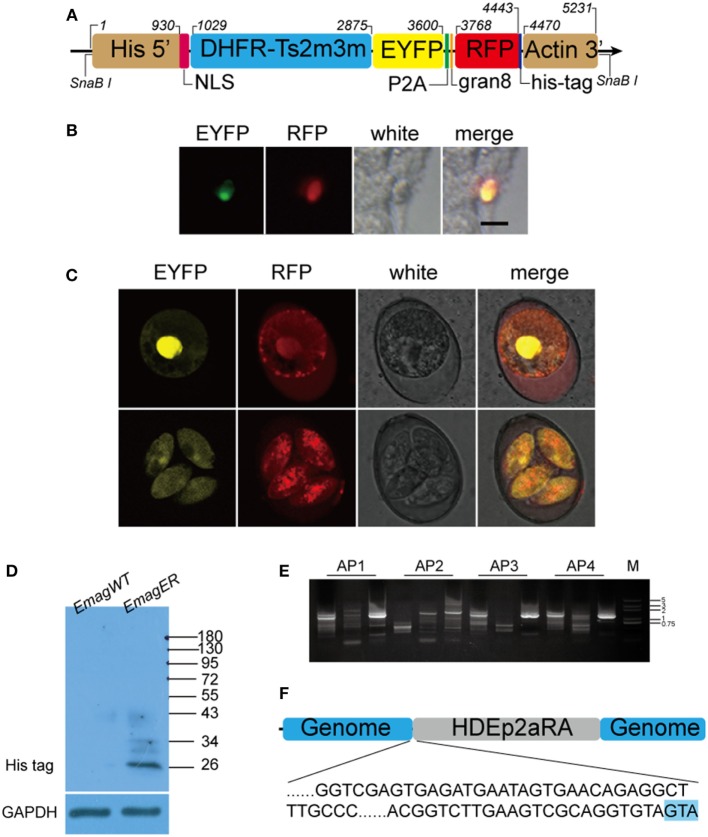
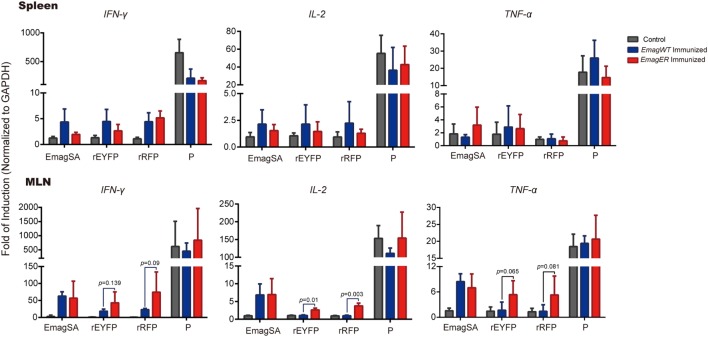
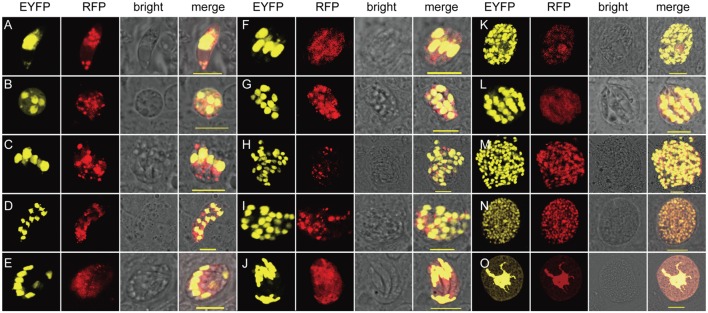
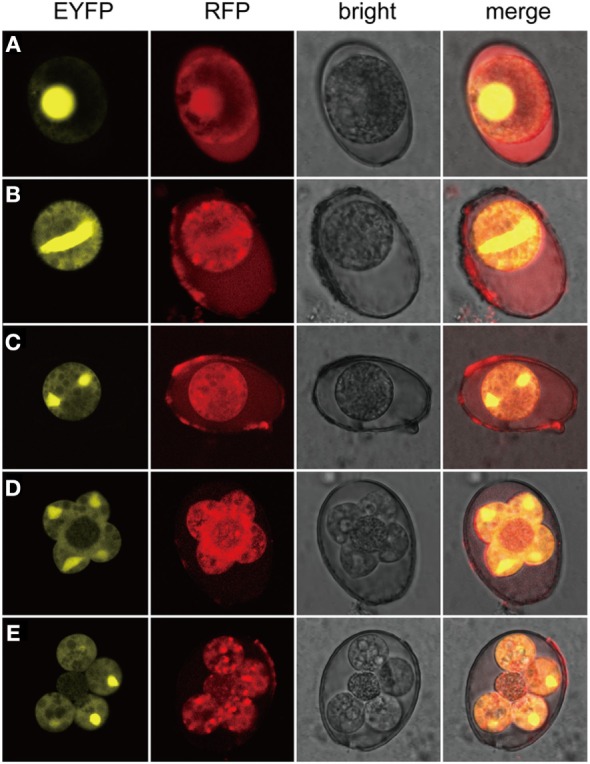
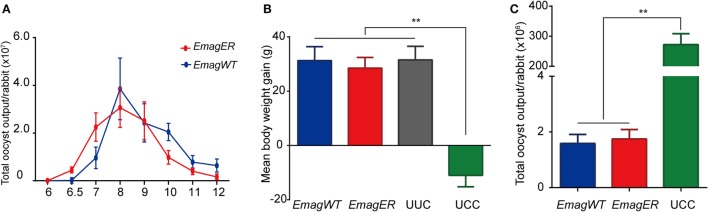
Rabbit coccidiosis causes great economic losses to world rabbitries. Little work has been done considering genetic manipulation on the etiological agents, rabbit spp. In this study, we constructed a transgenic line of () expressing enhanced yellow fluorescent protein (EYFP) and red fluorescent protein (RFP) using regulatory sequences of and . We observed the life cycle of and confirmed that the transgenic parasites express exogenous proteins targeted to different cellular compartments throughout the entire life cycle. EYFP was expressed mainly in the nucleus and RFP both in the nucleus and cytoplasm. Then, coccidia-free, laboratory-reared 40-day-old rabbits were primarily infected with either or wild-type strain oocysts and challenged with the wild-type strain. showed similar reproductivity and immunogenicity to the wild-type strain. Finally, we examined the foreign protein-specific immune response elicited by . Rabbits were immunized with either transgenic or wild-type oocysts. Immune response against parasite-soluble antigen, EYFP and RFP in spleen, and mesenteric lymph nodes were detected by quantitative real-time PCR. The relative expression level of IFN-γ, IL-2, and TNF-α were higher in -immunized rabbits than wild-type parasites-immunized rabbits after stimulation with EYFP and RFP. Our study confirmed that a specific immune response was induced by the exogenous protein expressed by and favored future studies on application of transgenic rabbit coccidia as recombinant vaccine vectors.
兔球虫病给全球养兔业造成了巨大的经济损失。针对病原体兔球虫进行基因操作的研究工作很少。在本研究中,我们利用和的调控序列构建了一个表达增强型黄色荧光蛋白(EYFP)和红色荧光蛋白(RFP)的转基因品系。我们观察了的生命周期,并证实转基因寄生虫在整个生命周期中都表达靶向不同细胞区室的外源蛋白。EYFP主要在细胞核中表达,RFP在细胞核和细胞质中均有表达。然后,将无球虫、实验室饲养的40日龄兔子先用或野生型菌株卵囊进行初次感染,再用野生型菌株进行攻击。显示出与野生型菌株相似的繁殖力和免疫原性。最后,我们检测了引发的外源蛋白特异性免疫反应。用转基因或野生型卵囊对兔子进行免疫。通过定量实时PCR检测脾脏和肠系膜淋巴结中针对寄生虫可溶性抗原、EYFP和RFP的免疫反应。在用EYFP和RFP刺激后,免疫的兔子中IFN-γ、IL-2和TNF-α的相对表达水平高于野生型寄生虫免疫的兔子。我们的研究证实,由表达的外源蛋白诱导了特异性免疫反应,这有利于未来关于转基因兔球虫作为重组疫苗载体应用的研究。