Campos Priscila C, Gomes Marco Túlio R, Guimarães Erika S, Guimarães Gabriela, Oliveira Sergio C
Departamento de Bioquímica e Imunologia, Universidade Federal de Minas Gerais , Belo Horizonte , Brazil.
Departamento de Bioquímica e Imunologia, Universidade Federal de Minas Gerais, Belo Horizonte, Brazil; Instituto Nacional de Ciência e Tecnologia em Doenças Tropicais (INCT-DT), Conselho Nacional de Desenvolvimento Científico e Tecnológico, Ministério de Ciência Tecnologia e Inovação, Salvador, Brazil.
Front Immunol. 2017 Jan 23;8:28. doi: 10.3389/fimmu.2017.00028. eCollection 2017.
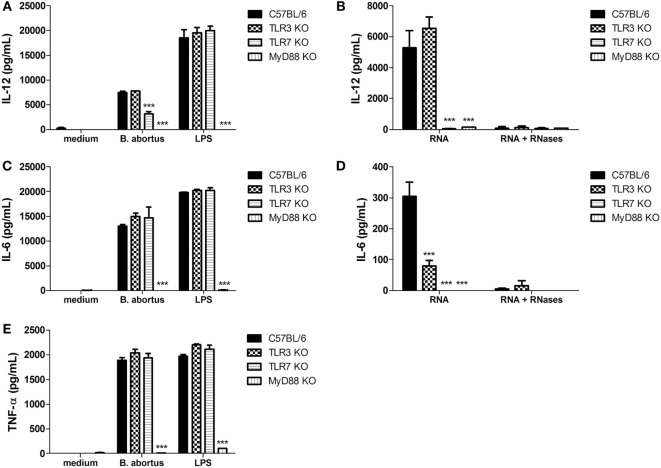
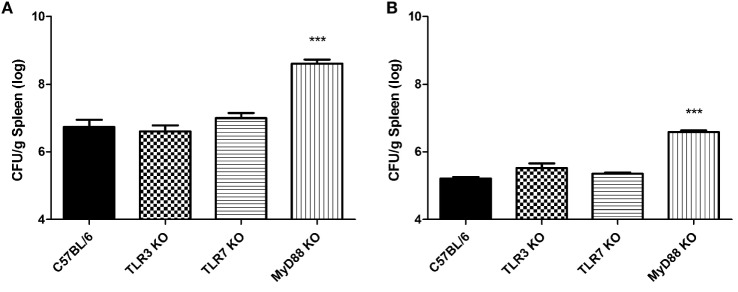
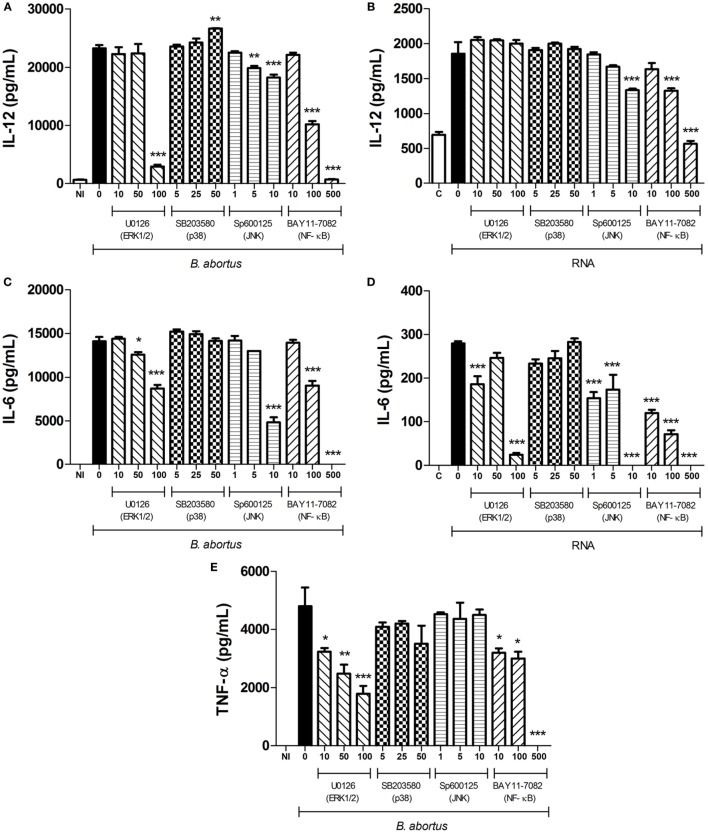
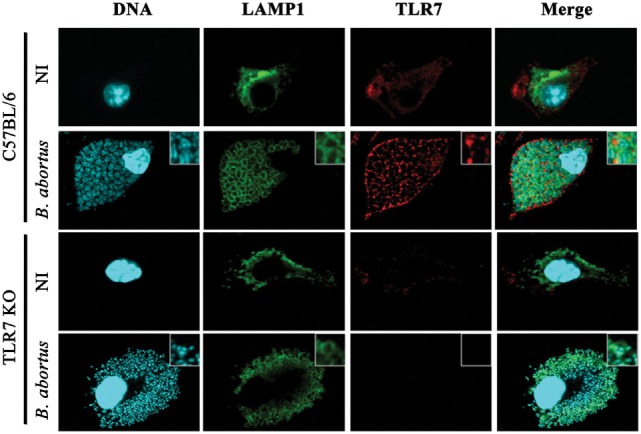
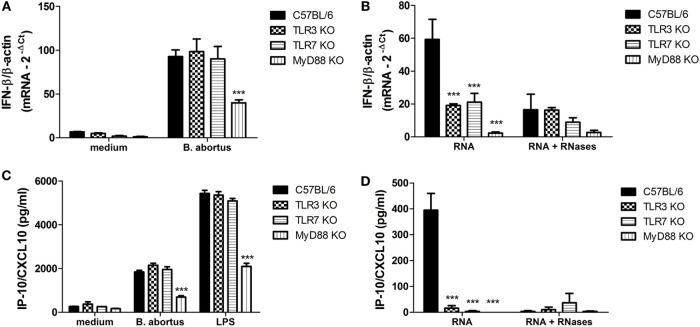
is a Gram-negative, facultative intracellular bacterium that causes brucellosis, a worldwide zoonotic disease leading to undulant fever in humans and abortion in cattle. The immune response against this bacterium relies on the recognition of microbial pathogen-associated molecular patterns, such as lipoproteins, lipopolysaccharides, and DNA; however, the immunostimulatory potential of RNA remains to be elucidated. Here, we show that dendritic cells (DCs) produce significant amounts of IL-12, IL-6, and IP-10/CXCL10, when stimulated with purified RNA. IL-12 secretion by DCs stimulated with RNA depends on TLR7 while IL-6 depends on TLR7 and partially on TLR3. Further, only TLR7 plays a role in IL-12 production induced by infection. Moreover, cytokine production in DCs infected with or stimulated with bacterial RNA was reduced upon pretreatment with MAPK/NF-κB inhibitors. By confocal microscopy, we demonstrated that TLR7 is colocalized with in LAMP-1-containing vacuoles. Additionally, type I IFN expression and IP-10/CXCL10 secretion in DCs stimulated with bacterial RNA were dependent on TLR3 and TLR7. Our results suggest that TLR3 and TLR7 are not required to control infection , but they play an important role on sensing RNA .
是一种革兰氏阴性兼性细胞内细菌,可引起布鲁氏菌病,这是一种全球性人畜共患病,可导致人类波状热和牛流产。针对这种细菌的免疫反应依赖于对微生物病原体相关分子模式的识别,如脂蛋白、脂多糖和DNA;然而,RNA的免疫刺激潜力仍有待阐明。在这里,我们表明,当用纯化的RNA刺激时,树突状细胞(DCs)会产生大量的IL-12、IL-6和IP-10/CXCL10。RNA刺激的DCs分泌IL-12依赖于TLR7,而IL-6依赖于TLR7且部分依赖于TLR3。此外,只有TLR7在感染诱导的IL-12产生中起作用。此外,在用MAPK/NF-κB抑制剂预处理后,感染或用细菌RNA刺激的DCs中的细胞因子产生减少。通过共聚焦显微镜,我们证明TLR7与在含有LAMP-1的液泡中共定位。此外,细菌RNA刺激的DCs中I型干扰素表达和IP-10/CXCL10分泌依赖于TLR3和TLR7。我们的结果表明,控制感染不需要TLR3和TLR7,但它们在感知RNA方面起重要作用。