Röschenbleck Joachim, Wicke Susann, Weinl Stefan, Kudla Jörg, Müller Kai F
Institute for Evolution and Biodiversity, University of Muenster, Muenster, Germany.
Institute for Plant Biology and Biotechnology, University of Muenster, Muenster, Germany.
Genome Biol Evol. 2017 Jan 1;9(1):64-76. doi: 10.1093/gbe/evw271.
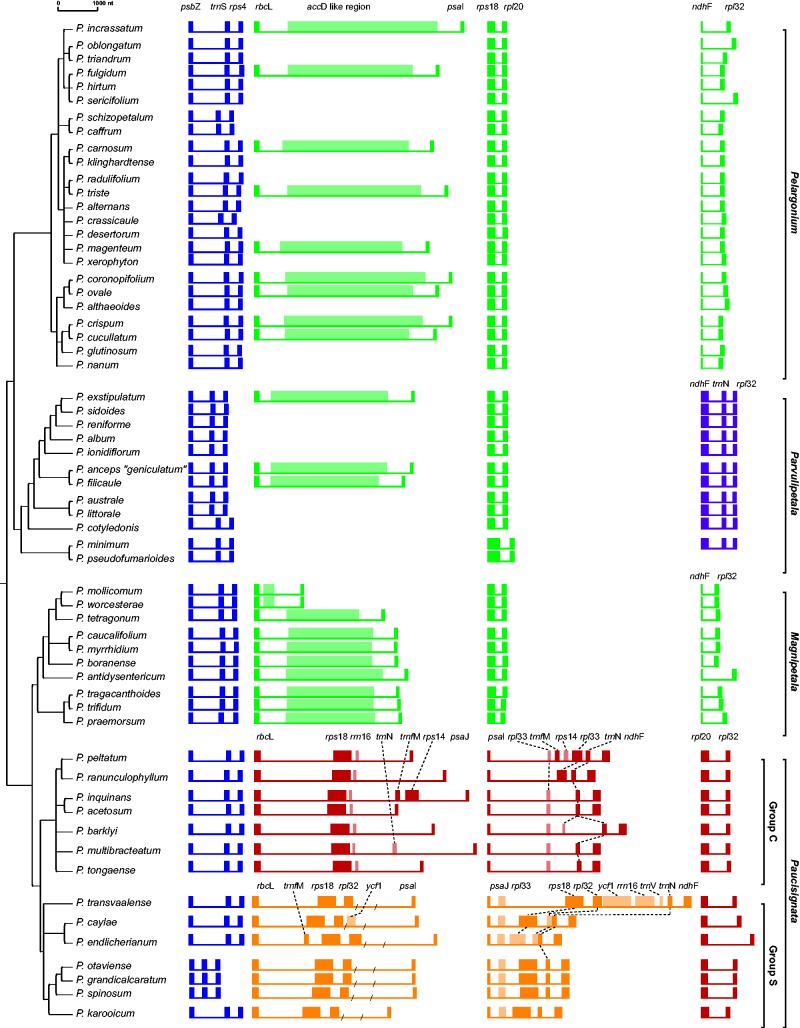
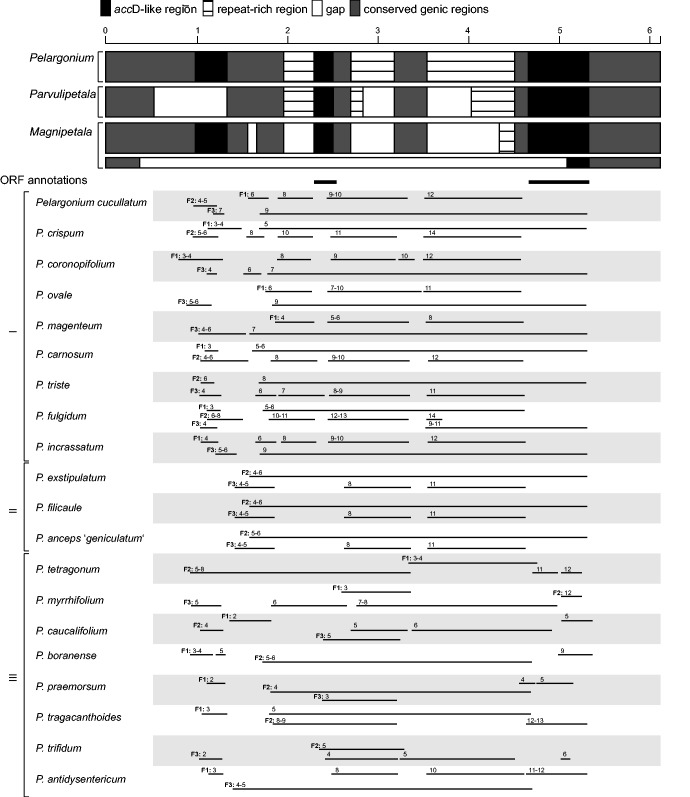
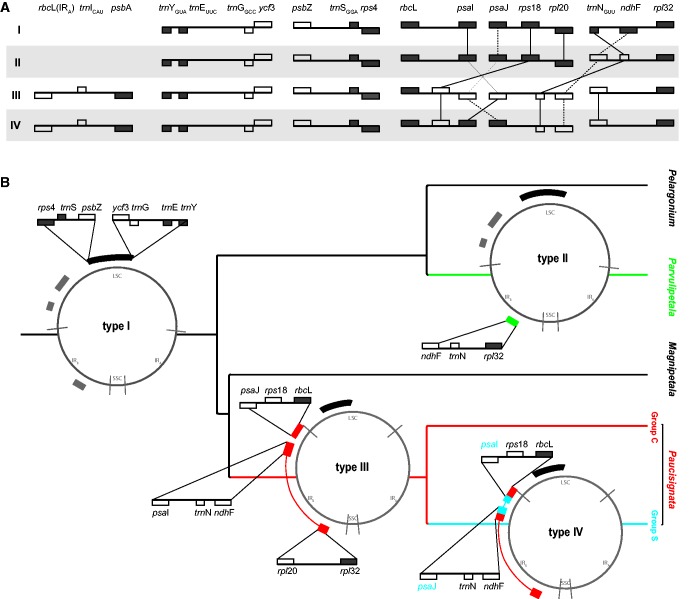
Geraniaceae are known for their unusual plastid genomes (plastomes), with the genus Pelargonium being most conspicuous with regard to plastome size and gene organization as judged by the sequenced plastomes of P. x hortorum and P. alternans. However, the hybrid origin of P. x hortorum and the uncertain phylogenetic position of P. alternans obscure the events that led to these extraordinary plastomes. Here, we examine all plastid reconfiguration hotspots for 60 Pelargonium species across all subgenera using a PCR and sequencing approach. Our reconstruction of the rearrangement history revealed four distinct plastome types. The ancestral plastome configuration in the two subgenera Magnipetala and Pelargonium is consistent with that of the P. alternans plastome, whereas that of the subgenus Parvulipetala deviates from this organization by one synapomorphic inversion in the trnNGUU–ndhF region. The plastome of P. x hortorum resembles those of one group of the subgenus Paucisignata, but differs from a second group by another inversion in the psaI–psaJ region. The number of microstructural changes and amount of repetitive DNA are generally elevated in all inverted regions. Nucleotide substitution rates correlate positively with the number of indels in all regions across the different subgenera. We also observed lineage- and species-specific changes in the gene content, including gene duplications and fragmentations. For example, the plastid rbcL–psaI region of Pelargonium contains a highly variable accD-like region. Our results suggest alternative evolutionary paths under possibly changing modes of plastid transmission and indicate the non-functionalization of the plastid accD gene in Pelargonium.
牻牛儿苗科以其独特的质体基因组(质体基因组)而闻名,就质体基因组大小和基因组织而言,天竺葵属最为显著,这是根据天竺葵杂交种和交替天竺葵的测序质体基因组判断的。然而,天竺葵杂交种的杂交起源以及交替天竺葵不确定的系统发育位置,使得导致这些非凡质体基因组的事件变得模糊不清。在这里,我们使用聚合酶链反应(PCR)和测序方法,研究了所有亚属中60种天竺葵的所有质体重新配置热点。我们对重排历史的重建揭示了四种不同的质体基因组类型。Magnipetala和天竺葵两个亚属的祖先质体基因组构型与交替天竺葵的质体基因组一致,而Parvulipetala亚属的构型在trnNGUU–ndhF区域通过一次共衍反转与该组织不同。天竺葵杂交种的质体基因组类似于Paucisignata亚属的一组,但在psaI–psaJ区域通过另一次反转与第二组不同。所有倒位区域的微观结构变化数量和重复DNA数量通常都会增加。不同亚属所有区域的核苷酸替换率与插入缺失的数量呈正相关。我们还观察到基因含量的谱系和物种特异性变化,包括基因重复和片段化。例如,天竺葵属的质体rbcL–psaI区域包含一个高度可变的accD样区域。我们的结果表明,在可能变化的质体传播模式下存在替代进化路径,并表明天竺葵属中质体accD基因的非功能化。