Sveinsson Saemundur, Cronk Quentin
BMC Evol Biol. 2014 Nov 18;14:228. doi: 10.1186/s12862-014-0228-6.
Some clover species, particularly Trifolium subterraneum, have previously been reported to have highly unusual plastomes, relative to closely related legumes, enlarged with many duplications, gene losses and the presence of DNA unique to Trifolium, which may represent horizontal transfer. In order to pinpoint the evolutionary origin of this phenomenon within the genus Trifolium, we sequenced and assembled the plastomes of eight additional Trifolium species widely sampled from across the genus.
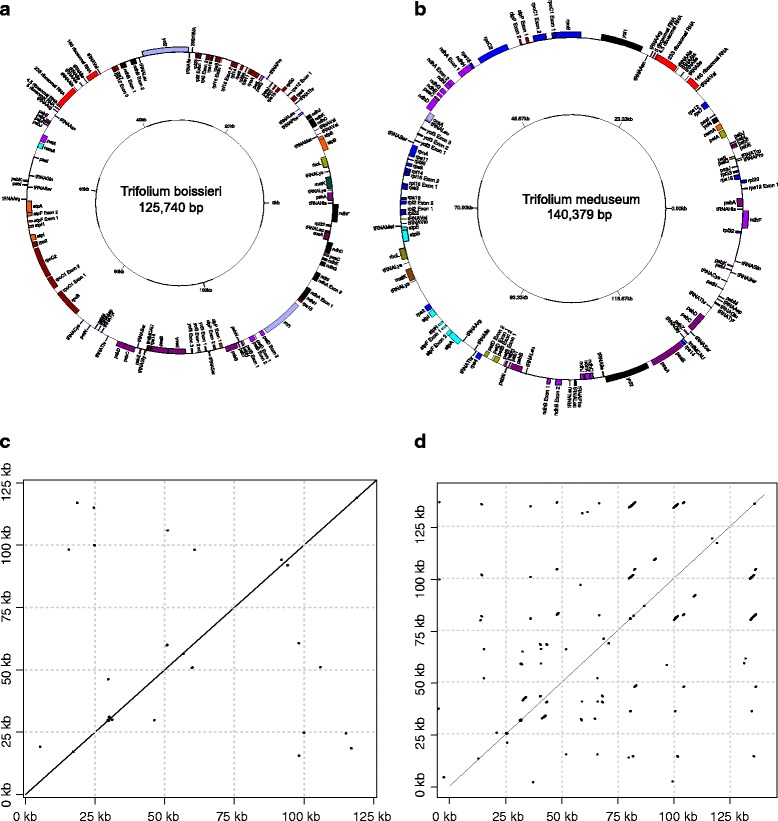
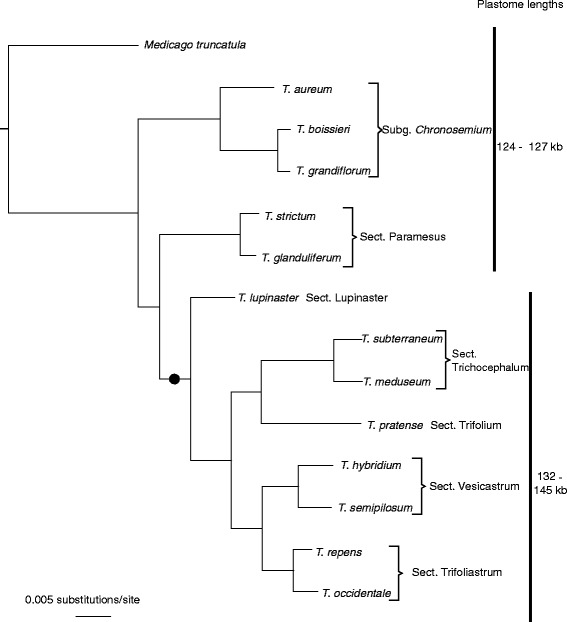
The Trifolium plastomes fell into two groups: those of Trifolium boissieri, T. strictum and T. glanduliferum (representing subgenus Chronosemium and subg. Trifolium section Paramesus) were tractable, assembled readily and were not unusual in the general context of Fabeae plastomes. The other Trifolium species ("core Trifolium") proved refractory to assembly mainly because of numerous short duplications. These species form a single clade, which we call the "refractory clade" (comprising subg, Trifolium sections Lupinaster, Trifolium, Trichocephalum, Vesicastrum and Trifoliastrum). The characteristics of the refractory clade are the presence of numerous short duplications and 7-15% longer genomes than the tractable species. Molecular dating estimates that the origin of the most recent common ancestor (MRCA) of the refractory clade is approximately 13.1 million years ago (MYA). This is considerably younger than the estimated MRCA ages of Trifolium (c. 18.6 MYA) and Trifolium subg. Trifolium (16.1 MYA).
We conclude that the unusual repetitive plastome type previously characterized in Trifolium subterraneum had a single origin within Trifolium and is characteristic of most (but not all) species of subgenus Trifolium. It appears that an ancestral plastome within Trifolium underwent an evolutionary change resulting in plastomes that either actively promoted, were permissive to, or were unable to control, duplications within the genome. The precise mechanism of this important change in the mode and tempo of plastome evolution deserves further investigation.
相对于亲缘关系较近的豆科植物,此前有报道称一些三叶草物种,尤其是地下三叶草,具有非常特殊的质体基因组,其基因组扩大,存在许多重复、基因丢失以及地下三叶草特有的DNA,这可能代表水平转移。为了确定这种现象在三叶草属内的进化起源,我们对从该属广泛采样的另外八个三叶草物种的质体基因组进行了测序和组装。
三叶草质体基因组分为两组:布瓦西耶三叶草、硬毛三叶草和腺毛三叶草(代表时间半翅亚属和三叶草亚属的副半翅组)的质体基因组易于处理,易于组装,在豆科质体基因组的一般背景下并无异常。其他三叶草物种(“核心三叶草”)由于大量短重复序列而难以组装。这些物种形成一个单系分支,我们称之为“难处理分支”(包括三叶草亚属的羽扇豆组、三叶草组、毛头组、囊萼组和三小叶组)。难处理分支的特征是存在大量短重复序列,基因组比易于处理的物种长7%-15%。分子年代测定估计,难处理分支最近共同祖先(MRCA)的起源约为1310万年前(百万年前)。这比估计的三叶草属(约1860万年前)和三叶草亚属(1610万年前)的MRCA年龄要年轻得多。
我们得出结论,先前在地下三叶草中表征的异常重复质体基因组类型在三叶草属内有单一起源,是三叶草亚属大多数(但不是全部)物种的特征。看来三叶草属内的一个祖先质体基因组经历了一次进化变化,导致质体基因组要么积极促进、允许要么无法控制基因组内的重复。质体基因组进化模式和速度这一重要变化的确切机制值得进一步研究。