Kraaijeveld Ken, Anvar Seyed Yahya, Frank Jeroen, Schmitz Arnoud, Bast Jens, Wilbrandt Jeanne, Petersen Malte, Ziesmann Tanja, Niehuis Oliver, de Knijff Peter, den Dunnen Johan T, Ellers Jacintha
Animal Ecology, Department of Ecological Sciences, VU University Amsterdam, The Netherlands.
Leiden Genome Technology Center, Department of Human Genetics, Leiden University Medical Center, Leiden, The Netherlands.
Genome Biol Evol. 2016 Dec 1;8(12):3685-3695. doi: 10.1093/gbe/evw273.
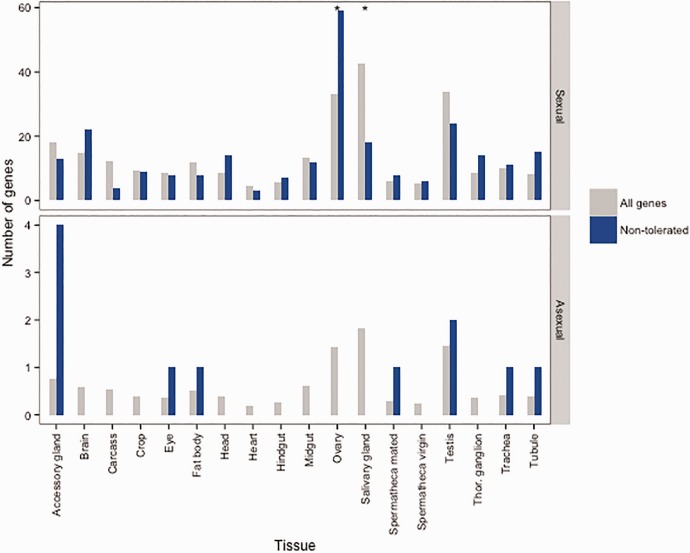
Trait loss is a widespread phenomenon with pervasive consequences for a species’ evolutionary potential. The genetic changes underlying trait loss have only been clarified in a small number of cases. None of these studies can identify whether the loss of the trait under study was a result of neutral mutation accumulation or negative selection. This distinction is relatively clear-cut in the loss of sexual traits in asexual organisms. Male-specific sexual traits are not expressed and can only decay through neutral mutations, whereas female-specific traits are expressed and subject to negative selection. We present the genome of an asexual parasitoid wasp and compare it to that of a sexual lineage of the same species. We identify a short-list of 16 genes for which the asexual lineage carries deleterious SNP or indel variants, whereas the sexual lineage does not. Using tissue-specific expression data from other insects, we show that fifteen of these are expressed in male-specific reproductive tissues. Only one deleterious variant was found that is expressed in the female-specific spermathecae, a trait that is heavily degraded and thought to be under negative selection in L. clavipes. Although the phenotypic decay of male-specific sexual traits in asexuals is generally slow compared with the decay of female-specific sexual traits, we show that male-specific traits do indeed accumulate deleterious mutations as expected by theory. Our results provide an excellent starting point for detailed study of the genomics of neutral and selected trait decay.
性状丧失是一种普遍现象,对物种的进化潜力具有广泛影响。导致性状丧失的基因变化仅在少数案例中得到阐明。这些研究均无法确定所研究性状的丧失是中性突变积累还是负选择的结果。在无性生物的性性状丧失中,这种区别相对明确。雄性特异性性性状不表达,只能通过中性突变而衰退,而雌性特异性性状则表达并受到负选择。我们展示了一种无性寄生蜂的基因组,并将其与同一物种的有性谱系的基因组进行比较。我们确定了一份包含16个基因的清单,无性谱系携带有害的单核苷酸多态性(SNP)或插入缺失变体,而有性谱系则没有。利用来自其他昆虫的组织特异性表达数据,我们表明其中15个基因在雄性特异性生殖组织中表达。仅发现一个有害变体在雌性特异性受精囊中表达,该性状严重退化,并且在棒足刺胫小蜂中被认为处于负选择之下。尽管与雌性特异性性性状的衰退相比,无性生物中雄性特异性性性状的表型衰退通常较慢,但我们表明雄性特异性性状确实如理论预期那样积累了有害突变。我们的结果为详细研究中性和受选择的性状衰退的基因组学提供了一个绝佳的起点。