Hong Toan Phuoc, Carter Michelle Q, Struffi Paolo, Casonato Stefano, Hao Youai, Lam Joseph S, Lory Stephen, Jousson Olivier
Centre for Integrative Biology, University of Trento, 38123, Trento, Italy.
Department of Microbiology and Immunobiology, Harvard Medical School, Boston, MA, 02115, USA.
BMC Microbiol. 2017 Feb 7;17(1):31. doi: 10.1186/s12866-017-0943-4.
Pseudomonas aeruginosa pathogenicity island 1 (PAPI-1) is one of the largest genomic islands of this important opportunistic human pathogen. Previous studies have shown that PAPI-1 encodes several putative virulence factors, including a major regulator of biofilm formation and antibiotic-resistance traits. PAPI-1 is horizontally transferable into recipient strains lacking this island via conjugation mediated by the specialized type IV pilus. The PAPI-1 encodes a cluster of ten genes associated with the synthesis and assembly of the type IV pilus. The PAPI-1 acquisition mechanism is currently not well understood.
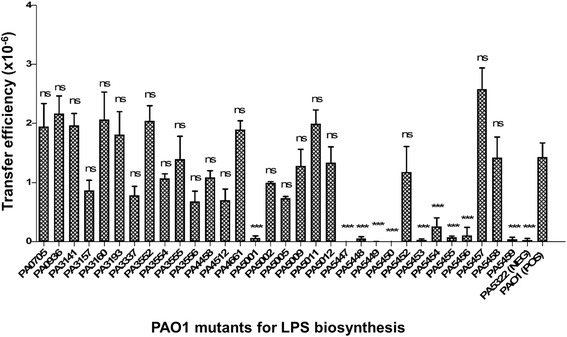
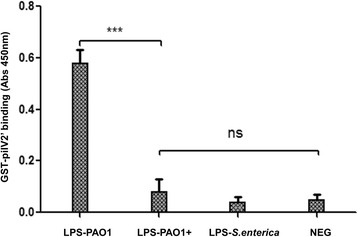
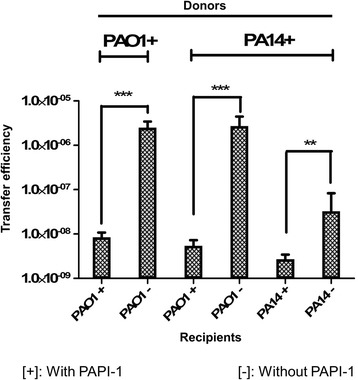
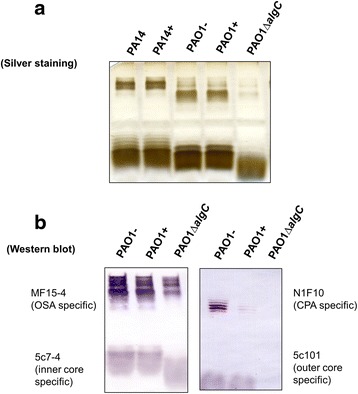
In this study, we performed a series of conjugation experiments and identified determinants of PAPI-1 acquisition by analyzing transfer efficiency between the donor and a series of mutant recipient strains. Our data show that common polysaccharide antigen (CPA) lipopolysaccharide (LPS), a homopolymer of D-rhamnose, is required for initiating PAPI-1 transfer, suggesting that this structure acts as a receptor for conjugative type IV pilus in recipient strains. These results were substantiated by experimental evidence from PAPI-1 transfer assay experiments, in which outer membrane or LPS preparations from well-defined LPS mutants were added to the transfer mix to assess the role of P. aeruginosa LPS in PAPI-1 transfer and in vitro binding experiments between pilin fusion protein GST-pilV2' and immobilized LPS molecules were performed. Our data also showed that P. aeruginosa strains that had already acquired a copy of PAPI-1 were unable to import additional copies of the island, and that such strains produced proportionally lower amounts of CPA LPS compared to the strains lacking PAPI-1.
These results suggest that a PAPI-1 exclusion mechanism exists in P. aeruginosa that might serve to regulate the avoidance of uncontrolled expansions of the bacterial genome.
铜绿假单胞菌致病岛1(PAPI-1)是这种重要的人类机会致病菌最大的基因组岛之一。先前的研究表明,PAPI-1编码几种假定的毒力因子,包括生物膜形成和抗生素抗性特征的主要调节因子。PAPI-1可通过特殊IV型菌毛介导的接合作用水平转移到缺乏该岛的受体菌株中。PAPI-1编码一组与IV型菌毛的合成和组装相关的十个基因。目前对PAPI-1的获取机制了解尚少。
在本研究中,我们进行了一系列接合实验,并通过分析供体与一系列突变受体菌株之间的转移效率来确定PAPI-1获取的决定因素。我们的数据表明,普通多糖抗原(CPA)脂多糖(LPS),一种D-鼠李糖的同聚物,是启动PAPI-1转移所必需的,这表明该结构作为受体菌株中接合IV型菌毛的受体。来自PAPI-1转移测定实验的实验证据证实了这些结果,在该实验中,将来自明确的LPS突变体的外膜或LPS制剂添加到转移混合物中,以评估铜绿假单胞菌LPS在PAPI-1转移中的作用,并进行了菌毛融合蛋白GST-pilV2'与固定化LPS分子之间的体外结合实验。我们的数据还表明,已经获得一份PAPI-1拷贝的铜绿假单胞菌菌株无法导入该岛的额外拷贝,并且与缺乏PAPI-1的菌株相比,此类菌株产生的CPA LPS量成比例地更低。
这些结果表明,铜绿假单胞菌中存在一种PAPI-1排除机制,可能用于调节避免细菌基因组的无控制扩增。