Sreedevi Aswathy, Gopalakrishnan Unnikrishnan Ambika, Karimassery Ramaiyer Sundaram, Kamalamma Leelamoni
Community Medicine, Amrita Institute of Medical Sciences, Amrita Vishwa Vidyapeetham, Kochi, Kerala, India.
Dept of Endocrinology, Amrita Institute of Medical Sciences, Amrita Vishwa Vidyapeetham, Kochi, Kerala, India.
BMC Complement Altern Med. 2017 Feb 7;17(1):100. doi: 10.1186/s12906-017-1574-x.
Type two diabetes is a complex and demanding chronic disease and its impact in a state (Kerala) which leads India in terms of the number of people with Diabetes is profound. Though the male to female ratio among the people with diabetes is roughly equal, women are uniquely and more severely affected. Management of type two Diabetes requires considerable dexterity on the part of the patient to manage drugs, diet and exercise. Therefore, in a low middle-income country like India it is necessary to look at low cost interventions that can empower the patient and build on available resources to help manage diabetes. Hence, we studied the feasibility and effect of two low cost interventions; yoga and peer support on glycaemic and other outcomes among women with type two diabetes.
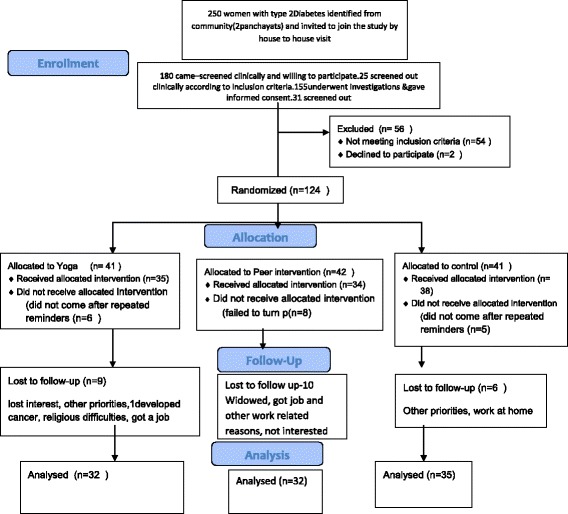
An open label parallel three armed randomized control trial was conducted among 124 recruited women with Diabetes for three months. Block randomization with a block length of six was carried out with each group having at least 41 women. In the Yoga arm, sessions by an instructor, consisting of a group of postures coordinated with breathing were conducted for an hour, two days a week. In the peer support arm each peer mentor after training visited 13-14 women with diabetes every week followed by a phone call. The meeting was about applying disease management or prevention plans in daily life.
There was a trend in decline of fasting plasma glucose in the peer and yoga group and of glycosylated haemoglobin (HbA1c) in the yoga group only, though not significant. A significant decrease was observed in diastolic blood pressure and hip circumference in the yoga group. The process indicated that most (80%) of the women in the yoga group attended classes regularly and 90% of the women in the peer group reported that peer mentoring was useful.
The effect of yoga and peer support on glycaemic outcomes was incremental. Longer term studies are necessary to ascertain the benefits shown by this feasibility study.
CTRI/2011/12/002227 dated 14/12/2011.
2型糖尿病是一种复杂且棘手的慢性病,在印度糖尿病患者人数居首的喀拉拉邦,其影响深远。尽管糖尿病患者中男女比例大致相等,但女性受到的影响尤为独特且更为严重。2型糖尿病的管理要求患者在药物、饮食和运动管理方面具备相当的技巧。因此,在印度这样的中低收入国家,有必要探索低成本干预措施,这些措施能够增强患者能力,并利用现有资源来帮助管理糖尿病。因此,我们研究了两种低成本干预措施(瑜伽和同伴支持)对2型糖尿病女性血糖及其他指标的可行性和效果。
对124名招募的糖尿病女性进行了一项为期三个月的开放标签平行三臂随机对照试验。采用每组至少41名女性的6人一组的区组随机化方法。在瑜伽组,由一名教练指导进行课程,包括一组与呼吸协调的体式,每周两次,每次一小时。在同伴支持组,每位经过培训的同伴导师每周探访13 - 14名糖尿病女性,之后还会打电话。会面内容是关于在日常生活中应用疾病管理或预防计划。
同伴组和瑜伽组的空腹血糖有下降趋势,仅瑜伽组的糖化血红蛋白(HbA1c)有下降趋势,尽管不显著。瑜伽组的舒张压和臀围有显著下降。过程显示,瑜伽组中大多数(80%)女性定期上课,同伴组中90%的女性报告同伴指导有用。
瑜伽和同伴支持对血糖指标的影响是渐进的。需要进行长期研究以确定这项可行性研究显示的益处。
2011年12月14日,CTRI/2011/12/002227。