Ku Jin Mo, Hong Se Hyang, Kim Hyo In, Seo Hye Sook, Shin Yong Cheol, Ko Seong-Gyu
Department of Science in Korean Medicine, Graduate School, Kyung Hee University, Seoul, 02447, Korea.
Department of Preventive Medicine, College of Korean Medicine, Kyung Hee University, 1 Hoegi, Seoul, 130-701, Korea.
BMC Complement Altern Med. 2017 Feb 7;17(1):98. doi: 10.1186/s12906-017-1584-8.
Atopic dermatitis (AD) is an inflammatory, chronically relapsing, and intensively pruritic skin disease that affect 10-30% of the global population. Angelicae dahuricae Radix (ADR) has been reported to be anti-inflammatory in Korean Medicine. In the present study, we investigated whether ADR suppresses the progression of AD in animal model.
AD was induced by 2, 4-Dinitrochlorobenzene (DNCB). ADR was orally administered to mice to study the effect of ADR on AD. Histological Analysis, immunohistochemistry, blood analysis, RT-PCR, and ELISA assay were performed.
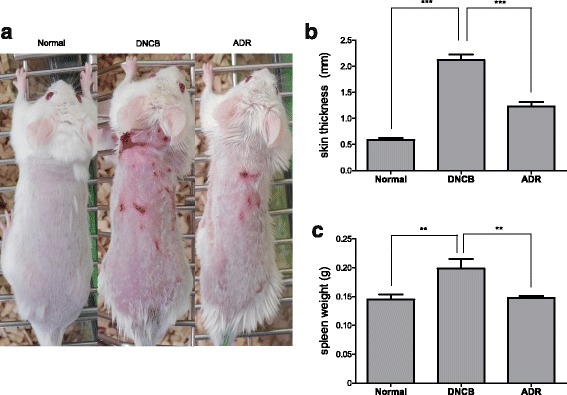
ADR significantly suppressed AD-like symptoms in BALB/c mice: ADR decreased skin thickness and spleen weight of mice. ADR reduced infiltration of mast cells, inflammatory cells and CD4+ cells into mouse skin. ADR lowered the number of WBCs in the blood of mice. ADR reduced the levels of IgE, IL-6, IL-10 and IL-12 in mice serum. ADR down-regulated mRNA expression of IL-4, IL-6 and TNF-α in mouse skin tissue.
Our present study clearly indicates that ADR suppresses the progression of AD induced by DNCB in BALB/c mice. This suggests that ADR might be a useful drug for the treatment of AD.
特应性皮炎(AD)是一种炎症性、慢性复发性且瘙痒剧烈的皮肤病,影响全球10%-30%的人口。在韩医学中,白芷已被报道具有抗炎作用。在本研究中,我们调查了白芷是否能抑制动物模型中特应性皮炎的进展。
用2,4-二硝基氯苯(DNCB)诱导特应性皮炎。给小鼠口服白芷以研究其对特应性皮炎的影响。进行了组织学分析、免疫组化、血液分析、逆转录聚合酶链反应(RT-PCR)和酶联免疫吸附测定(ELISA)。
白芷显著抑制BALB/c小鼠的特应性皮炎样症状:白芷降低了小鼠的皮肤厚度和脾脏重量。白芷减少了肥大细胞、炎性细胞和CD4+细胞向小鼠皮肤的浸润。白芷降低了小鼠血液中白细胞的数量。白芷降低了小鼠血清中免疫球蛋白E(IgE)、白细胞介素-6(IL-6)、白细胞介素-10(IL-10)和白细胞介素-12(IL-12)的水平。白芷下调了小鼠皮肤组织中白细胞介素-4(IL-4)、白细胞介素-6和肿瘤坏死因子-α(TNF-α)的信使核糖核酸(mRNA)表达。
我们目前的研究清楚地表明,白芷抑制了BALB/c小鼠中由DNCB诱导的特应性皮炎的进展。这表明白芷可能是一种治疗特应性皮炎的有效药物。