Chu Nathaniel D, Clarke Sean A, Timberlake Sonia, Polz Martin F, Grossman Alan D, Alm Eric J
Microbiology Graduate Program, Microbiology Graduate Program, Massachusetts Institute of Technology, Cambridge, Massachusetts, USA.
Center for Microbiome Informatics and Therapeutics, Massachusetts Institute of Technology, Cambridge, Massachusetts, USA.
mBio. 2017 Feb 7;8(1):e02045-16. doi: 10.1128/mBio.02045-16.
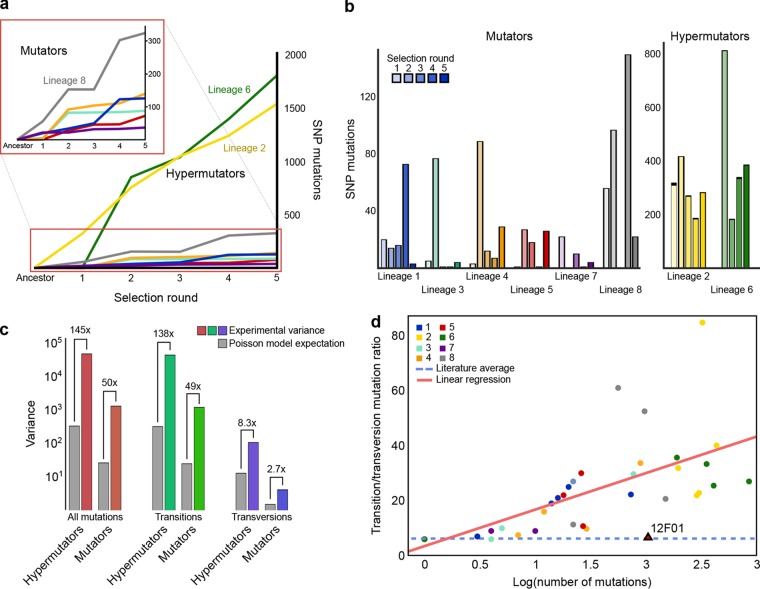
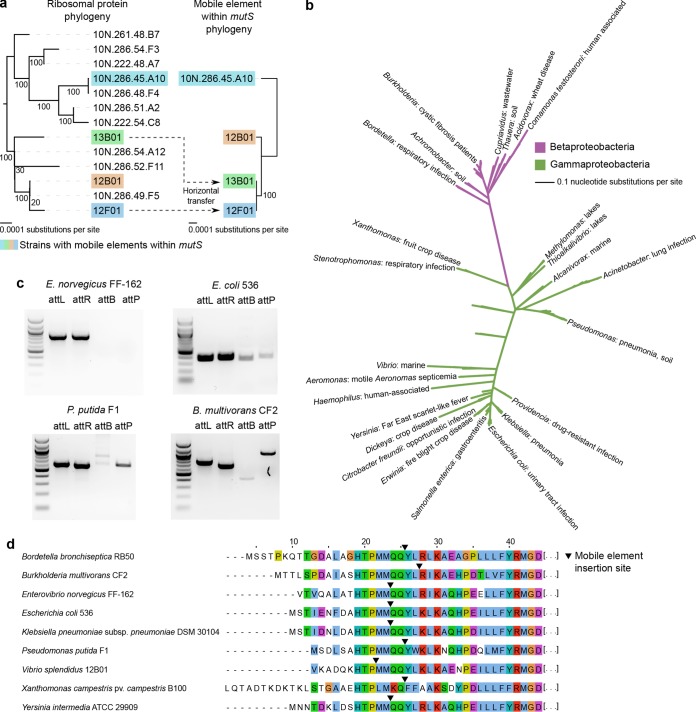
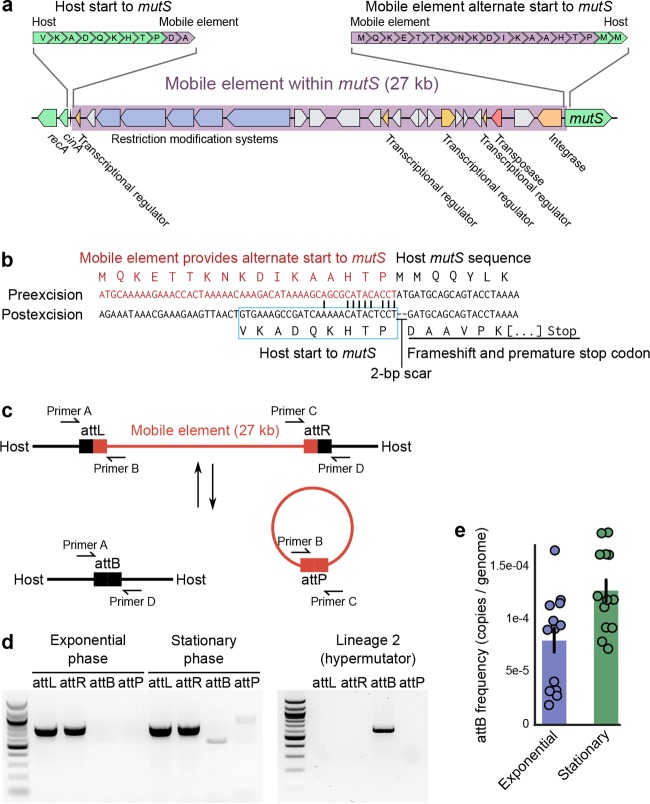
Bacteria face a trade-off between genetic fidelity, which reduces deleterious mistakes in the genome, and genetic innovation, which allows organisms to adapt. Evidence suggests that many bacteria balance this trade-off by modulating their mutation rates, but few mechanisms have been described for such modulation. Following experimental evolution and whole-genome resequencing of the marine bacterium Vibrio splendidus 12B01, we discovered one such mechanism, which allows this bacterium to switch to an elevated mutation rate. This switch is driven by the excision of a mobile element residing in mutS, which encodes a DNA mismatch repair protein. When integrated within the bacterial genome, the mobile element provides independent promoter and translation start sequences for mutS-different from the bacterium's original mutS promoter region-which allow the bacterium to make a functional mutS gene product. Excision of this mobile element rejoins the mutS gene with host promoter and translation start sequences but leaves a 2-bp deletion in the mutS sequence, resulting in a frameshift and a hypermutator phenotype. We further identified hundreds of clinical and environmental bacteria across Betaproteobacteria and Gammaproteobacteria that possess putative mobile elements within the same amino acid motif in mutS In a subset of these bacteria, we detected excision of the element but not a frameshift mutation; the mobile elements leave an intact mutS coding sequence after excision. Our findings reveal a novel mechanism by which one bacterium alters its mutation rate and hint at a possible evolutionary role for mobile elements within mutS in other bacteria.
DNA mutations are a double-edged sword. Most mutations are harmful; they can scramble precise genetic sequences honed over thousands of generations. However, in rare cases, mutations also produce beneficial new traits that allow populations to adapt to changing environments. Recent evidence suggests that some bacteria balance this trade-off by altering their mutation rates to suit their environment. To date, however, we know of few mechanisms that allow bacteria to change their mutation rates. We describe one such mechanism, driven by the action of a mobile element, in the marine bacterium Vibrio splendidus 12B01. We also found similar mobile genetic sequences in the mutS genes of many different bacteria, including clinical and agricultural pathogens. These mobile elements might play an as yet unknown role in the evolution of these important bacteria.
细菌在基因保真度(可减少基因组中的有害错误)和基因创新(使生物体能够适应环境)之间面临权衡。有证据表明,许多细菌通过调节其突变率来平衡这种权衡,但很少有机制被描述用于这种调节。在对海洋细菌灿烂弧菌12B01进行实验进化和全基因组重测序后,我们发现了一种这样的机制,它使这种细菌能够切换到更高的突变率。这种切换是由位于mutS中的一个移动元件的切除驱动的,mutS编码一种DNA错配修复蛋白。当整合到细菌基因组中时,该移动元件为mutS提供独立的启动子和翻译起始序列——与细菌原来的mutS启动子区域不同——这使得细菌能够产生一种功能性的mutS基因产物。这个移动元件的切除使mutS基因与宿主启动子和翻译起始序列重新连接,但在mutS序列中留下一个2碱基对的缺失,导致移码和高突变体表型。我们进一步在β-变形菌纲和γ-变形菌纲的数百种临床和环境细菌中鉴定出,它们在mutS的相同氨基酸基序内拥有推定的移动元件。在这些细菌的一个子集中,我们检测到了该元件的切除,但没有检测到移码突变;移动元件切除后留下完整的mutS编码序列。我们的发现揭示了一种细菌改变其突变率的新机制,并暗示了mutS中的移动元件在其他细菌中可能具有的进化作用。
DNA突变是一把双刃剑。大多数突变是有害的;它们会打乱历经数千代磨练的精确基因序列。然而,在极少数情况下,突变也会产生有益的新性状,使种群能够适应不断变化的环境。最近的证据表明,一些细菌通过改变其突变率来平衡这种权衡以适应环境。然而,迄今为止,我们所知的允许细菌改变其突变率的机制很少。我们描述了一种由移动元件的作用驱动的这样的机制,存在于海洋细菌灿烂弧菌12B01中。我们还在许多不同细菌的mutS基因中发现了类似的移动遗传序列,包括临床和农业病原体。这些移动元件可能在这些重要细菌的进化中发挥着尚未知晓的作用。