Li Qinglin, Zhao Meng, Du Jing, Wang Xiaodan
Department of Geriatric Nephrology.
Department of Clinical Data Repository.
Clin Interv Aging. 2017 Jan 18;12:153-160. doi: 10.2147/CIA.S121823. eCollection 2017.
The aim of this study was to explore the prognostic impact of clinical factors on the short-term outcomes of renal function (RF) in very elderly patients with acute kidney injury (AKI).
We carried out a retrospective cohort study of only very elderly patients who developed AKI at the geriatric department of a tertiary medical center during the period 2007-2015. All patients with AKI were followed up for 90 days after AKI diagnosis or until death. Survivors were divided into recovery and nonrecovery groups according to their RF 90 days post-AKI. RF recovery was defined as an estimated glomerular filtration rate (eGFR) of ≥60 mL/min/1.73 m.
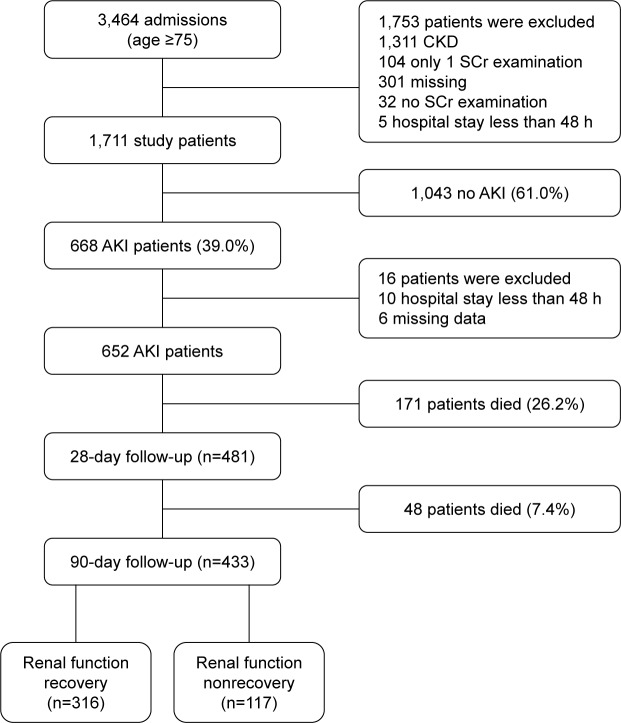
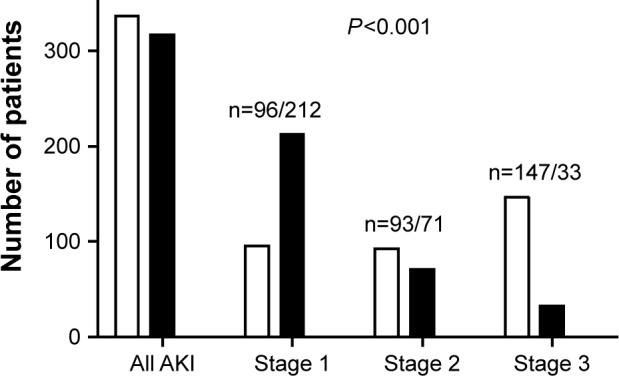
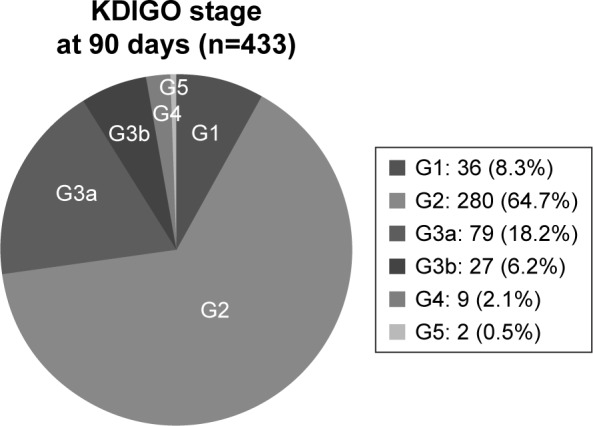
In total, 668 patients (39.0%) developed AKI, and 652 patients were included in the final analysis. The median age of this population was 87 years, with 95.6% being male. The 90-day mortality rate was 33.6%. Of the 433 survivors, 316 (73.0%) recovered to their baseline eGFR. Body mass index (BMI), baseline eGFR, low mean aortic pressure (MAP), low prealbumin level, hypoalbuminemia, oliguria, blood urea nitrogen (BUN) level, and more severe AKI stage were independent risk factors associated with nonrenal recovery or death. AKI etiology, evaluated by peak serum creatinine (SCr) level and the requirement for dialysis, was not associated with nonrenal recovery.
Risk factors for the poor outcomes of RF in very elderly patients with AKI were BMI, baseline eGFR, low MAP, low prealbumin level, hypoalbuminemia, oliguria, BUN level, and more severe AKI stage. Identifying risk factors may help to improve patient outcomes.
本研究旨在探讨临床因素对高龄急性肾损伤(AKI)患者肾功能(RF)短期预后的影响。
我们对2007年至2015年期间在一家三级医疗中心老年科发生AKI的高龄患者进行了一项回顾性队列研究。所有AKI患者在确诊AKI后随访90天或直至死亡。根据患者AKI后90天的RF情况,将幸存者分为恢复组和未恢复组。RF恢复定义为估计肾小球滤过率(eGFR)≥60 mL/min/1.73 m²。
共有668例患者(39.0%)发生AKI,652例患者纳入最终分析。该人群的中位年龄为87岁,男性占95.6%。90天死亡率为33.6%。在433名幸存者中,316例(73.0%)恢复到基线eGFR。体重指数(BMI)、基线eGFR、低平均动脉压(MAP)、低前白蛋白水平、低白蛋白血症、少尿、血尿素氮(BUN)水平以及更严重的AKI分期是与非肾脏恢复或死亡相关的独立危险因素。通过血清肌酐(SCr)峰值水平和透析需求评估的AKI病因与非肾脏恢复无关。
高龄AKI患者RF预后不良的危险因素包括BMI、基线eGFR、低MAP、低前白蛋白水平、低白蛋白血症、少尿、BUN水平以及更严重的AKI分期。识别危险因素可能有助于改善患者预后。