Yeh Chun Chieh, Spaggiari Mario, Tzvetanov Ivo, Oberholzer José
Division of Transplantation, University of Illinois at Chicago, IL Department of Surgery, China Medical University Hospital School of Medicine, China Medical University, Taichung, Taiwan.
Medicine (Baltimore). 2017 Feb;96(6):e5847. doi: 10.1097/MD.0000000000005847.
Obesity is considered a relative contraindication to pancreas transplantation due to increased risks of wound-related complications. Robotic surgeries have never been applied for pancreas transplantation in obese recipients though robotic kidney transplantation did and already proved its value in reducing wound-related complications in obese recipients.
PATIENT CONCERNS & DIAGNOSES: We performed the first robotic pancreas after kidney transplantation for a 34-year-old Hispanic type 1 diabetic male with class III obesity (BMI = 41 kg/m).
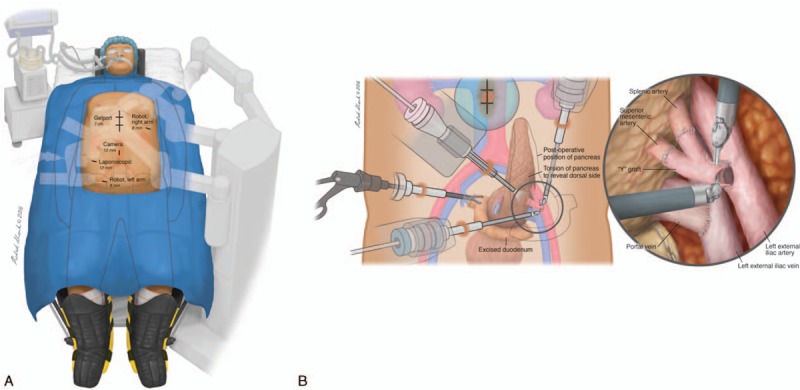
The pancreas graft was procured and benched in the standard fashion. Methylene blue was used to detect any vascular leaks. The operation was completed via two 12-mm ports (camera, laparoscopic bed-side assistance), two 8-mm ports for robotic arms, and a 7-cm epigastric incision for hand port. The portal vein and arterial Y-graft of the pancreas were anastomosed to the recipient's left external iliac vein and artery, respectively. Duodenum-bladder drainage was performed with a circular stapler.
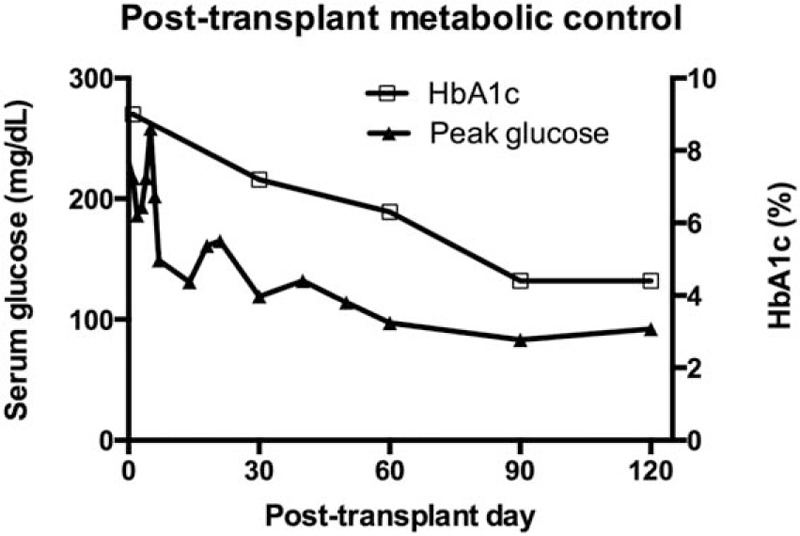
Duration of warm and cold ischemia was: 45 minutes and 7 hours, respectively. The patient was discharged uneventfully without wound-related complications. Excellent metabolic control was achieved with hemoglobin A1c lowering from 9% before transplantation to 4.4% on day 120. The patient remained in nondiabetic status in 1-year follow-up.
In conclusion, robotic pancreas transplantation is feasible in patients with morbid obesity.
由于伤口相关并发症风险增加,肥胖被视为胰腺移植的相对禁忌证。尽管机器人辅助肾移植已应用于肥胖受者并已证明其在降低肥胖受者伤口相关并发症方面的价值,但机器人辅助手术从未应用于肥胖受者的胰腺移植。
我们为一名34岁的西班牙裔1型糖尿病男性肥胖患者(BMI = 41kg/m²,Ⅲ级肥胖)进行了首例肾移植术后机器人辅助胰腺移植手术。
胰腺移植物以标准方式获取并在移植台上处理。使用亚甲蓝检测任何血管渗漏。手术通过两个12毫米端口(摄像头、腹腔镜床边辅助)、两个用于机器人手臂的8毫米端口以及一个用于手部操作的7厘米上腹部切口完成。胰腺的门静脉和动脉Y形移植物分别与受者的左髂外静脉和动脉吻合。采用圆形吻合器进行十二指肠膀胱引流。
热缺血和冷缺血时间分别为45分钟和7小时。患者顺利出院,无伤口相关并发症。实现了良好的代谢控制,糖化血红蛋白从移植前的9%降至第120天的4.4%。患者在1年随访中保持非糖尿病状态。
总之,机器人辅助胰腺移植在病态肥胖患者中是可行的。