Schöberl Iris, Wedl Manuela, Beetz Andrea, Kotrschal Kurt
Department of Behavioural Biology, University of Vienna, Vienna, Austria.
Core Facility Konrad Lorenz Research Station, University of Vienna, Grünau im Almtal, Austria.
PLoS One. 2017 Feb 8;12(2):e0170707. doi: 10.1371/journal.pone.0170707. eCollection 2017.
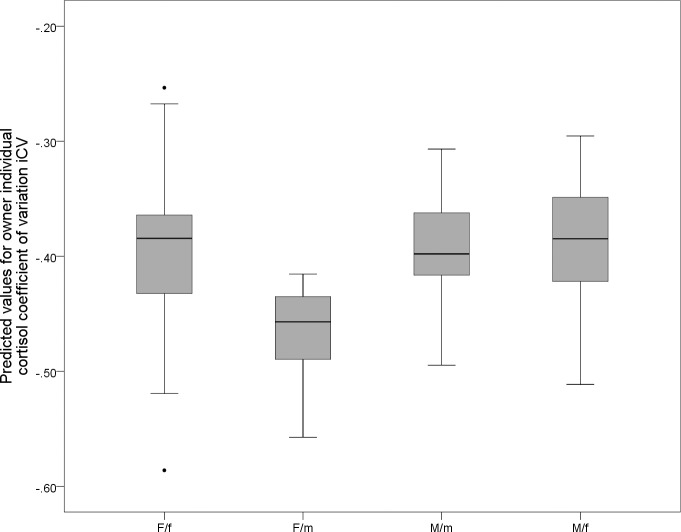
Stress responses within dyads are modulated by interactions such as mutual emotional support and conflict. We investigated dyadic psychobiological factors influencing intra-individual cortisol variability in response to different challenging situations by testing 132 owners and their dogs in a laboratory setting. Salivary cortisol was measured and questionnaires were used to assess owner and dog personality as well as owners' social attitudes towards the dog and towards other humans. We calculated the individual coefficient of variance of cortisol (iCV = sd/mean*100) over the different test situations as a parameter representing individual variability of cortisol concentration. We hypothesized that high cortisol variability indicates efficient and adaptive coping and a balanced individual and dyadic social performance. Female owners of male dogs had lower iCV than all other owner gender-dog sex combinations (F = 14.194, p<0.001), whereas owner Agreeableness (NEO-FFI) scaled positively with owner iCV (F = 4.981, p = 0.028). Dogs of owners high in Neuroticism (NEO-FFI) and of owners who were insecure-ambivalently attached to their dogs (FERT), had low iCV (F = 4.290, p = 0.041 and F = 5.948, p = 0.016), as had dogs of owners with human-directed separation anxiety (RSQ) or dogs of owners with a strong desire of independence (RSQ) (F = 7.661, p = 0.007 and F = 9.192, p = 0.003). We suggest that both owner and dog social characteristics influence dyadic cortisol variability, with the human partner being more influential than the dog. Our results support systemic approaches (i.e. considering the social context) in science and in counselling.
二元组内的应激反应会受到相互情感支持和冲突等互动的调节。我们通过在实验室环境中对132名主人及其宠物狗进行测试,研究了影响个体皮质醇变异性以应对不同挑战性情境的二元心理生物学因素。测量了唾液皮质醇,并使用问卷评估主人和狗的性格,以及主人对狗和对其他人的社会态度。我们计算了不同测试情境下皮质醇的个体变异系数(iCV = 标准差/均值*100),作为代表皮质醇浓度个体变异性的参数。我们假设高皮质醇变异性表明有效的适应性应对以及个体和二元组社会表现的平衡。雄性狗的雌性主人的iCV低于所有其他主人性别 - 狗性别组合(F = 14.194,p<0.001),而主人的宜人性(NEO - FFI)与主人的iCV呈正相关(F = 4.981,p = 0.028)。神经质得分高(NEO - FFI)的主人的狗,以及与狗有不安全 - 矛盾依恋关系(FERT)的主人的狗,iCV较低(F = 4.290,p = 0.041和F = 5.948,p = 0.016),有人类导向型分离焦虑(RSQ)的主人的狗或有强烈独立欲望(RSQ)的主人的狗也是如此(F = 7.661,p = 0.007和F = 9.192,p = 0.003)。我们认为主人和狗的社会特征都会影响二元组皮质醇变异性,其中人类伴侣的影响比狗更大。我们的结果支持科学和咨询中的系统方法(即考虑社会背景)。