Ahrens-Nicklas Rebecca C, Umanah George K E, Sondheimer Neal, Deardorff Matthew A, Wilkens Alisha B, Conlin Laura K, Santani Avni B, Nesbitt Addie, Juulsola Jane, Ma Erica, Dawson Ted M, Dawson Valina L, Marsh Eric D
Section of Biochemical Genetics (R.C.A.-N., N.S.), Division of Human Genetics (R.C.A.-N., M.A.D., A.B.W.), Department of Pathology and Laboratory Medicine (L.K.C., A.B.S., A.N.), Division of Child Neurology (E.D.M.), Children's Hospital of Philadelphia, PA; Department of Pediatrics (R.C.A.-N., N.S., M.A.D., E.D.M.) and Department of Neurology (E.D.M.), Perelman School of Medicine, and Department of Clinical Pathology (L.K.C., A.B.S.), University of Pennsylvania, Philadelphia; GeneDx (J.J.), Gaithersburg, MD; Neuroregeneration and Stem Cell Programs (G.K.E.U., T.M.D., V.L.D.), Institute for Cell Engineering; Departments of Neurology (G.K.E.U., T.M.D.), Solomon H. Snyder Department of Neuroscience (T.M.D., V.L.D.), Pharmacology and Molecular Sciences (T.M.D., V.L.D.), Physiology (V.L.D.), and Public Health (E.M.), Johns Hopkins University, Baltimore, MD.
Neurol Genet. 2017 Feb 1;3(1):e130. doi: 10.1212/NXG.0000000000000130. eCollection 2017 Feb.
encodes Thorase, a mediator of α-amino-3-hydroxy-5-methylisoxazole-4-proprionate (AMPA) receptor recycling; in this work, we characterized the phenotype resulting from mutations and developed a targeted therapy in both mice and humans.
Using exome sequencing, we identified a novel mutation (p.E276X) as the etiology of a devastating neurologic disorder characterized by hypertonia, seizures, and death in a consanguineous family. We postulated that pathogenesis was a result of excessive AMPA receptor activity and designed a targeted therapeutic approach using perampanel, an AMPA-receptor antagonist.
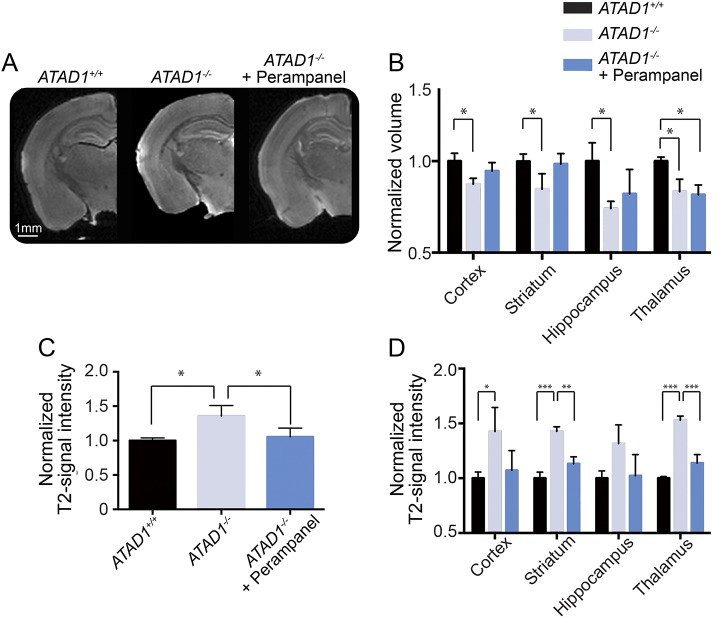
Perampanel therapy in knockout mice reversed behavioral defects, normalized brain MRI abnormalities, prevented seizures, and prolonged survival. The patients treated with perampanel showed improvement in hypertonicity and resolution of seizures.
This work demonstrates that identification of novel monogenic neurologic disorders and observation of response to targeted therapeutics can provide important insights into human nervous system functioning.
编码Thorase,一种α-氨基-3-羟基-5-甲基异恶唑-4-丙酸(AMPA)受体再循环的介质;在本研究中,我们对突变导致的表型进行了特征分析,并在小鼠和人类中开发了靶向治疗方法。
通过外显子组测序,我们在一个近亲家庭中鉴定出一种新的突变(p.E276X),它是一种以张力亢进、癫痫发作和死亡为特征的毁灭性神经系统疾病的病因。我们推测发病机制是AMPA受体活性过高的结果,并设计了一种使用AMPA受体拮抗剂吡仑帕奈的靶向治疗方法。
在基因敲除小鼠中进行吡仑帕奈治疗可逆转行为缺陷,使脑部MRI异常恢复正常,预防癫痫发作,并延长生存期。接受吡仑帕奈治疗的患者张力亢进情况有所改善,癫痫发作得到缓解。
这项研究表明,鉴定新的单基因神经系统疾病以及观察对靶向治疗的反应可为人类神经系统功能提供重要见解。