Samim M, Prevoo W, de Wit-van der Veen B J, Kuhlmann K F, Ruers T, van Hillegersberg R, van den Bosch M A A J, Verkooijen H M, Lam M G E H, Stokkel M P M
Department Surgery, University Medical Centre Utrecht, Heidelberglaan 100, 3508 GA, Utrecht, The Netherlands.
Department Radiology and Nuclear Medicine, University Medical Centre Utrecht, Heidelberglaan 100, 3508 GA, Utrecht, The Netherlands.
Eur J Nucl Med Mol Imaging. 2017 Jul;44(7):1165-1175. doi: 10.1007/s00259-017-3637-0. Epub 2017 Feb 8.
Recurrent disease following thermal ablation therapy is a frequently reported problem. Preoperative identification of patients with high risk of recurrent disease might enable individualized treatment based on patients' risk profile. The aim of the present work was to investigate the role of metabolic parameters derived from the pre-ablation F-FDG PET/CT as imaging biomarkers for recurrent disease in patients with colorectal liver metastases (CLM).
Included in this retrospective study were all consecutive patients with CLM treated with percutaneous or open thermal ablation therapy who had a pre-treatment baseline F-FDG PET/CT available. Multivariable cox regression for survival analysis was performed using different models for the metabolic parameters (SUL, SUL, SUL, partial volume corrected SUL (cSUL), and total lesion glycolysis (TLG)) corrected for tumour and procedure characteristics. The study endpoints were defined as local tumour progression free survival (LTP-FS), new intrahepatic recurrence free survival (NHR-FS) and extrahepatic recurrence free survival (EHR-FS). Clinical and imaging follow-up data was used as the reference standard.
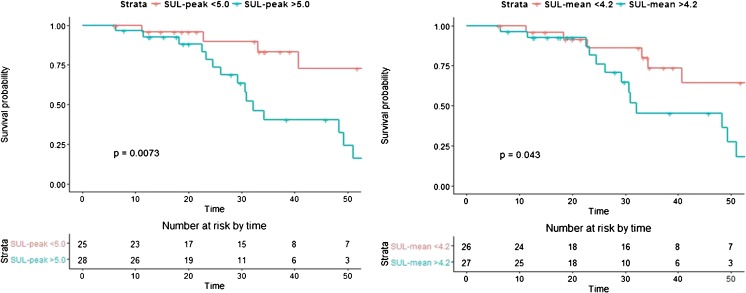
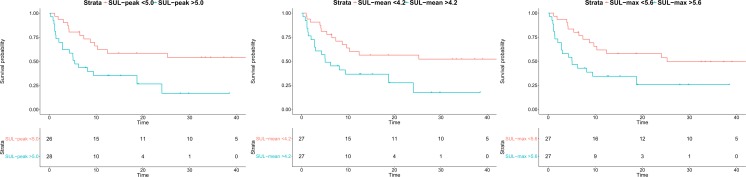
Fifty-four patients with 90 lesions were selected. Univariable cox regression analysis resulted in eight models. Multivariable analysis revealed that after adjusting for lesion size and the approach of the procedure, none of the metabolic parameters were associated with LTP-FS or EHR-FS. Percutaneous approach was significantly associated with a shorter LTP-FS. It was demonstrated that lower values of SUL, SUL, SUL , and cSUL are associated with a significant better NHR-FS, independent of the lesion size and number and prior chemotherapy.
We found no association between the metabolic parameters on pre-ablation F-FDG PET/CT and the LTP-FS. However, low values of the metabolic parameters were significantly associated with improved NHR-FS. The clinical implication of these findings might be the identification of high-risk patients who might benefit most from adjuvant or combined treatment strategies.
热消融治疗后疾病复发是一个经常被报道的问题。术前识别复发风险高的患者可能有助于根据患者的风险特征进行个体化治疗。本研究的目的是探讨消融前F-FDG PET/CT衍生的代谢参数作为结直肠癌肝转移(CLM)患者疾病复发的影像生物标志物的作用。
本回顾性研究纳入了所有接受经皮或开放热消融治疗且有治疗前基线F-FDG PET/CT的连续性CLM患者。使用针对肿瘤和手术特征校正的不同代谢参数模型(标准化摄取值(SUL)、SUL、SUL、部分容积校正SUL(cSUL)和总病变糖酵解(TLG))进行多变量Cox回归生存分析。研究终点定义为局部肿瘤无进展生存期(LTP-FS)、肝内新复发无进展生存期(NHR-FS)和肝外复发无进展生存期(EHR-FS)。临床和影像随访数据用作参考标准。
选择了54例患者的90个病灶。单变量Cox回归分析产生了8个模型。多变量分析显示,在调整病灶大小和手术方式后,没有一个代谢参数与LTP-FS或EHR-FS相关。经皮手术方式与较短的LTP-FS显著相关。结果表明,较低的SUL、SUL、SUL和cSUL值与显著更好的NHR-FS相关,与病灶大小、数量和既往化疗无关。
我们发现消融前F-FDG PET/CT上的代谢参数与LTP-FS之间没有关联。然而,代谢参数的低值与改善的NHR-FS显著相关。这些发现的临床意义可能是识别出可能从辅助或联合治疗策略中获益最大的高危患者。