Mateva Gabriela, Handzhiev Stoyan, Kostadinova Irena
Acibadem City Clinic Mladost, Clinic of Nuclear Medicine, Sofia, Bulgaria.
Acibadem City Clinic Mladost, Clinic of Gastroenterology, Sofia, Bulgaria.
Mol Imaging Radionucl Ther. 2021 Feb 9;30(1):1-7. doi: 10.4274/mirt.galenos.2020.63634.
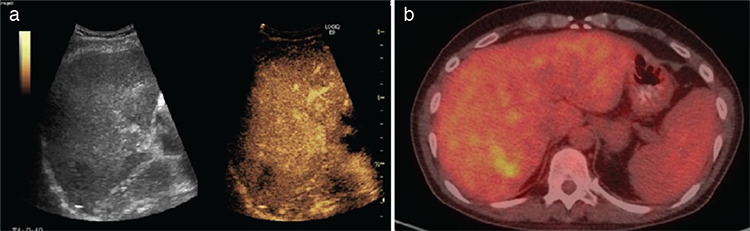
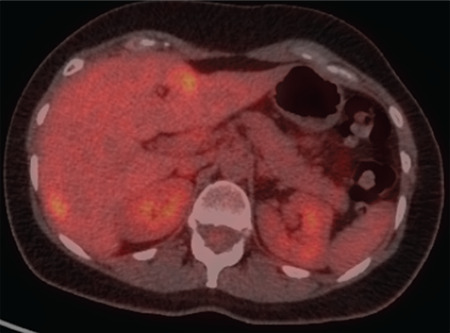
The aim of the study was to investigate the role of fluorine-fluorodeoxyglucose (F-FDG) positron emission tomography/computed tomography (PET/CT) for evaluating the efficacy of radiofrequency ablation (RFA) in primary and metastatic liver tumors compared with contrast-enhanced ultrasound examination (CEUS) and to find its place in overall staging and the follow-up diagnostic algorithm.
PET/CT examinations were performed 2 months after RFA for 20 patients with a total of 34 liver lesions. CEUS was performed within 10 days after PET/CT, and the results were compared. Seven patients were staged with PET/CT and the others with a contrast-enhanced CT.
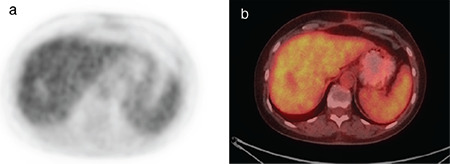
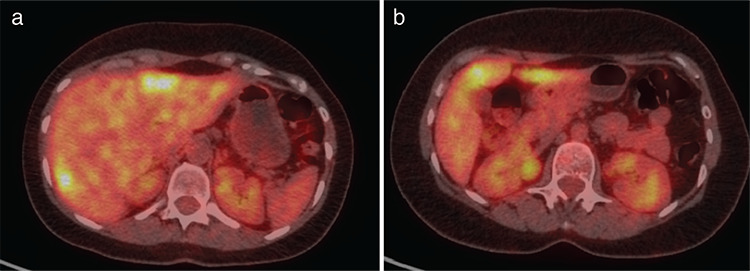
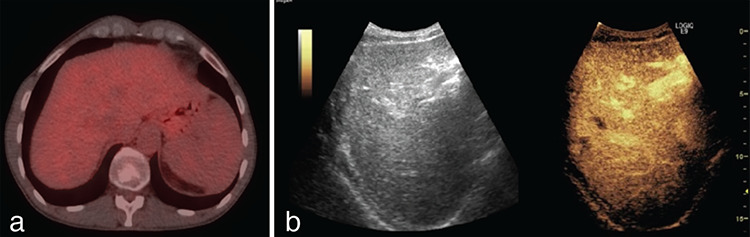
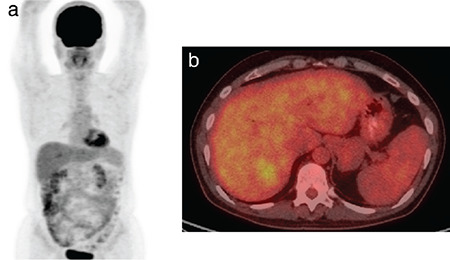
A total of 48 F-FDG PET/CT examinations were performed. We observed complete response in 8 patients (40%), 2 patients (10%) had stable disease, one (5%) had partial response, and 9 patients (45%) had progression (including 2 cases with extrahepatic involvement). Compared with CEUS, there was a mismatch in 3 cases. Five patients underwent additional RFA for 7 lesions.
According to our preliminary data, PET/CT may be a valuable method, with comparable or eventually even better sensitivity than CEUS, for early evaluation of the efficacy of RFA for the treatment of metastatic and primary liver lesions and planning of future treatment. PET/CT might be recommended as a staging method before undergoing RFA of liver lesions for determining the local extent of the disease in the liver in combination with CEUS with an advantage in visualization of extrahepatic involvement. However, more patients need to be investigated in order to demonstrate and confirm the obtained results with certainty.
本研究旨在探讨氟代脱氧葡萄糖(F-FDG)正电子发射断层扫描/计算机断层扫描(PET/CT)在评估原发性和转移性肝肿瘤射频消融(RFA)疗效方面的作用,并与对比增强超声检查(CEUS)进行比较,以确定其在整体分期及后续诊断算法中的地位。
对20例共有34个肝病灶的患者在RFA术后2个月进行PET/CT检查。在PET/CT检查后10天内进行CEUS检查,并比较结果。7例患者采用PET/CT进行分期,其余患者采用对比增强CT进行分期。
共进行了48次F-FDG PET/CT检查。我们观察到8例患者(40%)完全缓解,2例患者(10%)病情稳定,1例患者(5%)部分缓解,9例患者(45%)病情进展(包括2例肝外受累)。与CEUS相比,有3例结果不匹配。5例患者针对7个病灶进行了额外的RFA治疗。
根据我们的初步数据,PET/CT可能是一种有价值的方法,在评估RFA治疗转移性和原发性肝病灶的疗效及规划未来治疗方面,其敏感性与CEUS相当,甚至最终可能更好。PET/CT可被推荐作为肝病灶RFA术前的分期方法,与CEUS联合用于确定肝脏疾病的局部范围,在显示肝外受累方面具有优势。然而,需要更多患者进行研究,以便确切地证明和确认所获得的结果。