Department of Physical Chemistry, University of Science and Technology Beijing, Beijing 100083, China.
Department of Physics and Astronomy, University of Padova, I-35131 Padova, Italy.
Nat Commun. 2017 Feb 9;8:14441. doi: 10.1038/ncomms14441.
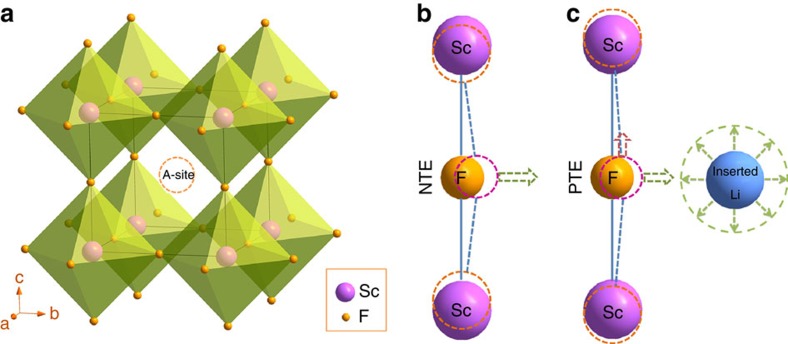
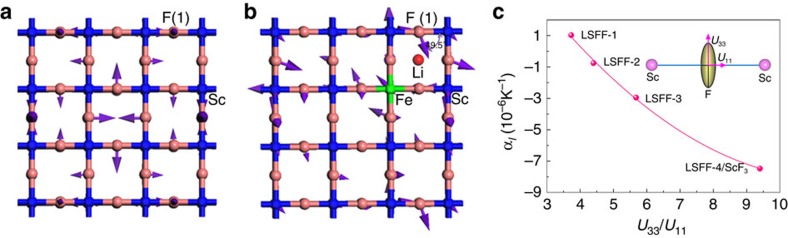
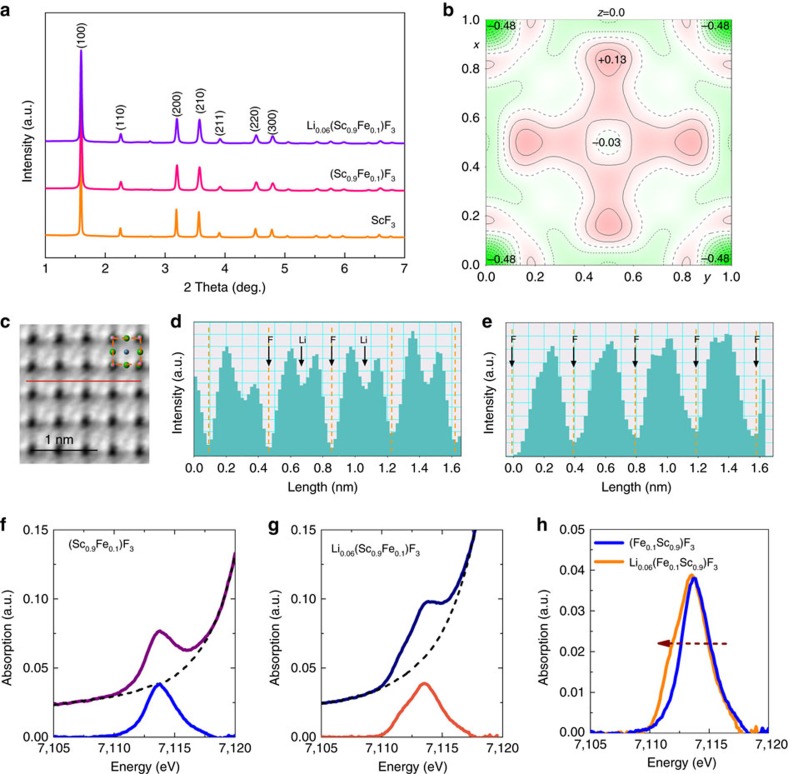
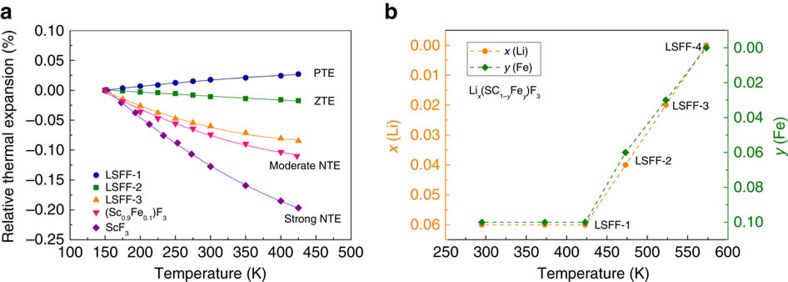
Thermal expansion properties of solids are of fundamental interest and control of thermal expansion is important for practical applications but can be difficult to achieve. Many framework-type materials show negative thermal expansion when internal cages are empty but positive thermal expansion when additional atoms or molecules fill internal voids present. Here we show that redox intercalation offers an effective method to control thermal expansion from positive to zero to negative by insertion of Li ions into the simple negative thermal expansion framework material ScF, doped with 10% Fe to enable reduction. The small concentration of intercalated Li ions has a strong influence through steric hindrance of transverse fluoride ion vibrations, which directly controls the thermal expansion. Redox intercalation of guest ions is thus likely to be a general and effective method for controlling thermal expansion in the many known framework materials with phonon-driven negative thermal expansion.
固体的热膨胀性质具有根本的意义,控制热膨胀对于实际应用很重要,但却难以实现。许多骨架型材料在内部笼为空时表现出负热膨胀,而在填充内部空隙时则表现出正热膨胀。在这里,我们表明,通过将锂离子插入掺杂了 10%铁以实现还原的简单负热膨胀骨架材料 ScF 中,可以进行氧化还原插层反应,从而提供一种从正到零到负控制热膨胀的有效方法。少量的插层锂离子通过横向氟离子振动的空间位阻产生强烈的影响,从而直接控制热膨胀。因此,对于许多具有声子驱动负热膨胀的已知骨架材料,氧化还原插层可能是一种通用且有效的控制热膨胀的方法。