Mondoñedo Jarred R, Suki Béla
Department of Biomedical Engineering, Boston University, Boston, MA, United States of America.
School of Medicine, Boston University, Boston, MA, United States of America.
PLoS Comput Biol. 2017 Feb 9;13(2):e1005282. doi: 10.1371/journal.pcbi.1005282. eCollection 2017 Feb.
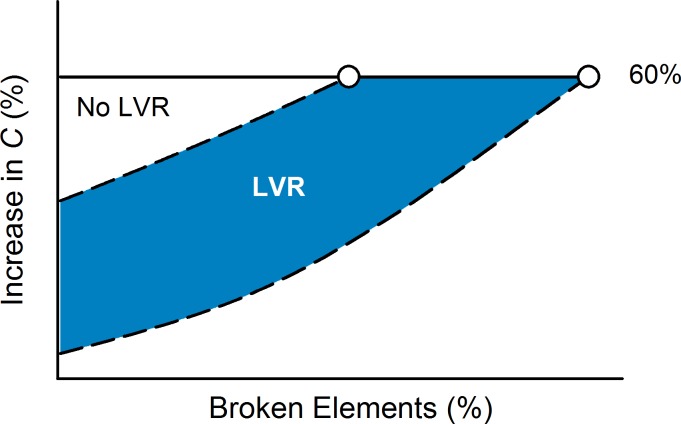
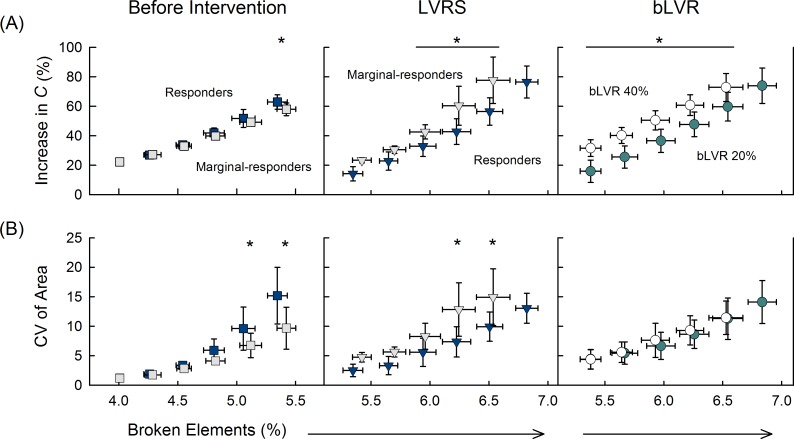
Lung volume reduction surgery (LVRS) and bronchoscopic lung volume reduction (bLVR) are palliative treatments aimed at reducing hyperinflation in advanced emphysema. Previous work has evaluated functional improvements and survival advantage for these techniques, although their effects on the micromechanical environment in the lung have yet to be determined. Here, we introduce a computational model to simulate a force-based destruction of elastic networks representing emphysema progression, which we use to track the response to lung volume reduction via LVRS and bLVR. We find that (1) LVRS efficacy can be predicted based on pre-surgical network structure; (2) macroscopic functional improvements following bLVR are related to microscopic changes in mechanical force heterogeneity; and (3) both techniques improve aspects of survival and quality of life influenced by lung compliance, albeit while accelerating disease progression. Our model predictions yield unique insights into the microscopic origins underlying emphysema progression before and after lung volume reduction.
肺减容手术(LVRS)和支气管镜肺减容术(bLVR)是旨在减轻晚期肺气肿过度充气的姑息性治疗方法。先前的研究评估了这些技术在功能改善和生存优势方面的效果,尽管它们对肺内微机械环境的影响尚未确定。在此,我们引入一个计算模型来模拟基于力的弹性网络破坏,以代表肺气肿的进展,我们用它来追踪通过LVRS和bLVR进行肺减容后的反应。我们发现:(1)LVRS的疗效可以根据术前的网络结构来预测;(2)bLVR术后的宏观功能改善与机械力异质性的微观变化有关;(3)这两种技术都改善了受肺顺应性影响的生存和生活质量方面,尽管同时也加速了疾病进展。我们的模型预测为肺减容前后肺气肿进展的微观起源提供了独特的见解。