Halvarsson Camilla, Eliasson Pernilla, Jönsson Jan-Ingvar
Department of Clinical and Experimental Medicine, Linköping University, Linköping, Sweden.
Linköping Integrative Regenerative Medicine Centre, Linköping University, Linköping, Sweden.
PLoS One. 2017 Feb 9;12(2):e0171714. doi: 10.1371/journal.pone.0171714. eCollection 2017.
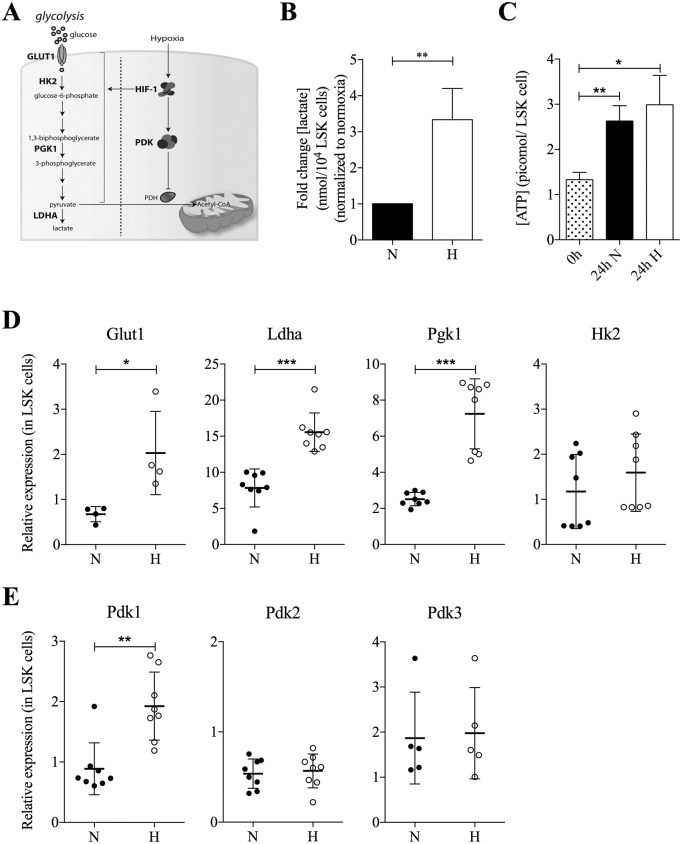
Accumulating evidence suggests that hypoxic areas in the bone marrow are crucial for maintenance of hematopoietic stem cells (HSCs) by supporting a quiescent state of cell cycle and regulating the transplantation capacity of long-term (LT)-HSCs. In addition, HSCs seem to express a metabolic profile of energy production away from mitochondrial oxidative phosphorylation in favor of glycolysis. At oxygen deprivation, hypoxia inducible factor 1α (HIF-1α) is known to induce glycolytic enzymes as well as suppressing mitochondrial energy production by inducing pyruvate dehydrogenase kinase 1 (Pdk1) in most cell types. It has not been established whether PDK1 is essential for HSC function and mediates hypoxia-adapting functions in HSCs. While the Pdk gene family contains four members (Pdk1-4), it was recently shown that Pdk2 and Pdk4 have an important role in regulating LT-HSCs.
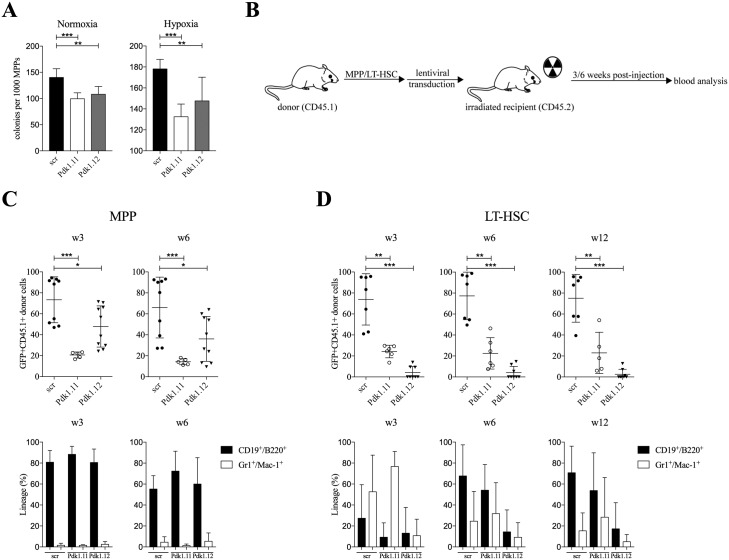
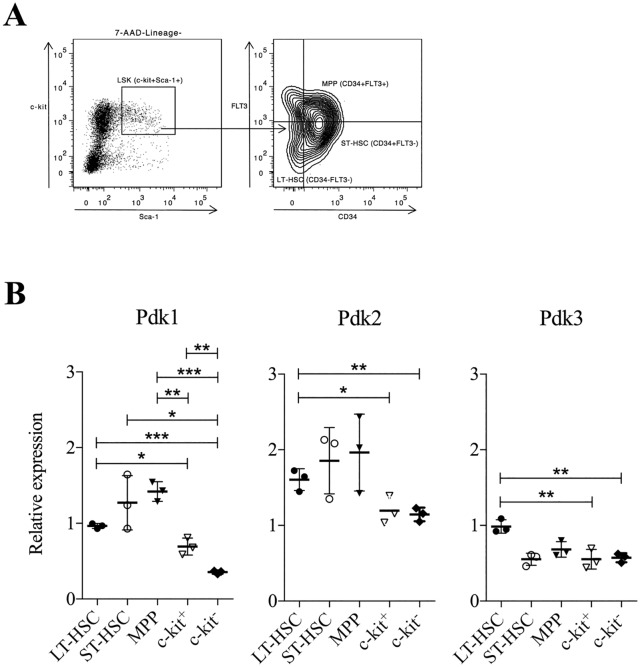
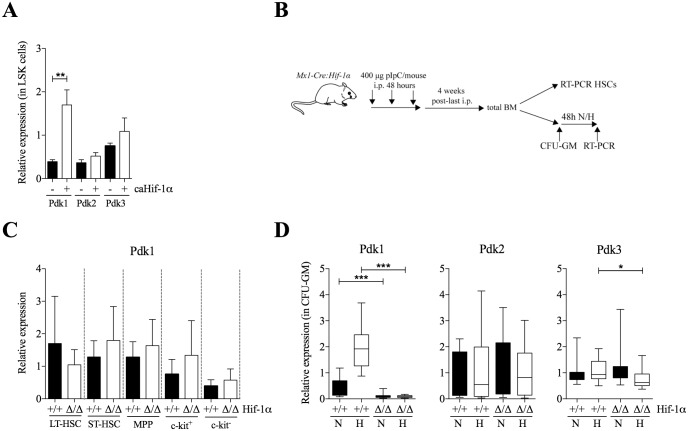
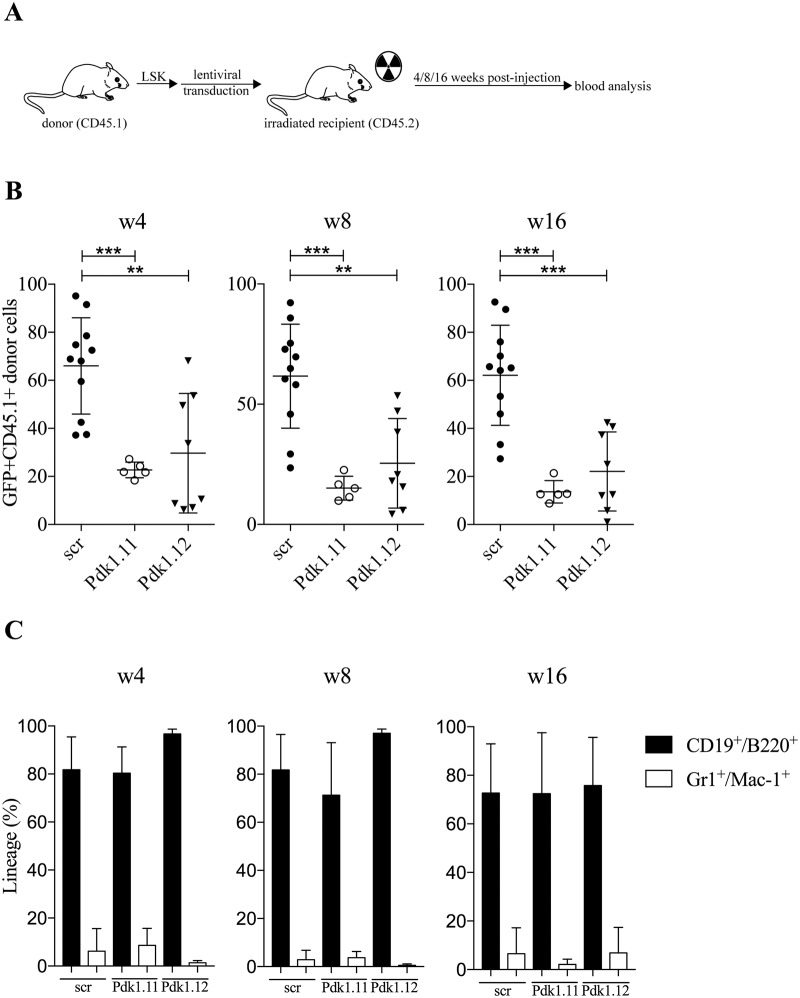
Here we demonstrate that PDK1 activity is crucial for transplantable HSC function. Whereas Pdkl, Pdk2, and Pdk3 transcripts were expressed at higher levels in different subtypes of HSCs compared to differentiated cells, we could not detect any major differences in expression between LT-HSCs and more short-term HSCs and multipotent progenitors. When studying HIF-1α-mediated regulation of Pdk activity in vitro, Pdk1 was the most robust target regulated by hypoxia, whereas Pdk2, Pdk3, and Pdk4 were not affected. Contrary, genetic ablation in a cre-inducible Hif-1α knockout mouse did not support a link between HIF-1α and Pdk1. Silencing of Pdk1 by shRNA lentiviral gene transfer partially impaired progenitor colony formation in vitro and had a strong negative effect on both long-term and short-term engraftment in mice.
Our study demonstrates that PDK1 has broad effects in hematopoiesis and is a critical factor for engraftment of both HSCs and multipotent progenitors upon transplantation to recipient mice. While Pdk1 was a robust hypoxia-inducible gene mediated by HIF-1α in vitro, we could not find evidence of any in vivo links between Pdk1 and HIF-1α.
越来越多的证据表明,骨髓中的缺氧区域对于维持造血干细胞(HSC)至关重要,它通过支持细胞周期的静止状态和调节长期(LT)-HSC的移植能力来实现。此外,HSC似乎表现出一种能量产生的代谢模式,从线粒体氧化磷酸化转向糖酵解。在缺氧条件下,缺氧诱导因子1α(HIF-1α)已知会诱导糖酵解酶,并通过在大多数细胞类型中诱导丙酮酸脱氢酶激酶1(Pdk1)来抑制线粒体能量产生。目前尚未确定PDK1对于HSC功能是否必不可少,以及它是否介导HSC中的缺氧适应功能。虽然Pdk基因家族包含四个成员(Pdk1-4),但最近的研究表明Pdk2和Pdk4在调节LT-HSC中具有重要作用。
在这里,我们证明PDK1活性对于可移植的HSC功能至关重要。与分化细胞相比,Pdkl、Pdk2和Pdk3转录本在不同亚型的HSC中表达水平更高,但我们未检测到LT-HSC与更短期的HSC和多能祖细胞之间在表达上有任何主要差异。在体外研究HIF-1α介导的Pdk活性调节时,Pdk1是受缺氧调节最显著的靶点,而Pdk2、Pdk3和Pdk4则不受影响。相反,在cre诱导的Hif-1α基因敲除小鼠中的基因消融不支持HIF-1α与Pdk1之间存在联系。通过shRNA慢病毒基因转移使Pdk1沉默会部分损害体外祖细胞集落形成,并对小鼠的长期和短期植入产生强烈负面影响。
我们的研究表明,PDK1在造血过程中具有广泛影响,并且是移植到受体小鼠体内时HSC和多能祖细胞植入的关键因素。虽然Pdk1在体外是由HIF-1α介导的一个强大的缺氧诱导基因,但我们未找到任何体内证据表明Pdk1与HIF-1α之间存在联系。