Nelson Karin, Taylor Leslie, Silverman Julie, Kiefer Meghan, Hebert Paul, Lessler Dan, Krieger James
VA Health Services Research and Development, Seattle-Denver Center of Innovation for Veteran-Centered and Value-Driven Care, Seattle, Washington.
VA Puget Sound Health Care System, General Internal Medicine Service, Seattle, Washington.
Prev Chronic Dis. 2017 Feb 9;14:E15. doi: 10.5888/pcd14.160344.
Community health workers (CHWs) can improve diabetes outcomes; however, questions remain about translating research findings into practical low-intensity models for safety-net providers. We tested the effectiveness of a home-based low-intensity CHW intervention for improving health outcomes among low-income adults with diabetes.
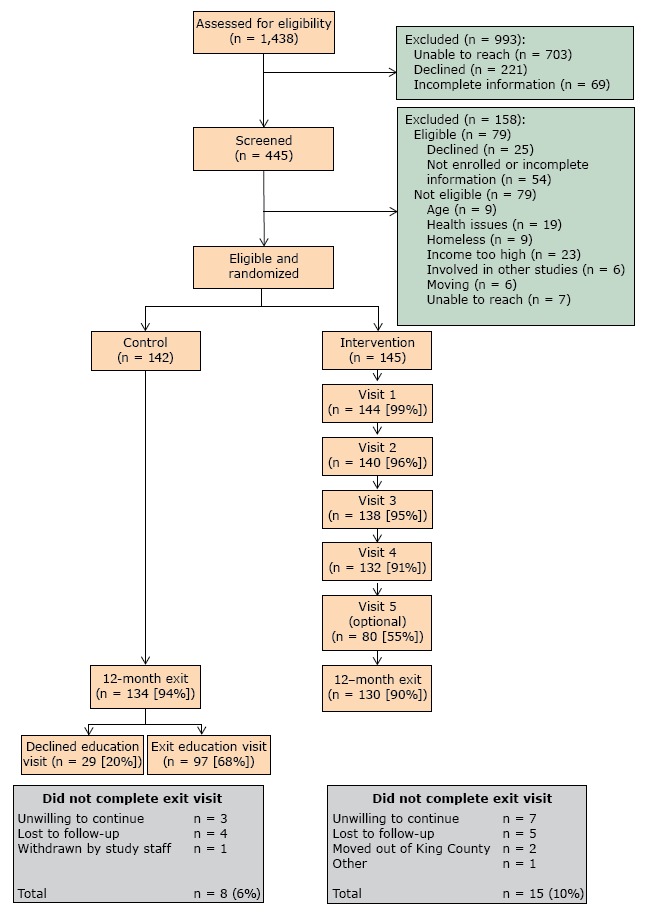
Low-income patients with glycated hemoglobin A (HbA) of 8.0% or higher in the 12 months before enrollment from 3 safety-net providers were randomized to a 12-month CHW-delivered diabetes self-management intervention or usual care. CHWs were based at a local health department. The primary outcome was change in HbA from baseline enrollment to 12 months; secondary outcomes included blood pressure and lipid levels, quality of life, and health care use.
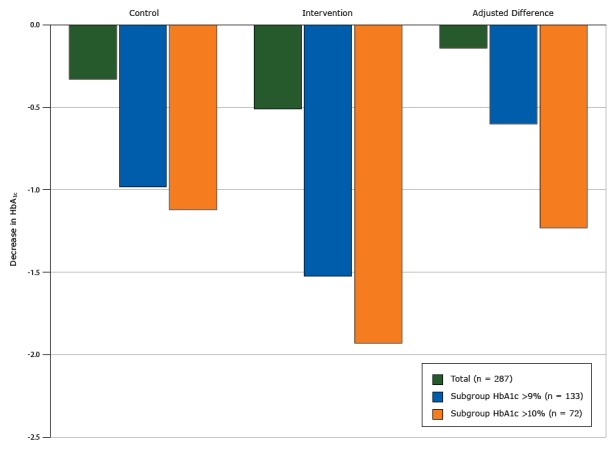
The change in HbA in the intervention group (n = 145) (unadjusted mean of 9.09% to 8.58%, change of -0.51) compared with the control group (n = 142) (9.04% to 8.71%, change of -0.33) was not significant (P = .54). In an analysis of participants with poor glycemic control (HbA >10%), the intervention group had a 1.23-point greater decrease in HbA compared with controls (P = .046). For the entire study population, we found a decrease in reported physician visits (P < .001) and no improvement in health-related quality of life (P = .07) in the intervention group compared with the control group.
A low-intensity CHW-delivered intervention to support diabetes self-management did not significantly improve HbA relative to usual care. Among the subgroup of participants with poor glycemic control (HbA >10% at baseline), the intervention was effective.
社区卫生工作者(CHW)能够改善糖尿病治疗效果;然而,对于如何将研究结果转化为安全网提供者可采用的实用低强度模式,仍存在疑问。我们测试了一项基于家庭的低强度CHW干预措施对改善低收入糖尿病成年人健康结局的有效性。
来自3个安全网提供者的低收入患者,若在入组前12个月糖化血红蛋白A(HbA)≥8.0%,则被随机分为接受为期12个月的由CHW提供的糖尿病自我管理干预组或常规治疗组。CHW隶属于当地卫生部门。主要结局指标为从基线入组至12个月时HbA的变化;次要结局指标包括血压、血脂水平、生活质量和医疗保健利用情况。
干预组(n = 145)HbA的变化(未调整均值从9.09%降至8.58%,变化值为 -0.51)与对照组(n = 142)(从9.04%降至8.71%,变化值为 -0.