Muszyński Paweł, Groblewska Magdalena, Kulczyńska-Przybik Agnieszka, Kułakowska Alina, Mroczko Barbara
Department of Neurodegeneration Diagnostics, Medical University of Białystok, Białystok, Poland.
Department of Biochemical Diagnostics, University Hospital in Białystok, Białystok, Poland.
Curr Neuropharmacol. 2017;15(6):906-917. doi: 10.2174/1570159X15666170208124324.
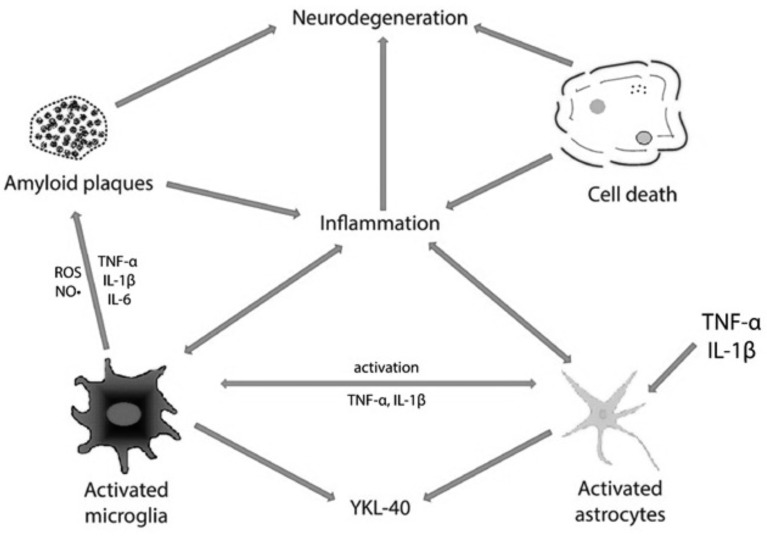
Growing body of evidence suggests that the pathogenesis of Alzheimer's disease (AD), a progressing neurodegenerative condition, is not limited to the neuronal compartment, but also involves various immunological mechanisms. Insoluble Aβ aggregates in the brain can induce the activation of microglia, resulting in the synthesis of proinflammatory mediators, which further can stimulate astrocytic expression of YKL-40. Therefore, the aim of the current review is to present up-to-date data about the role of YKL-40 as a biomarker of AD as well as the possibility of therapeutic strategies targeting neuroinflammation.
OBJECTIVE/METHODS: We searched PubMed articles for the terms "YKL-40", "neurodegeneration", "neuroinflammation" and "Alzheimer's disease", and included papers focusing on this review's scope.
Recent studies indicate that CSF concentrations of YKL-40 were significantly higher in AD patients than in cognitively normal individuals and correlated with dementia biomarkers, such as tau proteins and amyloid beta. Determination of YKL-40 CSF concentration may be also helpful in differentiation between types of dementia and in the distinction of patients in the stable phase of MCI from those who progressed to dementia. Moreover, significantly increased levels of YKL-40 mRNA were found in AD brains in comparison with non-demented controls. Additionally, it was suggested that anti-inflammatory treatment might relief the symptoms of AD and slow its progression.
Based on the recent knowledge, YKL-40 might be useful as a possible biomarker in the diagnosis and prognosis of AD. Modulation of risk factors and targeting of immune mechanisms, including systemic inflammation could lead to future preventive or therapeutic strategies for AD.
越来越多的证据表明,阿尔茨海默病(AD)作为一种进行性神经退行性疾病,其发病机制不仅局限于神经元部分,还涉及多种免疫机制。大脑中不溶性β淀粉样蛋白(Aβ)聚集体可诱导小胶质细胞活化,导致促炎介质合成,进而刺激星形胶质细胞表达YKL-40。因此,本综述的目的是介绍有关YKL-40作为AD生物标志物的作用以及针对神经炎症的治疗策略可能性的最新数据。
目的/方法:我们在PubMed上搜索了有关“YKL-40”、“神经退行性变”、“神经炎症”和“阿尔茨海默病”的文章,并纳入了专注于本综述范围的论文。
最近的研究表明,AD患者脑脊液中YKL-40的浓度显著高于认知正常个体,且与痴呆生物标志物如tau蛋白和β淀粉样蛋白相关。测定脑脊液中YKL-40的浓度也可能有助于区分痴呆类型以及区分处于轻度认知障碍(MCI)稳定期的患者和进展为痴呆的患者。此外,与非痴呆对照组相比,AD脑内YKL-40 mRNA水平显著升高。另外,有研究表明抗炎治疗可能缓解AD症状并减缓其进展。
基于目前的知识,YKL-40可能作为AD诊断和预后的一种潜在生物标志物。调节危险因素以及针对包括全身炎症在内的免疫机制可能会带来未来AD的预防或治疗策略。