Lane Natasha E, Wodchis Walter P, Boyd Cynthia M, Stukel Thérèse A
Institute of Health Policy, Management and Evaluation, University of Toronto, 155 College St, 4th Floor, Toronto, ON, M5T 3M6, Canada.
Institute for Clinical Evaluative Sciences, G1 06 - 2075 Bayview Avenue, Toronto, ON, M4N 3M5, Canada.
BMC Geriatr. 2017 Feb 10;17(1):49. doi: 10.1186/s12877-017-0444-1.
Self-care disability is dependence on others to conduct activities of daily living, such as bathing, eating and dressing. Among long-term care residents, self-care disability lowers quality of life and increases health care costs. Understanding the correlates of self-care disability in this population is critical to guide clinical care and ongoing research in Geriatrics. This study examines which resident geriatric syndromes and chronic conditions are associated with residents' self-care disability and whether these relationships vary across strata of age, sex and cognitive status. It also describes the proportion of variance in residents' self-care disability that is explained by residents' geriatric syndromes versus long-term care home characteristics.
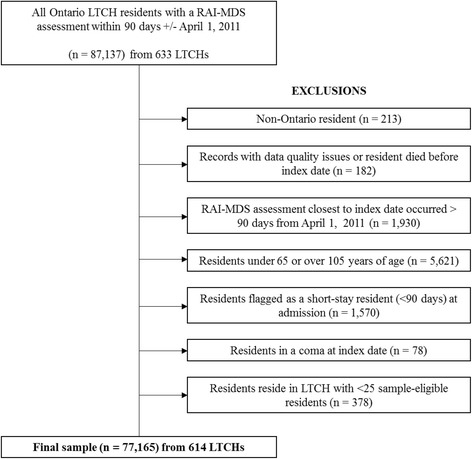
We conducted a cross-sectional study using a health administrative cohort of 77,165 long-term care home residents residing in 614 Ontario long-term care homes. Eligible residents had their self-care disability assessed using the RAI-MDS 2.0 activities of daily living long-form score (range: 0-28) within 90 days of April 1st, 2011. Hierarchical multivariable regression models with random effects for long-term care homes were used to estimate the association between self-care disability and resident geriatric syndromes, chronic conditions and long-term care home characteristics. Differences in findings across strata of sex, age and cognitive status (cognitively intact versus cognitively impaired) were examined.
Geriatric syndromes were much more strongly associated with self-care disability than chronic conditions in multivariable models. The direction and size of some of these effects were different for cognitively impaired versus cognitively intact residents. Residents' geriatric syndromes explained 50% of the variation in their self-care disability scores, while characteristics of long-term care homes explained an additional 2% of variation.
Differences in long-term care residents' self-care disability are largely explained by prevalent geriatric syndromes. After adjusting for resident characteristics, there is little variation in self-care disability associated with long-term care home characteristics. This suggests that residents' geriatric syndromes-not the homes in which they live-may be the appropriate target of interventions to reduce self-care disability, and that such interventions may need to differ for cognitively impaired versus unimpaired residents.
自我护理残疾是指在诸如洗澡、进食和穿衣等日常生活活动中依赖他人。在长期护理机构的居民中,自我护理残疾会降低生活质量并增加医疗保健成本。了解该人群中自我护理残疾的相关因素对于指导老年病临床护理和持续研究至关重要。本研究考察了哪些老年综合征和慢性病与居民的自我护理残疾相关,以及这些关系在年龄、性别和认知状态分层中是否存在差异。研究还描述了居民的老年综合征与长期护理机构特征分别在居民自我护理残疾差异中所占的比例。
我们采用横断面研究,对安大略省614家长期护理机构的77165名居民进行健康管理队列研究。符合条件的居民在2011年4月1日起90天内使用RAI-MDS 2.0日常生活长表评分(范围:0 - 28)对其自我护理残疾情况进行评估。采用具有长期护理机构随机效应的分层多变量回归模型来估计自我护理残疾与居民老年综合征、慢性病和长期护理机构特征之间的关联。研究了性别、年龄和认知状态(认知健全与认知受损)分层结果的差异。
在多变量模型中,老年综合征与自我护理残疾的关联比慢性病更为密切。其中一些影响的方向和大小在认知受损居民与认知健全居民中有所不同。居民的老年综合征解释了其自我护理残疾评分变异的50%,而长期护理机构的特征又额外解释了2%的变异。
长期护理居民自我护理残疾的差异在很大程度上可由普遍存在的老年综合征来解释。在调整居民特征后,与长期护理机构特征相关的自我护理残疾差异很小。这表明居民的老年综合征而非他们居住的机构可能是减少自我护理残疾干预措施的合适目标,并且此类干预措施可能需要针对认知受损居民与未受损居民有所不同。