Liao Mei-Chen, Yen Cheng-Chang, Lin Yuh-Te, Huang Fong-Dee, Chang Yun-Te
Center for Geriatrics and Gerontology, Kaohsiung Veterans General Hospital, Kaohsiung City, Taiwan.
Division of Neurology, Department of Internal Medicine, Kaohsiung Veterans General Hospital, Kaohsiung City, Taiwan.
Front Med (Lausanne). 2023 Jan 11;9:1027503. doi: 10.3389/fmed.2022.1027503. eCollection 2022.
Geriatric syndrome (GS) increases risk of disability and mortality in older adults. Sarcopenia is a predominant illness of GS and accelerate its progression. This study aimed to investigate associations between mortality, emergency department (ED) re-visits and GS-related illnesses among older adults who visited the ED.
This retrospective observational study enrolled elderly patients who visited the ED in our hospital between January 2018 and October 2020. Patients were evaluated for potential sarcopenia, which was defined by both low handgrip strength and calf circumference. Follow-up was at least 6 months. Data of age, gender, mortality, ED re-visits, and GS-related illnesses were collected and analyzed for associations.
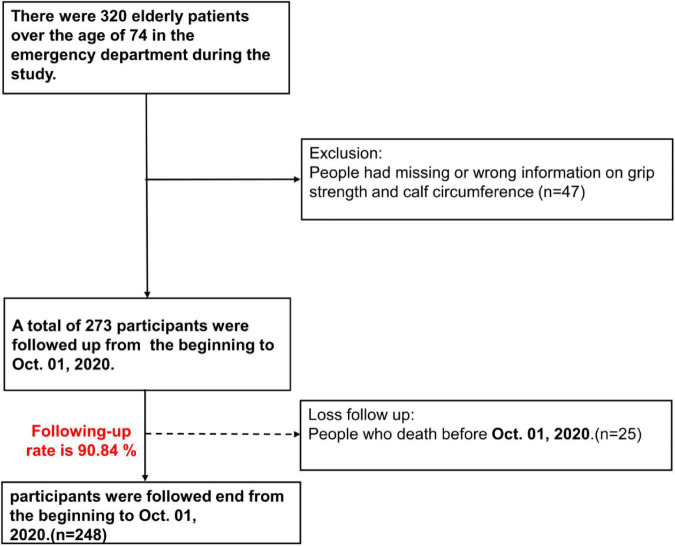
A total of 273 older adults aged 74 years or older were included, of whom 194 were diagnosed with possible sarcopenia. Older adults with possible sarcopenia also had significantly lower body mass index (BMI); a higher proportion needed assistance with daily activities; more had malnutrition, frailty, and history of falls (all < 0.001) and acute decline in activities of daily living ( = 0.027). Multivariate analysis showed that possible sarcopenia [adjusted hazard ratio, aHR): 9.89, 95% confidence interval (CI): 1.17-83.81, = 0.036], living in residential institutions (aHR: 2.85, 95% CI: 1.08-7.50, = 0.034), and frailty (aHR: 7.30, 95% CI: 1.20-44.62, = 0.031) were associated with mortality. Aged over 85 years (adjusted odds ratio: 2.44, 95% CI: 1.25-4.80, = 0.02) was associated with ED re-visits.
Sarcopenia is associated with mortality among older adults who visit ED. Initial screening for sarcopenia and relevant risk factors among older adults in the ED may help with early intervention for those at high-risk and may improve their prognosis.
老年综合征(GS)会增加老年人残疾和死亡的风险。肌肉减少症是GS的主要病症,并加速其进展。本研究旨在调查急诊科(ED)就诊的老年人中死亡率、再次就诊与GS相关疾病之间的关联。
这项回顾性观察研究纳入了2018年1月至2020年10月期间在我院急诊科就诊的老年患者。对患者进行潜在肌肉减少症评估,其定义为握力和小腿围度均较低。随访至少6个月。收集并分析年龄、性别、死亡率、ED再次就诊情况以及GS相关疾病的数据,以探讨它们之间的关联。
共纳入273名74岁及以上的老年人,其中194人被诊断为可能患有肌肉减少症。可能患有肌肉减少症的老年人的体重指数(BMI)也显著较低;更高比例的人在日常生活中需要帮助;更多人存在营养不良、虚弱以及跌倒史(均P<0.001)和日常生活活动能力急性下降(P = 0.027)。多因素分析显示,可能患有肌肉减少症[调整后风险比(aHR):9.89,95%置信区间(CI):1.17 - 83.81,P = 0.036]、居住在养老机构(aHR:2.85,95%CI:1.08 - 7.50,P = 0.034)以及虚弱(aHR:7.30,95%CI:1.20 - 44.62,P = 0.031)与死亡率相关。年龄超过85岁(调整后比值比:2.44,95%CI:1.25 - 4.80,P = 0.02)与ED再次就诊相关。
肌肉减少症与急诊科就诊的老年人的死亡率相关。对急诊科老年患者进行肌肉减少症及相关危险因素的初步筛查,可能有助于对高危人群进行早期干预,并改善其预后。