Renaudin Pierre, Baumstarck Karine, Daumas Aurélie, Esteve Marie-Anne, Gayet Stéphane, Auquier Pascal, Tsimaratos Michel, Villani Patrick, Honore Stéphane
Hôpitaux de Marseille, Hôpital La Timone, Service Pharmacie, Marseille, F-13000, France.
Hôpitaux de Marseille, Hôpital La Timone, Unité d'Aide Méthodologique à la Recherche Clinique et Epidémiologique, Marseille, F-13000, France.
Trials. 2017 Feb 9;18(1):65. doi: 10.1186/s13063-017-1798-6.
Early hospital readmission of patients after discharge is a public health problem. One major cause of hospital readmission is dysfunctions in integrated pathways between community and hospital care that can cause adverse drug events. Furthermore, the French ENEIS 2 study showed that 1.3% of hospital stays originated from serious adverse drug events in 2009. Pharmacy-led medication reviews at hospital transitions are an effective means of decreasing medication discrepancies when conducted at admission or discharge. However, it is difficult to assess the true impact of pharmacist-led medication reviews in specific high-risk populations, such as pediatric and geriatric populations. In such a context, it is important to demonstrate the effectiveness of medication reconciliation as part of a standardized medication review process-in pediatric and elderly populations-on all-cause readmissions in a large randomized controlled clinical trial. The aim of this study is to assess the impact of the pharmacist-led medication review on the rate of readmissions and/or death after hospital discharge and patient treatment satisfaction.
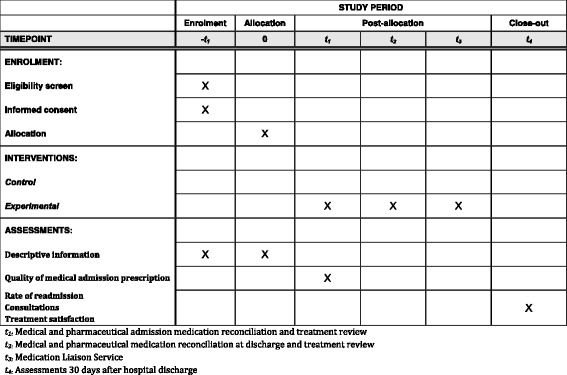
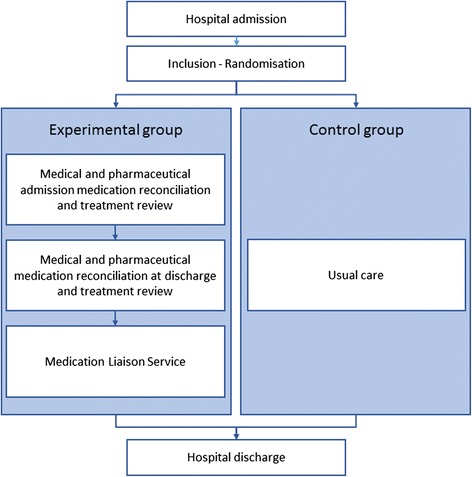
METHODS/DESIGN: The study is a randomized controlled clinical trial. A total of 1400 hospitalized patients will be randomized in two groups: (1) the experimental group (group receiving a pharmacist-led medication review) and (2) the control group (group receiving usual care). The pharmacist-led medication review process includes medication reconciliation, treatment review and medication liaison service. The primary endpoint will be the rate of readmissions and/or death at 30 days following initial hospitalization discharge. The secondary endpoints will be the rate of hospital readmission, the rate of emergency department visits, the rate of mortality, the number of consultations and patient treatment satisfaction at 30 days following initial hospitalization discharge.
A randomized controlled trial provides the most extensive evidence on the impact of pharmacist-led medication reviews on early hospital readmission for extreme age populations.
Current Controlled Trials, NCT02734017 . Registered on 4 May 2016.
患者出院后早期再次入院是一个公共卫生问题。医院再次入院的一个主要原因是社区与医院护理之间的综合路径功能失调,这可能导致药物不良事件。此外,法国ENEIS 2研究表明,2009年1.3%的住院治疗源于严重药物不良事件。在医院转诊时由药剂师主导的药物审查是在入院或出院时减少用药差异的有效手段。然而,很难评估药剂师主导的药物审查在特定高危人群(如儿科和老年人群)中的真正影响。在这种情况下,在一项大型随机对照临床试验中,证明作为标准化药物审查过程一部分的用药核对在儿科和老年人群中对全因再次入院的有效性非常重要。本研究的目的是评估药剂师主导的药物审查对出院后再次入院率和/或死亡率以及患者治疗满意度的影响。
方法/设计:该研究是一项随机对照临床试验。总共1400名住院患者将被随机分为两组:(1)实验组(接受药剂师主导的药物审查的组)和(2)对照组(接受常规护理的组)。药剂师主导的药物审查过程包括用药核对、治疗审查和药物联络服务。主要终点将是首次住院出院后30天的再次入院率和/或死亡率。次要终点将是首次住院出院后30天的医院再入院率、急诊就诊率、死亡率、会诊次数和患者治疗满意度。
随机对照试验提供了关于药剂师主导的药物审查对极端年龄人群早期医院再入院影响的最广泛证据。
当前受控试验,NCT02734017。于2016年5月4日注册。