Salomon Sarah, Guignant Caroline, Morel Pierre, Flahaut Gauthier, Brault Clément, Gourguechon Clément, Fardellone Patrice, Marolleau Jean-Pierre, Gubler Brigitte, Goëb Vincent
Rheumatology Department & EA 4666, Amiens University Hospital, University of Picardie-Jules Verne, Amiens, France.
Immunology laboratory & EA 4666, Amiens University Hospital, University of Picardie-Jules Verne, Amiens, France.
Arthritis Res Ther. 2017 Feb 10;19(1):33. doi: 10.1186/s13075-017-1244-x.
The aim was to describe the regulatory B and T cells (Breg and Treg) and T helper 17 (Th17) lymphocytes before and under treatment with biologic drugs, and to assess their potential predictive value as biomarkers of response in rheumatoid arthritis (RA).
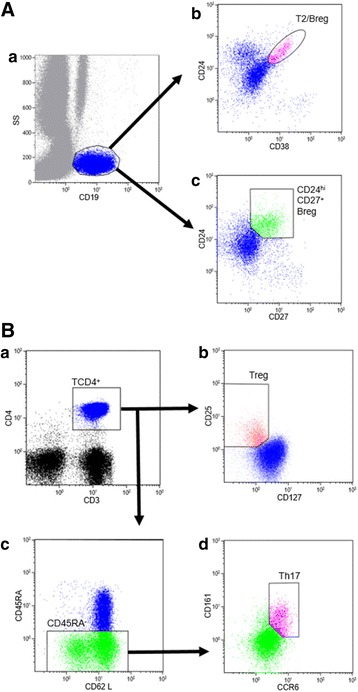
This was a non-randomised, single-centre, prospective study. Patients with active RA (American College of Rheumatology (ACR)/European League Against Rheumatism (EULAR) 2010) who required the initiation or switch to any biologic drug except rituximab were included. The main judgement criterion was the frequency and absolute number of CD24CD27 Breg and CD24CD38 T2/Breg cells, CD25CD127 Treg and CD45RACD161CCR6 Th17 cells measured at inclusion in both patients and controls, and after 1, 3 and 6 months of treatment (M1, M3 and M6) in patients with RA, and compared with the M6 response to treatment (EULAR response and Disease Activity Score in 28 joints (DAS28) remission).
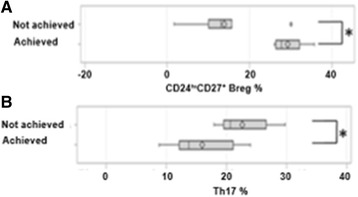
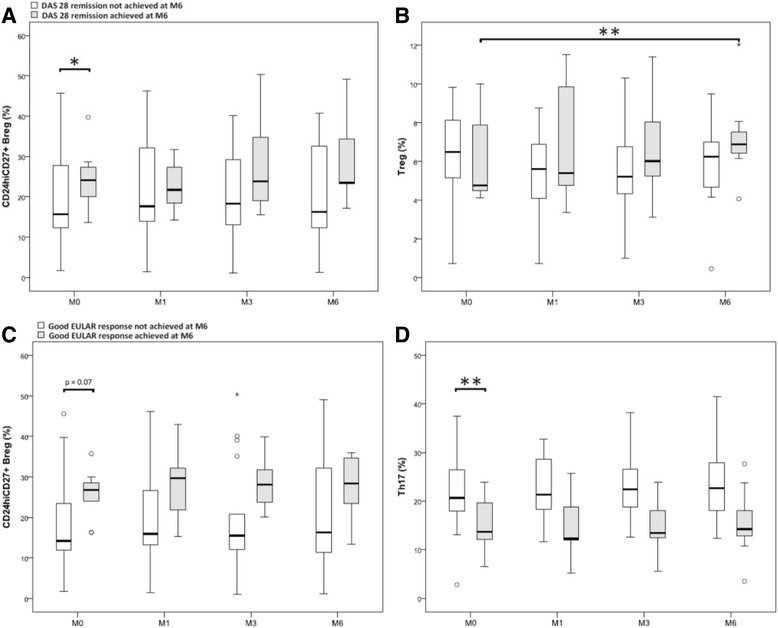
Thirty-one patients with RA and 17 controls were included. There was a reduction in T2/Breg frequency at M0 in patients (p < 0.001) and absolute numbers (p = 0.014) and in immunopositive vs. immunonegative RA (p = 0.016). DAS28 remission at M6 was associated with increased frequency of Treg (p = 0.01). A higher level of CD24CD27 Breg at baseline was associated with DAS28 remission at M6 (p = 0.04) and a good EULAR response at M6 for abatacept-treated patients (p = 0.01). A lower M0 level of Th17 was associated with a good EULAR response at M6 (p = 0.007), notably under anti-cytokine drugs (p = 0.048).
Altogether, these data, although preliminary, suggest that phenotyping of T and B cells has potential value for the stratification of biologic drugs, notably with respect to choosing between abatacept and anti-cytokine blockade.
目的是描述类风湿关节炎(RA)患者在使用生物药物治疗前及治疗期间的调节性B细胞和T细胞(Breg和Treg)以及辅助性T细胞17(Th17)淋巴细胞,并评估它们作为RA治疗反应生物标志物的潜在预测价值。
这是一项非随机、单中心的前瞻性研究。纳入了符合美国风湿病学会(ACR)/欧洲抗风湿病联盟(EULAR)2010标准的活动性RA患者,这些患者需要开始或转换使用除利妥昔单抗之外的任何生物药物。主要判断标准是在纳入研究时患者和对照中测量的CD24CD27 Breg和CD24CD38 T2/Breg细胞、CD25CD127 Treg和CD45RACD161CCR6 Th17细胞的频率和绝对数量,以及RA患者治疗1、3和6个月(M1、M3和M6)后的上述指标,并与M6时的治疗反应(EULAR反应和28个关节疾病活动评分(DAS28)缓解情况)进行比较。
纳入了31例RA患者和17名对照。患者在M0时T2/Breg频率降低(p < 0.001),绝对数量降低(p = 0.014),免疫阳性与免疫阴性RA患者之间也有差异(p = 0.016)。M6时DAS28缓解与Treg频率增加相关(p = 0.01)。基线时较高水平的CD24CD27 Breg与M6时DAS28缓解相关(p = 0.04),对于接受阿巴西普治疗的患者,与M6时良好的EULAR反应相关(p = 0.01)。M0时较低水平的Th17与M6时良好的EULAR反应相关(p = 0.007),尤其是在使用抗细胞因子药物治疗时(p = 0.048)。
总体而言,这些数据虽然是初步的,但表明T细胞和B细胞的表型分析对于生物药物的分层具有潜在价值,特别是在阿巴西普和抗细胞因子阻断治疗之间进行选择时。