Wang Yan, Li Gang, Zuo Man-Zhen, Fang Jun-Hua, Li Hai-Rong, Quan Dan-Dan, Huang Lu, Peng Ping-Ping
Department of Gynecology and Obstetrics, The People's Hospital of Three Gorges University, The First People's Hospital of Yichang, Yichang 443000, P. R. China.
Department of Neurosurgery, The People's Hospital of Three Gorges University, The First People's Hospital of Yichang, Yichang 443000, P. R. China
Biosci Rep. 2017 Mar 27;37(2). doi: 10.1042/BSR20160528. Print 2017 Apr 28.
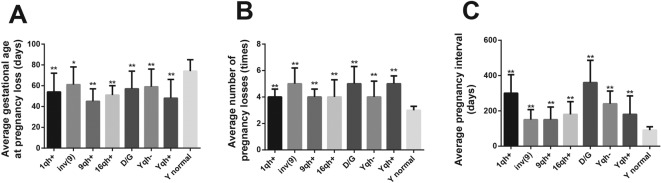
The present study aims to explore the relationship between the Y chromosome polymorphisms (1qh+, inv(9), 9qh+, 16qh+, group D/G, Yqh- and Yqh+) and the risk of unexplained recurrent miscarriage (URM). A total of 507 couples with URM were recruited as case group and 465 healthy couples as control group. The Y chromosome polymorphisms of the male individuals were analysed with the G-banding technique, and the results of the chromosome G-banding analysis were determined using the International Naming Standards of Human Genetics (ISCN). Logistic regression analysis was used to analyse the risk factors for URM. The detection rate of Y chromosome polymorphisms in the case group (12.03%) was higher than that in the control group (2.15%). Y chromosome polymorphisms were detected at significantly higher rates in the case group than in the control group. Using the normal Y chromosomes in individuals of the case group as reference, the partners of their counterparts were more likely to experience miscarriage. The couples who were Y chromosome-polymorphism carriers had shorter gestational age, increased frequency of URM and longer average interval between pregnancies. The results of logistic regression analysis revealed that Y chromosome polymorphisms, shorter gestational age, a higher frequency of miscarriage and longer pregnancy interval were independent risk factors for URM. Y chromosome polymorphisms may be associated with the risk of URM and may play an important role in the development of URM.
本研究旨在探讨Y染色体多态性(1qh +、inv(9)、9qh +、16qh +、D/G组、Yqh -和Yqh +)与不明原因复发性流产(URM)风险之间的关系。共招募了507对URM夫妇作为病例组,465对健康夫妇作为对照组。采用G显带技术分析男性个体的Y染色体多态性,并根据人类遗传学国际命名标准(ISCN)确定染色体G显带分析结果。采用逻辑回归分析URM的危险因素。病例组Y染色体多态性的检出率(12.03%)高于对照组(2.15%)。病例组Y染色体多态性的检出率显著高于对照组。以病例组个体的正常Y染色体为参照,其配偶更易发生流产。Y染色体多态性携带者夫妇的孕周较短,URM发生频率增加,平均妊娠间隔时间延长。逻辑回归分析结果显示,Y染色体多态性、较短的孕周、较高的流产频率和较长的妊娠间隔是URM的独立危险因素。Y染色体多态性可能与URM风险相关,并可能在URM的发生发展中起重要作用。