Modibbo Fatima, Iregbu K C, Okuma James, Leeman Annemiek, Kasius Annemieke, de Koning Maurits, Quint Wim, Adebamowo Clement
Department of Medical Microbiology and Parasitology, National Hospital Abuja, Plot 132 Central Business District (Phase II), PMB 425 Garki, Abuja, 90001 Nigeria.
Department of Research, Institute of Human Virology, Abuja, Nigeria.
Infect Agent Cancer. 2017 Feb 6;12:11. doi: 10.1186/s13027-017-0123-z. eCollection 2017.
Cervical cancer incidence and mortality rates in Sub-Saharan Africa (SSA) remain high due to several factors including low levels of uptake of cervical cancer screening. Self-collection of cervicovaginal samples for HPV DNA testing may be an effective modality that can increase uptake of cervical cancer screening in SSA and hard to reach populations in developed countries. We investigated whether self-collection of cervicovaginal samples for HPV DNA tests would be associated with increased uptake of screening compared with clinic based collection of samples. Furthermore, we compared the quality of samples collected by both approaches for use in HPV genotyping.
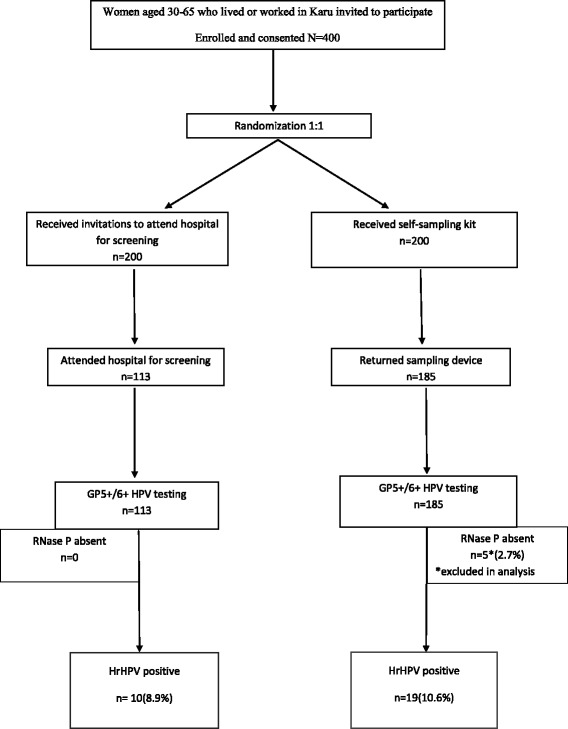
We conducted a community based randomized trial in a semi-urban district of Abuja, Nigeria with 400 women, aged 30 to 65 years randomized to either hospital-collection or self-collection of cervicovaginal samples. We compared cervical cancer screening uptake among the 2 groups and evaluated the concentration of human DNA in the samples by measuring RNase P gene levels using qPCR. High-risk HPV DNA detection and typing was done using the GP5+/6+ Luminex system.
Most participants in the self-collection arm (93%, 185/200) submitted their samples while only 56% (113/200) of those invited to the hospital for sample collection attended and were screened during the study period ( value < 0.001). Human genomic DNA was detected in all but five (1.7%) participants, all of whom were in the self-collection arm. The prevalence of high-risk HPV in the study population was 10% with types 35, 52 and 18 being the commonest.
Our study shows that self-sampling significantly increased uptake of HPV DNA based test for cervical cancer screening in this population and the samples collected were adequate for HPV detection and genotyping. Cervical cancer screening programs that incorporate self-sampling and HPV DNA tests are feasible and may significantly improve uptake of cervical cancer screening in SSA.
由于包括宫颈癌筛查接受率低在内的多种因素,撒哈拉以南非洲地区(SSA)的宫颈癌发病率和死亡率仍然很高。自行采集宫颈阴道样本进行HPV DNA检测可能是一种有效的方式,可提高SSA以及发达国家难以接触到的人群的宫颈癌筛查接受率。我们调查了与在诊所采集样本相比,自行采集宫颈阴道样本进行HPV DNA检测是否会使筛查接受率提高。此外,我们比较了两种采集方法所采集样本用于HPV基因分型的质量。
我们在尼日利亚阿布贾的一个半城市地区开展了一项基于社区的随机试验,将400名年龄在30至65岁的女性随机分为医院采集组或自行采集宫颈阴道样本组。我们比较了两组的宫颈癌筛查接受率,并通过使用qPCR测量RNase P基因水平来评估样本中的人类DNA浓度。使用GP5+/6+ Luminex系统进行高危型HPV DNA检测和分型。
自行采集组的大多数参与者(93%,185/200)提交了样本,而受邀到医院采集样本的参与者中只有56%(113/200)在研究期间前来接受了采集和筛查(P值<0.001)。除五名(1.7%)参与者外,所有参与者均检测到人类基因组DNA,这五名参与者均在自行采集组。研究人群中高危型HPV的患病率为10%,其中35型、52型和18型最为常见。
我们的研究表明,自行采样显著提高了该人群基于HPV DNA检测的宫颈癌筛查接受率,且所采集的样本足以进行HPV检测和基因分型。纳入自行采样和HPV DNA检测的宫颈癌筛查项目是可行的,可能会显著提高SSA地区的宫颈癌筛查接受率。