Gordon Siamon, Martinez-Pomares Luisa
Graduate Institute of Biomedical Sciences, College of Medicine, Chang Gung University, Taoyuan City, 33302, Taiwan.
Sir William Dunn School of Pathology, Oxford University, Oxford, UK.
Pflugers Arch. 2017 Apr;469(3-4):365-374. doi: 10.1007/s00424-017-1945-7. Epub 2017 Feb 9.
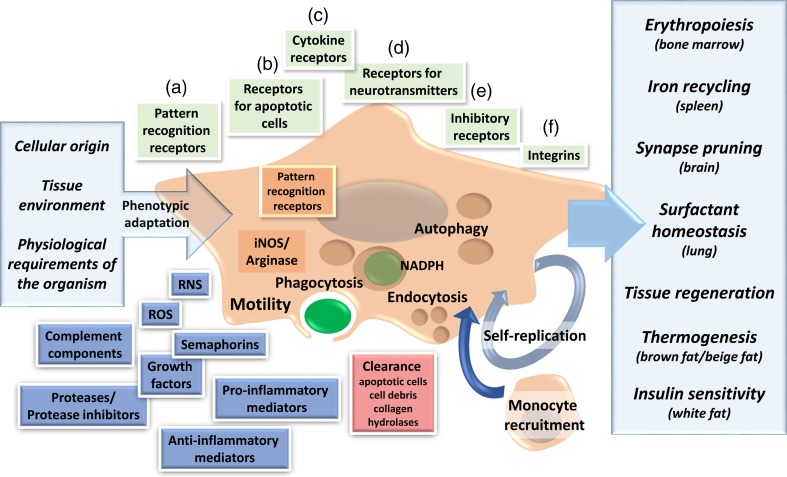
Macrophages are present in mammals from midgestation, contributing to physiologic homeostasis throughout life. Macrophages arise from yolk sac and foetal liver progenitors during embryonic development in the mouse and persist in different organs as heterogeneous, self-renewing tissue-resident populations. Bone marrow-derived blood monocytes are recruited after birth to replenish tissue-resident populations and to meet further demands during inflammation, infection and metabolic perturbations. Macrophages of mixed origin and different locations vary in replication and turnover, but are all active in mRNA and protein synthesis, fulfilling organ-specific and systemic trophic functions, in addition to host defence. In this review, we emphasise selected properties and non-immune functions of tissue macrophages which contribute to physiologic homeostasis.
巨噬细胞在哺乳动物妊娠中期出现,在整个生命过程中维持生理稳态。在小鼠胚胎发育过程中,巨噬细胞起源于卵黄囊和胎儿肝脏祖细胞,并作为异质性、自我更新的组织驻留群体存在于不同器官中。出生后,骨髓来源的血液单核细胞被招募来补充组织驻留群体,并在炎症、感染和代谢紊乱期间满足进一步需求。混合来源和不同位置的巨噬细胞在复制和更新方面存在差异,但都活跃于mRNA和蛋白质合成,除了宿主防御外,还履行器官特异性和全身营养功能。在这篇综述中,我们强调了组织巨噬细胞有助于生理稳态的特定特性和非免疫功能。