Ozawa Sachiko, Paina Ligia, Qiu Mary
Division of Practice Advancement and Clinical Education, UNC Eshelman School of Pharmacy, University of North Carolina - Chapel Hill, Chapel Hill, NC, 27599, USA.
Department of International Health, Johns Hopkins Bloomberg School of Public Health, Baltimore, MD, 21205, USA.
BMC Health Serv Res. 2016 Nov 15;16(Suppl 7):639. doi: 10.1186/s12913-016-1867-7.
Trust is critical to generate and maintain demand for vaccines in low and middle income countries. However, there is little documentation on how health system insufficiencies affect trust in vaccination and the process of re-building trust once it has been compromised. We reflect on how disruptions to immunizations systems can affect trust in vaccination and can compromise vaccine utilization. We then explore key pathways for overcoming system vulnerabilities in order to restore trust, to strengthen the resilience of health systems and communities, and to promote vaccine utilization.
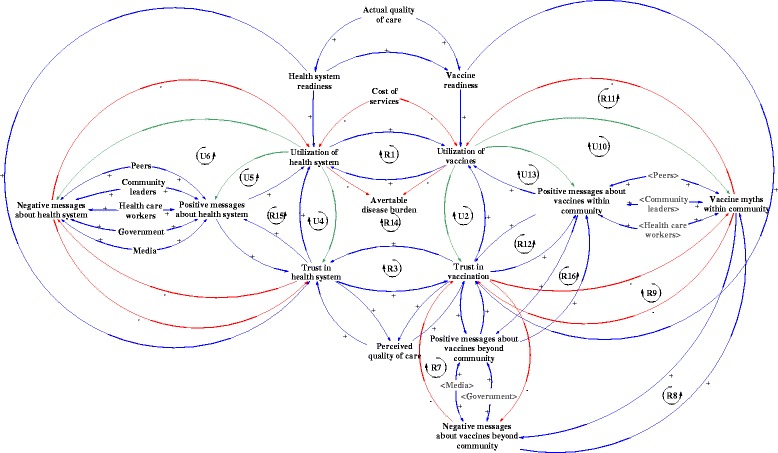
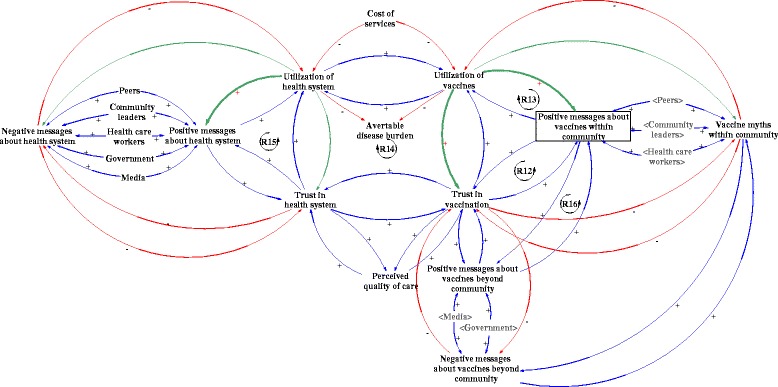
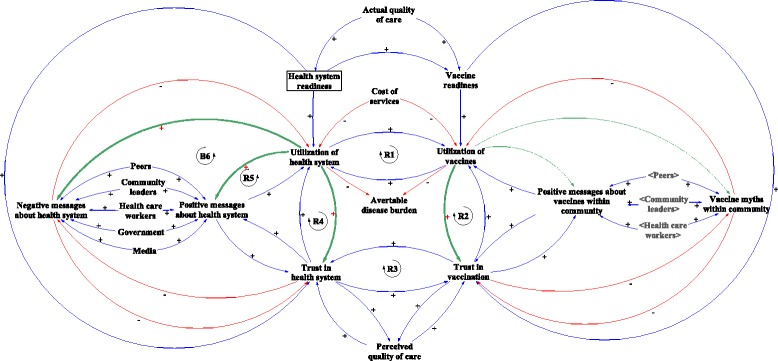
Utilizing secondary data and a review of the literature, we developed a causal loop diagram (CLD) to map the determinants of building trust in immunizations. Using the CLD, we devised three scenarios to illustrate common vulnerabilities that compromise trust and pathways to strengthen trust and utilization of vaccines, specifically looking at weak health systems, harmful communication channels, and role of social capital. Spill-over effects, interactions and other dynamics in the CLD were then examined to assess leverage points to counter these vulnerabilities.
Trust in vaccination arises from the interactions among experiences with the health system, the various forms of communication and social capital - both external and internal to communities. When experiencing system-wide shocks such as the case in Ebola-affected countries, distrust is reinforced by feedback between the health and immunization systems where distrust often lingers even after systems are restored and spills over beyond vaccination in the broader health system. Vaccine myths or anti-vaccine movements reinforce distrust. Social capital - the collective value of social networks of community members - plays a central role in increasing levels of trust.
Trust is important, yet underexplored, in the context of vaccine utilization. Using a CLD to illustrate various scenarios helped to explore how common health and vaccine vulnerabilities can reinforce and spill over distrust through vicious, reinforcing feedback. Restoring trust requires a careful balance between eliminating vulnerabilities and strengthening social capital and interactions among communication channels.
信任对于在低收入和中等收入国家产生和维持疫苗需求至关重要。然而,关于卫生系统不足如何影响对疫苗接种的信任以及信任受损后重建信任的过程,几乎没有文献记载。我们思考免疫接种系统的中断如何影响对疫苗接种的信任并损害疫苗的使用。然后,我们探索克服系统脆弱性的关键途径,以恢复信任、增强卫生系统和社区的复原力并促进疫苗使用。
利用二手数据和文献综述,我们绘制了一个因果循环图(CLD)来描绘建立对免疫接种信任的决定因素。使用该因果循环图,我们设计了三种情景,以说明损害信任的常见脆弱性以及加强信任和疫苗使用的途径,特别关注薄弱的卫生系统、有害的沟通渠道和社会资本的作用。然后检查因果循环图中的溢出效应、相互作用和其他动态,以评估应对这些脆弱性的杠杆点。
对疫苗接种的信任源于与卫生系统的经历、各种形式的沟通以及社区内外的社会资本之间的相互作用。当经历埃博拉疫情影响国家那样的全系统冲击时,卫生系统和免疫接种系统之间的反馈会加剧不信任,即使在系统恢复后,不信任往往仍然存在,并在更广泛的卫生系统中蔓延到疫苗接种之外。疫苗谣言或反疫苗运动加剧了不信任。社会资本——社区成员社会网络的集体价值——在提高信任水平方面发挥着核心作用。
在疫苗使用的背景下,信任很重要,但尚未得到充分探索。使用因果循环图来说明各种情景有助于探讨常见的卫生和疫苗脆弱性如何通过恶性循环、强化反馈来加剧和蔓延不信任。恢复信任需要在消除脆弱性与加强社会资本以及沟通渠道之间的相互作用之间谨慎平衡。