• 文献检索
  • 文档翻译
  • 深度研究
  • 学术资讯
  • Suppr Zotero 插件Zotero 插件
  • 邀请有礼
  • 套餐&价格
  • 历史记录
应用&插件
Suppr Zotero 插件Zotero 插件浏览器插件Mac 客户端Windows 客户端微信小程序
定价
高级版会员购买积分包购买API积分包
服务
文献检索文档翻译深度研究API 文档MCP 服务
关于我们
关于 Suppr公司介绍联系我们用户协议隐私条款
关注我们

Suppr 超能文献

核心技术专利:CN118964589B侵权必究
粤ICP备2023148730 号-1Suppr @ 2026

文献检索

告别复杂PubMed语法,用中文像聊天一样搜索,搜遍4000万医学文献。AI智能推荐,让科研检索更轻松。

立即免费搜索

文件翻译

保留排版,准确专业,支持PDF/Word/PPT等文件格式,支持 12+语言互译。

免费翻译文档

深度研究

AI帮你快速写综述,25分钟生成高质量综述,智能提取关键信息,辅助科研写作。

立即免费体验

在生命的最后几周从姑息治疗患者身上收集生物材料:一项可行性研究。

Collecting biological material from palliative care patients in the last weeks of life: a feasibility study.

作者信息

Coyle Séamus, Scott Aileen, Nwosu Amara Callistus, Latten Richard, Wilson James, Mayland Catriona R, Mason Stephen, Probert Chris, Ellershaw John

机构信息

Marie Curie Palliative Care Institute Liverpool, University of Liverpool, Liverpool, UK.

Marie Curie Hospice Liverpool, Liverpool, UK.

出版信息

BMJ Open. 2016 Nov 10;6(11):e011763. doi: 10.1136/bmjopen-2016-011763.

DOI:10.1136/bmjopen-2016-011763
PMID:28186928
原文链接:https://pmc.ncbi.nlm.nih.gov/articles/PMC5128854/
Abstract

OBJECTIVE

To assess the feasibility of prospectively collecting biological samples (urine) from palliative care patients in the last weeks of life.

SETTING

A 30-bedded specialist hospice in the North West of England.

PARTICIPANTS

Participants were adults with a diagnosis of advanced disease and able to provide written informed consent.

METHOD

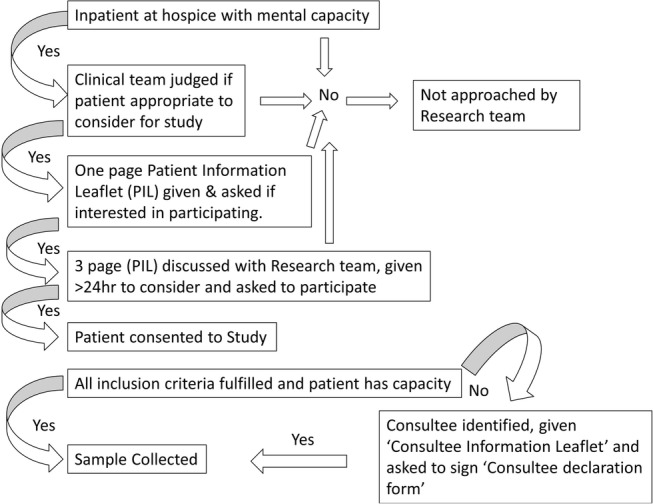
Potential participants were identified by a senior clinician over a 12-week period in 2014. They were then approached by a researcher and invited to participate according to a developed recruitment protocol.

OUTCOMES

Feasibility targets included a recruitment rate of 50%, with successful collection of samples from 80% who consented.

RESULTS

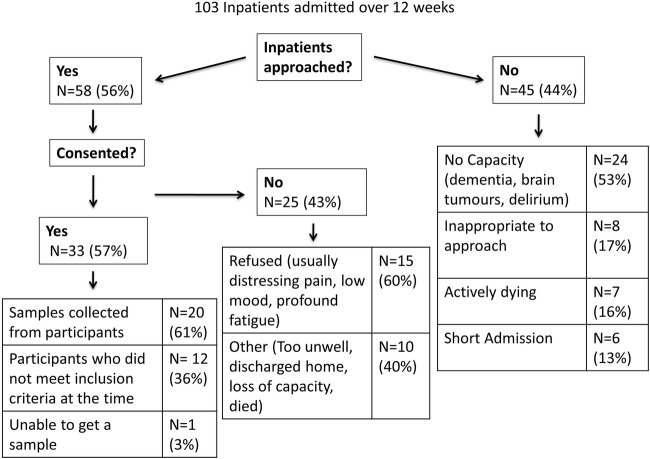
A total of 58 patients were approached and 33 consented (57% recruitment rate). Twenty-five patients (43%) were unable to participate or declined; 10 (17%) became unwell, too fatigued, lost capacity, died or were discharged home; and 15 (26%) refused, usually these patients had distressing pain, low mood or profound fatigue. From the 33 recruited, 20 participants provided 128 separate urine samples, 12 participants did not meet the inclusion criteria at the time of consent and 1 participant was unable to provide a sample. The criterion for a urinary catheter was removed for the latter 6 weeks. The collection rate during the first 6 weeks was 29% and 93% for the latter 6 weeks. Seven people died while the study was ongoing, and another 4 participants died in the following 4 weeks.

CONCLUSIONS

It is possible to recruit and collect multiple biological samples over time from palliative care patients in the last weeks and days of life even if they have lost capacity. Research into the biological changes at the end of life could develop a greater understanding of the biology of the dying process. This may lead to improved prognostication and care of patients towards the end of life.

摘要

目的

评估在临终前几周前瞻性收集姑息治疗患者生物样本(尿液)的可行性。

背景

英格兰西北部一家拥有30张床位的专科临终关怀医院。

参与者

参与者为被诊断患有晚期疾病且能够提供书面知情同意书的成年人。

方法

2014年,一名资深临床医生在12周内识别出潜在参与者。随后,一名研究人员与他们联系,并根据制定的招募方案邀请他们参与。

结果

可行性目标包括招募率达到50%,且从80%同意的参与者中成功收集样本。

结果

总共接触了58名患者,33名同意参与(招募率为57%)。25名患者(43%)无法参与或拒绝;10名(17%)病情恶化、过于疲劳、失去行为能力、死亡或出院回家;15名(26%)拒绝,通常这些患者有剧痛、情绪低落或极度疲劳。在招募的33名患者中,20名参与者提供了128份单独的尿液样本,12名参与者在同意时不符合纳入标准,1名参与者无法提供样本。在最后6周取消了导尿管标准。前6周的收集率为29%,后6周为93%。7人在研究进行期间死亡,另有4名参与者在接下来的4周内死亡。

结论

即使临终关怀患者已失去行为能力,也有可能在生命的最后几周和几天内随着时间推移招募并收集多个生物样本。对生命末期生物变化的研究有助于更深入地了解死亡过程的生物学机制。这可能会改善对临终患者的预后评估和护理。
https://cdn.ncbi.nlm.nih.gov/pmc/blobs/468f/5128854/16308f726c83/bmjopen2016011763f02.jpg
https://cdn.ncbi.nlm.nih.gov/pmc/blobs/468f/5128854/15b6b3ba87f2/bmjopen2016011763f01.jpg
https://cdn.ncbi.nlm.nih.gov/pmc/blobs/468f/5128854/16308f726c83/bmjopen2016011763f02.jpg
https://cdn.ncbi.nlm.nih.gov/pmc/blobs/468f/5128854/15b6b3ba87f2/bmjopen2016011763f01.jpg
https://cdn.ncbi.nlm.nih.gov/pmc/blobs/468f/5128854/16308f726c83/bmjopen2016011763f02.jpg

相似文献

1
Collecting biological material from palliative care patients in the last weeks of life: a feasibility study.在生命的最后几周从姑息治疗患者身上收集生物材料:一项可行性研究。
BMJ Open. 2016 Nov 10;6(11):e011763. doi: 10.1136/bmjopen-2016-011763.
2
Palliative care experiences of adult cancer patients from ethnocultural groups: a qualitative systematic review protocol.不同种族文化群体成年癌症患者的姑息治疗体验:一项定性系统评价方案
JBI Database System Rev Implement Rep. 2015 Jan;13(1):99-111. doi: 10.11124/jbisrir-2015-1809.
3
Feasibility of a rural palliative supportive service.农村姑息支持服务的可行性
Rural Remote Health. 2015 Apr-Jun;15(2):3116. Epub 2015 May 4.
4
Is palliative care support associated with better quality end-of-life care indicators for patients with advanced cancer? A retrospective cohort study.姑息治疗支持是否与晚期癌症患者更好的临终关怀质量指标相关?一项回顾性队列研究。
BMJ Open. 2018 Jan 31;8(1):e018284. doi: 10.1136/bmjopen-2017-018284.
5
Parents' perspective on symptoms, quality of life, characteristics of death and end-of-life decisions for children dying from cancer.父母对患癌濒死儿童的症状、生活质量、死亡特征及临终决策的看法。
Klin Padiatr. 2008 May-Jun;220(3):166-74. doi: 10.1055/s-2008-1065347.
6
Older adults' attitudes to death, palliative treatment and hospice care.老年人对死亡、姑息治疗和临终关怀的态度。
Palliat Med. 2005 Jul;19(5):402-10. doi: 10.1191/0269216305pm1037oa.
7
Novel Augmentation Strategies in Major Depression.重度抑郁症的新型强化治疗策略
Dan Med J. 2017 Apr;64(4).
8
Palliative care for patients with advanced fibrotic lung disease: a randomised controlled phase II and feasibility trial of a community case conference intervention.晚期纤维化肺疾病患者的姑息治疗:社区病例会议干预的随机对照二期和可行性试验。
Thorax. 2015 Sep;70(9):830-9. doi: 10.1136/thoraxjnl-2014-206583. Epub 2015 Jun 23.
9
The utilization of palliative care in gynecologic oncology patients near the end of life.在妇科肿瘤患者生命末期对姑息治疗的利用。
Gynecol Oncol. 2012 Oct;127(1):175-9. doi: 10.1016/j.ygyno.2012.06.025. Epub 2012 Jun 24.
10
Exercise therapy for chronic fatigue syndrome.慢性疲劳综合征的运动疗法
Cochrane Database Syst Rev. 2015 Feb 10(2):CD003200. doi: 10.1002/14651858.CD003200.pub3.

引用本文的文献

1
Urinary metabolite model to predict the dying process in lung cancer patients.预测肺癌患者死亡过程的尿液代谢物模型。
Commun Med (Lond). 2025 Feb 27;5(1):49. doi: 10.1038/s43856-025-00764-3.
2
Understanding barriers and facilitators to palliative and end-of-life care research: a mixed method study of generalist and specialist health, social care, and research professionals.理解姑息治疗和临终关怀研究的障碍和促进因素:一项针对全科和专科卫生、社会保健以及研究专业人员的混合方法研究。
BMC Palliat Care. 2024 Jun 25;23(1):159. doi: 10.1186/s12904-024-01488-2.
3
In old anticoagulated patients with mild traumatic brain injury, a 24-h observation period should not be recommended without evidence of a clear benefit: a retrospective study of delayed hemorrhagic versus iatrogenic complications.

本文引用的文献

1
Patients want to be involved in end-of-life care research.
BMJ Support Palliat Care. 2013 Dec;3(4):457. doi: 10.1136/bmjspcare-2013-000537. Epub 2013 Jul 23.
2
The challenges of uncertainty and interprofessional collaboration in palliative care for non-cancer patients in the community: a systematic review of views from patients, carers and health-care professionals.社区非癌症患者姑息治疗中不确定性和跨专业协作的挑战:对患者、护理人员和医疗保健专业人员观点的系统评价
Palliat Med. 2014 Oct;28(9):1081-98. doi: 10.1177/0269216314531999. Epub 2014 May 12.
3
Factors affecting recruitment to an observational multicentre palliative care study.影响一项多中心姑息治疗观察性研究招募工作的因素。
在陈旧性抗凝治疗且合并轻度创伤性脑损伤的患者中,若无明确获益证据,不推荐常规行 24 小时观察:延迟性出血与医源性并发症的回顾性研究。
Intern Emerg Med. 2024 Mar;19(2):523-534. doi: 10.1007/s11739-023-03435-0. Epub 2023 Oct 9.
4
GC-MS Techniques Investigating Potential Biomarkers of Dying in the Last Weeks with Lung Cancer.GC-MS 技术研究肺癌患者最后几周死亡的潜在生物标志物。
Int J Mol Sci. 2023 Jan 13;24(2):1591. doi: 10.3390/ijms24021591.
5
Identification of Digital Health Priorities for Palliative Care Research: Modified Delphi Study.确定姑息治疗研究的数字健康优先事项:改良德尔菲研究
JMIR Aging. 2022 Mar 21;5(1):e32075. doi: 10.2196/32075.
BMJ Support Palliat Care. 2013 Sep;3(3):318-23. doi: 10.1136/bmjspcare-2012-000396. Epub 2013 Jan 7.
4
Development of prognosis in palliative care study (PiPS) predictor models to improve prognostication in advanced cancer: prospective cohort study.姑息治疗研究预后(PiPS)预测模型的开发,以改善晚期癌症的预后:前瞻性队列研究。
BMJ. 2011 Aug 25;343:d4920. doi: 10.1136/bmj.d4920.
5
Formal feasibility studies in palliative care: why they are important and how to conduct them.姑息治疗中的正式可行性研究:为什么它们很重要以及如何进行。
J Pain Symptom Manage. 2011 Aug;42(2):278-89. doi: 10.1016/j.jpainsymman.2010.11.015. Epub 2011 Mar 27.
6
Interleukin-2 as a neuromodulator possibly implicated in the physiopathology of sudden infant death syndrome.白细胞介素-2作为一种神经调节剂,可能与婴儿猝死综合征的生理病理学有关。
Neurosci Lett. 2010 Aug 16;480(2):122-6. doi: 10.1016/j.neulet.2010.06.021. Epub 2010 Jun 11.
7
Identifying, recruiting, and retaining seriously-ill patients and their caregivers in longitudinal research.在纵向研究中识别、招募并留住重症患者及其照顾者。
Palliat Med. 2006 Dec;20(8):745-54. doi: 10.1177/0269216306073112.
8
Hospice patients' views on research in palliative care.临终关怀患者对姑息治疗研究的看法。
Intern Med J. 2006 Jul;36(7):406-13. doi: 10.1111/j.1445-5994.2006.01078.x.
9
Terminal care: the last weeks of life.临终关怀:生命的最后几周。
J Palliat Med. 2005 Oct;8(5):1042-54. doi: 10.1089/jpm.2005.8.1042.
10
Novel consent process for research in dying patients unable to give consent.针对无法给出同意的临终患者的新型研究同意程序。
BMJ. 2003 Jul 26;327(7408):198. doi: 10.1136/bmj.327.7408.198.