Li Mengjiao, Li Haoran, Liu Fei, Bi Rui, Tu Xiaoyu, Chen Lihua, Ye Shuang, Cheng Xi
Department of Gynecologic Oncology, Fudan University Shanghai Cancer Center, 270 Dong-an Road, Shanghai, 200032, China.
Department of Oncology, Shanghai Medical College, Fudan University, Shanghai, 200032, China.
J Ovarian Res. 2017 Feb 10;10(1):9. doi: 10.1186/s13048-017-0304-9.
It has long been appreciated that different subtypes (serous, clear cell, endometrioid and mucinous) of epithelial ovarian carcinoma (EOC) have distinct pathogenetic pathways. However, clinical management, especially chemotherapeutic regimens, for EOC patients is not subtype specific. Ovarian clear cell carcinoma (CCC) is a rare histological subtype of EOC, which exhibits high rates of recurrence and low chemosensitivity. We assessed potential therapeutic targets for ovarian CCC patients through analyzing the variation of drug-based molecular biomarkers expression between ovarian CCC and high-grade serous carcinoma (HGSC).
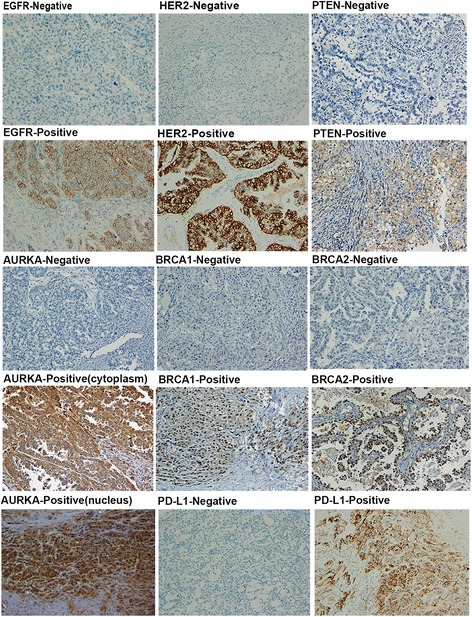
Seven candidate drug-based molecular biomarkers, human epidermal growth factor receptor (EGFR), human epidermal growth factor receptor-2 (HER2), phosphatase and tensin homolog deleted on chromosome ten (PTEN), aurora kinase A (AURKA), breast cancer susceptibility gene 1 (BRCA1), breast cancer susceptibility gene 2 (BRCA2) and programmed death-ligand 1 (PD-L1) were measured in 96 ovarian CCC and 113 HGSC by immunohistochemistry in paraffin embedded tissues. The relationship between these biomarkers and clinicopathological factors were explored.
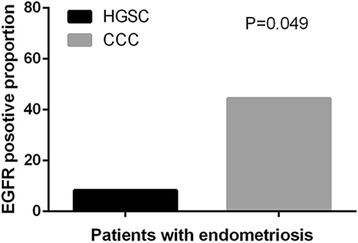
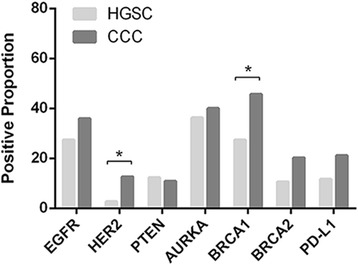
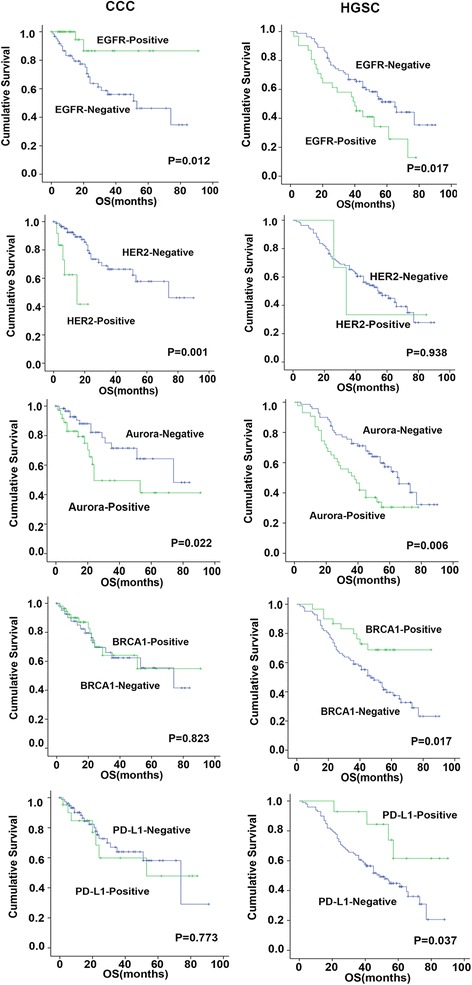
The expression level of four of the seven drug-based molecular biomarkers was markedly different between HGSC and CCC. High expression levels of HER2 and PD-L1 were more commonly observed in CCC patients (12.6% vs 2.7%, 21.1% vs 11.6%, P = 0.006, 0.064, respectively), while loss of BRCA1 and BRCA2 expression were more frequently occurred in HGSC patients (72.6% vs 54.3%, 89.4% vs 79.8%, P = 0.007, 0.054, respectively). Survival analysis showed that five of seven biomarkers had prognostic values but varied between subtypes. Furthermore, EGFR expressed frequently in CCC patients with endometriosis than in HGSC patients (44.4% vs 8.3%, P = 0.049). AURKA and PD-L1 correlated with the resistance to platinum-based chemotherapy in CCC patients (P = 0.043, 0.028, respectively) while no similar results were observed in HGSC patients.
Ovarian CCC showed a markedly different expression map of drug-based molecular biomarkers from HGSC, which suggested a new personalized target therapy in this rare subtype.
长期以来,人们认识到上皮性卵巢癌(EOC)的不同亚型(浆液性、透明细胞、子宫内膜样和黏液性)具有不同的致病途径。然而,EOC患者的临床管理,尤其是化疗方案,并非亚型特异性的。卵巢透明细胞癌(CCC)是EOC的一种罕见组织学亚型,其复发率高且化疗敏感性低。我们通过分析卵巢CCC与高级别浆液性癌(HGSC)之间基于药物的分子生物标志物表达的差异,评估卵巢CCC患者的潜在治疗靶点。
通过对石蜡包埋组织进行免疫组织化学检测,在96例卵巢CCC和113例HGSC中测量了7种基于药物的候选分子生物标志物,即人表皮生长因子受体(EGFR)、人表皮生长因子受体2(HER2)、10号染色体上缺失的磷酸酶和张力蛋白同源物(PTEN)、极光激酶A(AURKA)、乳腺癌易感基因1(BRCA1)、乳腺癌易感基因2(BRCA2)和程序性死亡配体1(PD-L1)。探讨了这些生物标志物与临床病理因素之间的关系。
7种基于药物的分子生物标志物中有4种在HGSC和CCC之间的表达水平存在显著差异。HER2和PD-L1的高表达在CCC患者中更常见(分别为12.6%对2.7%,21.1%对11.6%,P = 0.006,0.064),而BRCA1和BRCA2表达缺失在HGSC患者中更频繁出现(分别为72.6%对54.3%,89.4%对79.8%,P = 0.007,0.054)。生存分析表明,7种生物标志物中有5种具有预后价值,但在不同亚型之间有所不同。此外,EGFR在患有子宫内膜异位症的CCC患者中的表达频率高于HGSC患者(44.4%对8.3%,P = 0.049)。AURKA和PD-L1与CCC患者对铂类化疗的耐药性相关(分别为P = 0.043,0.028),而在HGSC患者中未观察到类似结果。
卵巢CCC显示出与HGSC明显不同的基于药物的分子生物标志物表达图谱,这表明在这种罕见亚型中可采用新的个性化靶向治疗。