Kramer Daniel B, Tsai Timothy, Natarajan Poorna, Tewksbury Elise, Mitchell Susan L, Travison Thomas G
Hebrew SeniorLife Institute for Aging Research, Boston, MA
Harvard Medical School, Boston, MA.
J Am Heart Assoc. 2017 Feb 10;6(2):e004659. doi: 10.1161/JAHA.116.004659.
This study aimed to demonstrate the feasibility of measuring frailty in patients with cardiac implantable electrical devices while validating the physiologic significance of device-detected physical activity by evaluating its association with frailty and mobility.
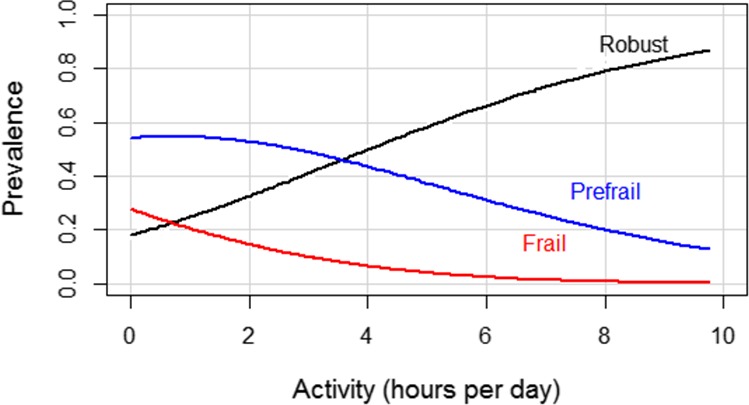
Outpatients with cardiac implantable electrical devices compatible with physical activity analysis with at least 7 days of data were eligible. Office testing included frailty status (Study of Osteoporotic Fractures instrument), gait speed (m/s), mobility according to the Timed Up and Go (TUG) test (seconds), and daily physical activity (h/d) as measured by cardiac implantable electrical device. Among 219 patients, Study of Osteoporotic Fractures testing found 39.7% to be robust, 47.5% prefrail, and 12.8% frail. The mean gait speed for the cohort was 0.8±0.3 m/s, mean TUG time was 10.9±4.4 seconds, and mean activity was 2.8±1.9 h/d. Frail patients were markedly more likely to have gait speeds <0.8 m/s (OR 6.25, 95% CI 1.79-33.3). In unadjusted analyses each 1-hour increase in mean daily activity was associated with a 46% reduction of frail phenotype (OR 0.54, 95% CI 0.40-0.74) versus robust and with a 27% reduction in the odds of having the prefrail phenotype (OR 0.73, 95% CI 0.62-0.86). After adjustment this association per hour of activity persisted, with an adjusted OR for frailty of 0.71 (95% CI 0.51-0.99) and adjusted OR for prefrailty of 0.81 (95% CI 0.67-0.99).
Frailty and mobility limitation are common among cardiac implantable electrical device patients and are correlated to device-detected physical activity.
本研究旨在证明在心脏植入式电子设备患者中测量衰弱的可行性,同时通过评估其与衰弱和活动能力的关联来验证设备检测到的身体活动的生理意义。
符合条件的门诊患者需植入可进行身体活动分析且至少有7天数据的心脏植入式电子设备。门诊测试包括衰弱状态(骨质疏松性骨折研究工具)、步速(米/秒)、根据定时起立行走测试(TUG)得出的活动能力(秒)以及心脏植入式电子设备测量的每日身体活动量(小时/天)。在219名患者中,骨质疏松性骨折研究测试发现39.7%为强健,47.5%为衰弱前期,12.8%为衰弱。该队列的平均步速为0.8±0.3米/秒,平均TUG时间为10.9±4.4秒,平均活动量为2.8±1.9小时/天。衰弱患者步速<0.8米/秒的可能性显著更高(比值比6.25,95%置信区间1.79 - 33.3)。在未调整分析中,平均每日活动量每增加1小时,与强健患者相比,衰弱表型的减少率为46%(比值比0.54,95%置信区间0.40 - 0.74),与衰弱前期表型的比值比降低27%(比值比0.73,95%置信区间0.62 - 0.86)。调整后,每小时活动量与衰弱的关联持续存在,衰弱的调整后比值比为0.71(95%置信区间0.51 - 0.99),衰弱前期的调整后比值比为0.81(95%置信区间0.67 - 0.99)。
衰弱和活动能力受限在心脏植入式电子设备患者中很常见,且与设备检测到的身体活动相关。