Hirata Makoto, Nagai Akiko, Kamatani Yoichiro, Ninomiya Toshiharu, Tamakoshi Akiko, Yamagata Zentaro, Kubo Michiaki, Muto Kaori, Kiyohara Yutaka, Mushiroda Taisei, Murakami Yoshinori, Yuji Koichiro, Furukawa Yoichi, Zembutsu Hitoshi, Tanaka Toshihiro, Ohnishi Yozo, Nakamura Yusuke, Matsuda Koichi
Laboratory of Genome Technology, Institute of Medical Science, The University of Tokyo, Tokyo, Japan.
Department of Public Policy, Institute of Medical Science, The University of Tokyo, Tokyo, Japan.
J Epidemiol. 2017 Mar;27(3S):S22-S28. doi: 10.1016/j.je.2016.12.006. Epub 2017 Feb 10.
We established a patient-oriented biobank, BioBank Japan, with information on approximately 200,000 patients, suffering from any of 47 common diseases. This follow-up survey focused on 32 diseases, potentially associated with poor vital prognosis, and collected patient survival information, including cause of death. We performed a survival analysis for all subjects to get an overview of BioBank Japan follow-up data.
A total of 141,612 participants were included. The survival data were last updated in 2014. Kaplan-Meier survival analysis was performed after categorizing subjects according to sex, age group, and disease status. Relative survival rates were estimated using a survival-rate table of the Japanese general population.
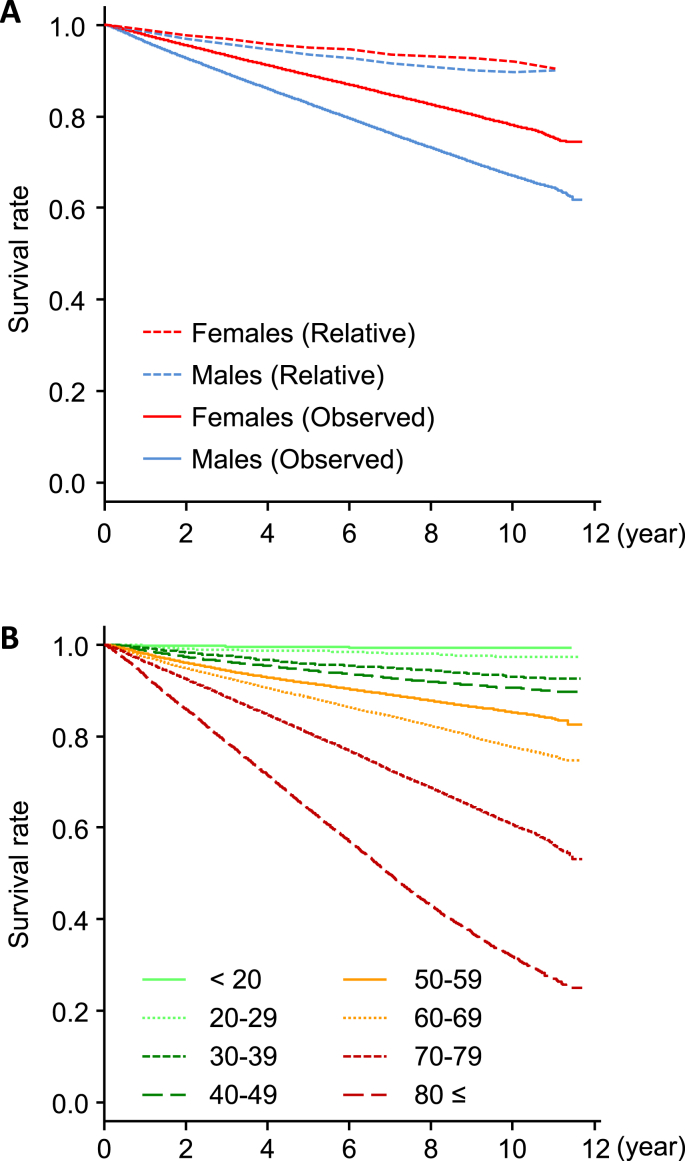
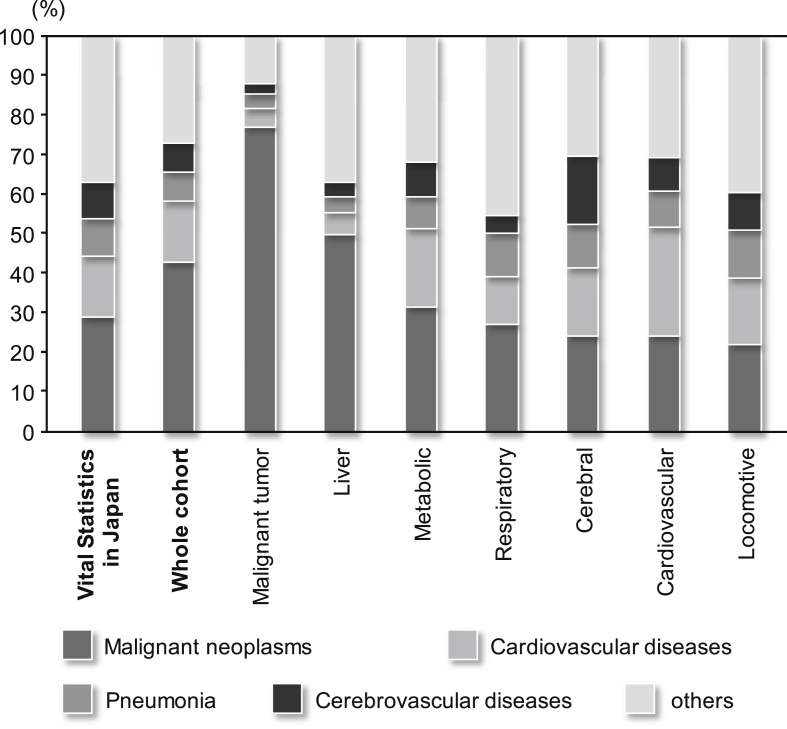
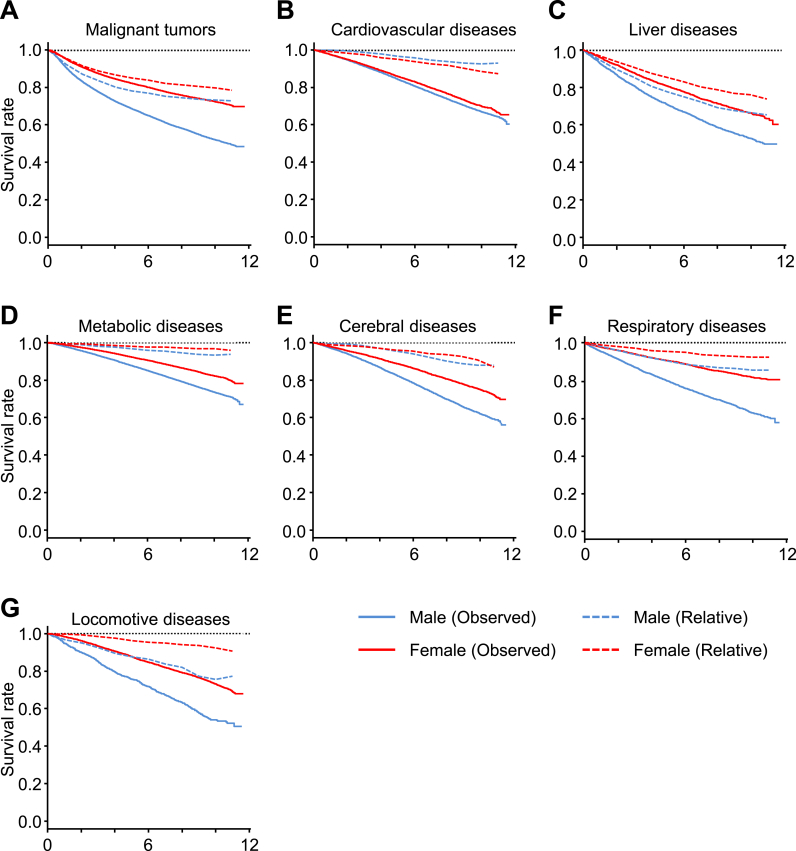
Of 141,612 subjects (56.48% male) with 1,087,434 person-years and a 97.0% follow-up rate, 35,482 patients died during follow-up. Mean age at enrollment was 64.24 years for male subjects and 63.98 years for female subjects. The 5-year and 10-year relative survival rates for all subjects were 0.944 and 0.911, respectively, with a median follow-up duration of 8.40 years. Patients with pancreatic cancer had the least favorable prognosis (10-year relative survival: 0.184) and patients with dyslipidemia had the most favorable prognosis (1.013). The most common cause of death was malignant neoplasms. A number of subjects died from diseases other than their registered disease(s).
This is the first report to perform follow-up survival analysis across various common diseases. Further studies should use detailed clinical and genomic information to identify predictors of mortality in patients with common diseases, contributing to the implementation of personalized medicine.
我们建立了一个以患者为导向的生物样本库——日本生物样本库,其中包含约20万名患有47种常见疾病中任何一种疾病的患者的信息。这项随访调查聚焦于32种可能与不良生命预后相关的疾病,并收集了患者的生存信息,包括死亡原因。我们对所有受试者进行了生存分析,以全面了解日本生物样本库的随访数据。
共纳入141,612名参与者。生存数据的最后更新时间为2014年。在根据性别、年龄组和疾病状态对受试者进行分类后,进行了Kaplan-Meier生存分析。使用日本普通人群的生存率表估计相对生存率。
在141,612名受试者(男性占56.48%)中,随访人年数为1,087,434人年,随访率为97.0%,35,482名患者在随访期间死亡。男性受试者的入组平均年龄为64.24岁,女性受试者为63.98岁。所有受试者的5年和10年相对生存率分别为0.944和0.911,中位随访时间为8.40年。胰腺癌患者的预后最差(10年相对生存率:0.184),血脂异常患者的预后最好(1.013)。最常见的死亡原因是恶性肿瘤。许多受试者死于其登记疾病以外的疾病。
这是首份对多种常见疾病进行随访生存分析的报告。进一步的研究应利用详细的临床和基因组信息来确定常见疾病患者的死亡预测因素,为个性化医疗的实施做出贡献。