Nakamura Koshi, Okada Emiko, Ukawa Shigekazu, Hirata Makoto, Nagai Akiko, Yamagata Zentaro, Kiyohara Yutaka, Muto Kaori, Kamatani Yoichiro, Ninomiya Toshiharu, Matsuda Koichi, Kubo Michiaki, Nakamura Yusuke, Tamakoshi Akiko
Department of Public Health, Hokkaido University Graduate School of Medicine, Sapporo, Japan.
Laboratory of Genome Technology, Institute of Medical Science, The University of Tokyo, Tokyo, Japan.
J Epidemiol. 2017 Mar;27(3S):S58-S64. doi: 10.1016/j.je.2016.12.009. Epub 2017 Feb 20.
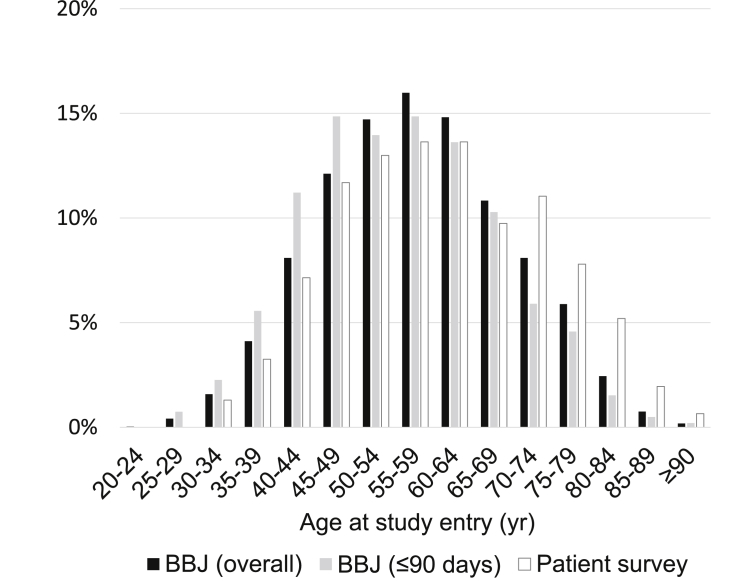
Breast cancer is currently the most common type of cancer in Japanese females. Unlike most other types of cancer, breast cancer develops more frequently in middle-aged females than in elderly females.
Of all Japanese female breast cancer patients aged ≥20 years whom the BioBank Japan Project originally enrolled between 2003 and 2008, 2034 were registered within 90 days after their diagnosis. We described the lifestyle and clinical characteristics of these patients at study entry. Furthermore, we examined the effect of these characteristics on all-cause mortality.
In the female patients registered within 90 days after diagnosis, the frequency of stage 0 or unclassified, stage I, II, III and IV were 11.4%, 47.9%, 37.0%, 2.9% and 0.8%, respectively. The proportion of histological types was 12.9% for non-invasive carcinoma (ductal carcinoma and lobular carcinoma), 81.0% for invasive carcinoma (papillotubular carcinoma, solid tubular carcinoma, scirrhous carcinoma and special types), 0.2% for Paget's diseases and 5.8% for others. Those positive for the estrogen and progesterone receptors accounted for 75.8% and 62.1% of all patients, respectively. Among 1860 female participants registered within 90 days, 218 participants died during 144,54 person-years of follow-up. More advanced stage, elevation of serum carcinoembryonic antigen and carbohydrate antigen 15-3 levels and absence of the estrogen receptor at study entry were crudely associated with an increased risk of all-cause mortality after adjustment for age.
This study showed the association of several clinical characteristics with all-cause mortality in female breast cancer patients.
乳腺癌是目前日本女性中最常见的癌症类型。与大多数其他类型的癌症不同,乳腺癌在中年女性中比在老年女性中更频繁地发生。
在日本生物样本库项目于2003年至2008年最初纳入的所有年龄≥20岁的日本女性乳腺癌患者中,2034例在诊断后90天内进行了登记。我们描述了这些患者在研究入组时的生活方式和临床特征。此外,我们研究了这些特征对全因死亡率的影响。
在诊断后90天内登记的女性患者中,0期或未分类、I期、II期、III期和IV期的频率分别为11.4%、47.9%、37.0%、2.9%和0.8%。组织学类型的比例为:非浸润性癌(导管癌和小叶癌)占12.9%,浸润性癌(乳头管状癌、实体管状癌、硬癌和特殊类型)占81.0%,佩吉特病占0.2%,其他占5.8%。雌激素受体和孕激素受体阳性的患者分别占所有患者的75.8%和62.1%。在90天内登记的1860名女性参与者中,218名参与者在14454人年的随访期间死亡。在调整年龄后,更晚期、血清癌胚抗原和糖类抗原15-3水平升高以及研究入组时无雌激素受体与全因死亡率增加粗略相关。
本研究显示了女性乳腺癌患者的几种临床特征与全因死亡率之间的关联。