Kojima Naoki, Koido Masaru, He Yunye, Shimmori Yuka, Hachiya Tsuyoshi, Japan BioBank, Debette Stéphanie, Kamatani Yoichiro
Laboratory of Complex Trait Genomics, Department of Computational Biology and Medical Sciences, Graduate School of Frontier Sciences, The University of Tokyo, Tokyo, Japan.
Bordeaux Population Health Research Center, University of Bordeaux, Inserm, UMR 1219, Bordeaux, France.
medRxiv. 2024 Jun 17:2024.06.17.24309034. doi: 10.1101/2024.06.17.24309034.
Recently, various polygenic risk score (PRS)-based methods were developed to improve stroke prediction. However, current PRSs (including cross-ancestry PRS) poorly predict recurrent stroke. Here, we aimed to determine whether the best PRS for Japanese individuals can also predict stroke recurrence in this population by extensively comparing the methods and maximizing the predictive performance for stroke onset.
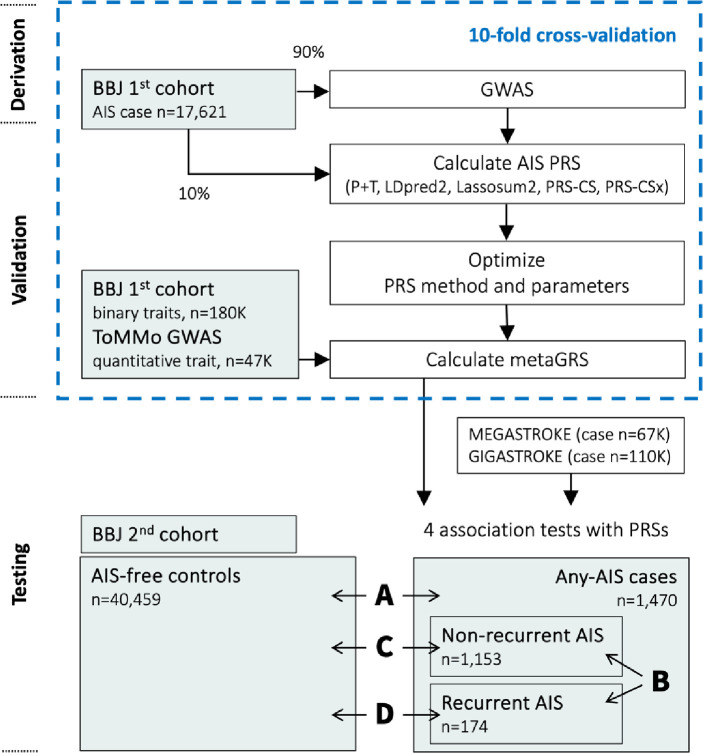
We used data from the BioBank Japan (BBJ) 1 cohort (n=179,938) to derive and optimize the PRSs using a 10-fold cross-validation. We integrated the optimized PRSs for multiple traits, such as vascular risk factors and stroke subtypes to generate a single PRS using the meta-scoring approach (metaGRS). We used an independent BBJ 2 cohort (n=41,929) as a test sample to evaluate the association of the metaGRS with stroke and recurrent stroke.
We analyzed recurrent stroke cases (n=174) and non-recurrent stroke controls (n=1,153) among subjects within the BBJ 2 cohort. After adjusting for known risk factors, metaGRS was associated with stroke recurrence (adjusted OR per SD 1.18 [95% CI: 1.00-1.39, p=0.044]), although no significant correlation was observed with the published PRSs. We administered three distinct tests to consider the potential index event bias; however, the outcomes derived from these examinations did not provide any significant indication of the influence of index event bias. The high metaGRS group without a history of hypertension had a higher risk of stroke recurrence than that of the low metaGRS group (adjusted OR 2.24 [95% CI: 1.07-4.66, p=0.032]). However, this association was weak in the hypertension group (adjusted OR 1.21 [95% CI: 0.69-2.13, p=0.50]).
The metaGRS developed in a Japanese cohort predicted stroke recurrence in an independent cohort of patients. In particular, it predicted an increased risk of recurrence among stroke patients without hypertension. These findings provide clues for additional genetic risk stratification and help in developing personalized strategies for stroke recurrence prevention.
最近,人们开发了各种基于多基因风险评分(PRS)的方法来改善中风预测。然而,目前的PRS(包括跨血统PRS)对复发性中风的预测效果不佳。在这里,我们旨在通过广泛比较各种方法并最大化中风发病的预测性能,来确定日本人群中最佳的PRS是否也能预测该人群中的中风复发情况。
我们使用了日本生物银行(BBJ)1队列(n = 179,938)的数据,通过10倍交叉验证来推导和优化PRS。我们整合了针对多种特征(如血管危险因素和中风亚型)的优化PRS,使用元评分方法(metaGRS)生成单个PRS。我们使用独立的BBJ 2队列(n = 41,929)作为测试样本,以评估metaGRS与中风和复发性中风的关联。
我们分析了BBJ 2队列中的复发性中风病例(n = 174)和非复发性中风对照(n = 1,153)。在调整已知危险因素后,metaGRS与中风复发相关(每标准差调整后的OR为1.18 [95% CI:1.00 - 1.39,p = 0.044]),尽管与已发表的PRS未观察到显著相关性。我们进行了三项不同的测试以考虑潜在的索引事件偏差;然而,这些检查得出的结果并未提供任何关于索引事件偏差影响的显著迹象。没有高血压病史的高metaGRS组中风复发风险高于低metaGRS组(调整后的OR为2.24 [95% CI:1.07 - 4.66,p = 0.032])。然而,这种关联在高血压组中较弱(调整后的OR为1.21 [95% CI:0.69 - 2.13,p = 0.50])。
在日本队列中开发的metaGRS在独立的患者队列中预测了中风复发。特别是,它预测了无高血压的中风患者复发风险增加。这些发现为进一步的遗传风险分层提供了线索,并有助于制定预防中风复发的个性化策略。