Jung Jiyoon, Kang Youngjin, Lee Yoo Jin, Kim Eojin, Ahn Bokyung, Lee Eunjung, Kim Joo Young, Lee Jeong Hyeon, Lee Youngseok, Kim Chul Hwan, Chae Yang-Seok
Department of Pathology, Korea University Anam Hospital, Seoul, Korea.
J Pathol Transl Med. 2017 Mar;51(2):129-136. doi: 10.4132/jptm.2016.12.09. Epub 2017 Feb 14.
Colorectal cancer (CRC) is one of the most common malignancies worldwide. Approximately 10%-15% of the CRC cases have defective DNA mismatch repair (MMR) genes. Although the high level of microsatellite instability status is a predictor of favorable outcome in primary CRC, little is known about its frequency and importance in secondary CRC. Immunohistochemical staining (IHC) for MMR proteins (e.g., MLH1, MSH2, MSH6, and PMS2) has emerged as a useful technique to complement polymerase chain reaction (PCR) analyses.
In this study, comparison between the MMR system of primary CRCs and paired liver and lung metastatic lesions was done using IHC and the correlation with clinical outcomes was also examined.
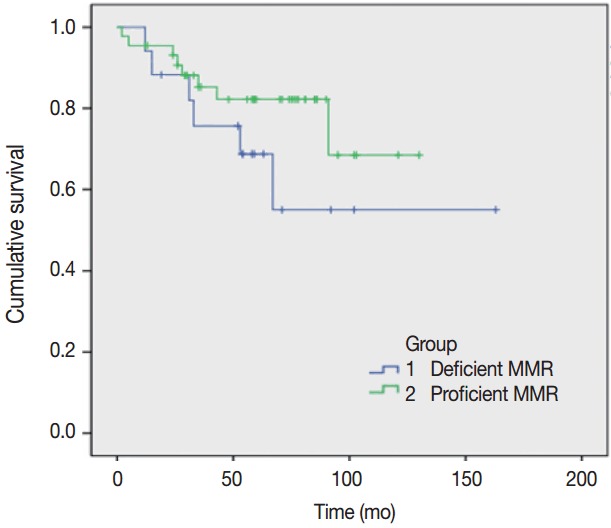
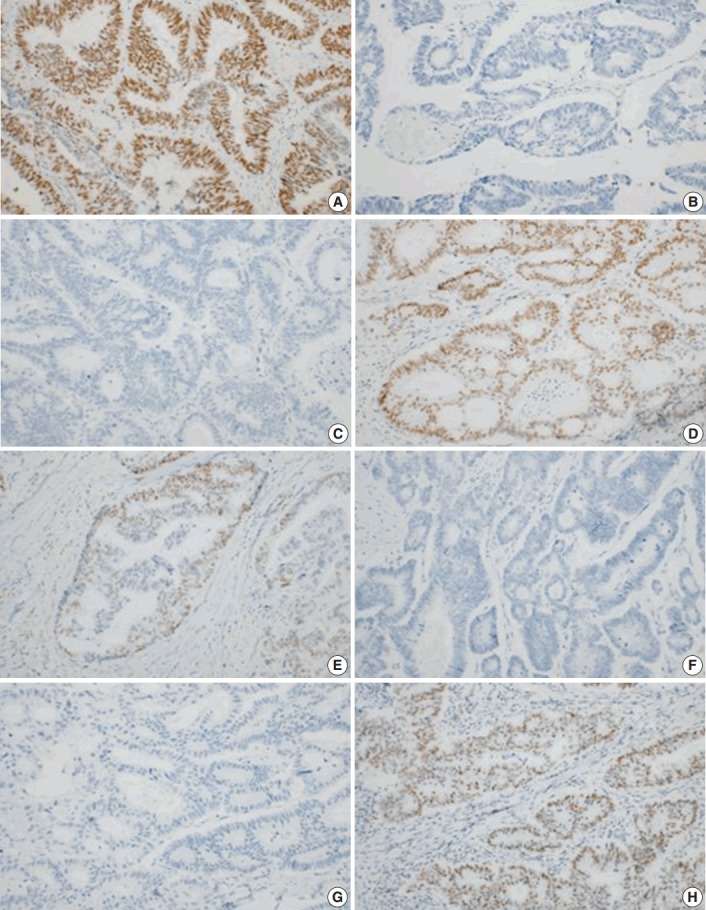
Based on IHC, 7/61 primary tumors (11.4%) showed deficient MMR systems, while 13/61 secondary tumors (21.3%) showed deficiencies. In total, 44 cases showed proficient expression in both the primary and metastatic lesions. Three cases showed deficiencies in both the primary and paired metastatic lesions. In 10 cases, proficient expression was found only in the primary lesions, and not in the corresponding metastatic lesions. In four cases, proficient expression was detected in the secondary tumor, but not in the primary tumor.
Although each IHC result and the likely defective genes were not exactly matched between the primary and the metastatic tumors, identical results for primary and metastatic lesions were obtained in 77% of the cases (47/61). These data are in agreement with the previous microsatellite detection studies that used PCR and IHC.
结直肠癌(CRC)是全球最常见的恶性肿瘤之一。约10%-15%的CRC病例存在DNA错配修复(MMR)基因缺陷。尽管微卫星高度不稳定状态是原发性CRC预后良好的一个预测指标,但关于其在继发性CRC中的发生率及重要性却知之甚少。MMR蛋白(如MLH1、MSH2、MSH6和PMS2)的免疫组织化学染色(IHC)已成为一种补充聚合酶链反应(PCR)分析的有用技术。
在本研究中,采用IHC对原发性CRC及其配对的肝和肺转移灶的MMR系统进行比较,并检测其与临床结局的相关性。
基于IHC,7/61例原发性肿瘤(11.4%)显示MMR系统缺陷,而13/61例继发性肿瘤(21.3%)显示缺陷。总共44例在原发性和转移灶中均显示表达正常。3例原发性和配对转移灶均显示缺陷。10例仅在原发性病变中发现表达正常,而在相应转移灶中未发现。4例在继发性肿瘤中检测到表达正常,但在原发性肿瘤中未检测到。
虽然原发性和转移性肿瘤之间的每个IHC结果及可能的缺陷基因并不完全匹配,但77%的病例(47/61)原发性和转移灶的结果相同。这些数据与先前使用PCR和IHC的微卫星检测研究结果一致。