Schwarz S, Prokopchuk O, Esefeld K, Gröschel S, Bachmann J, Lorenzen S, Friess H, Halle M, Martignoni M E
Department of Prevention, Rehabilitation and Sports Medicine, Klinikum rechts der Isar, Technical University, Munich, Germany.
Department of Surgery, Klinikum rechts der Isar, Technical University, Munich, Germany.
BMC Cancer. 2017 Feb 14;17(1):130. doi: 10.1186/s12885-017-3116-9.
Despite our growing knowledge about the pathomechanisms of cancer cachexia, a whole clinical picture of the cachectic patient is still missing. Our objective was to evaluate the clinical characteristics in cancer patients with and without cachexia to get the whole picture of a cachectic patient.
Cancer patients of the University Clinic "Klinikum rechts der Isar" with gastrointestinal, gynecological, hematopoietic, lung and some other tumors were offered the possibility to take part in the treatment concept including a nutrition intervention and an individual training program according to their capability. We now report on the first 503 patients at the time of inclusion in the program between March 2011 and October 2015. We described clinical characteristics such as physical activity, quality of life, clinical dates and food intake.
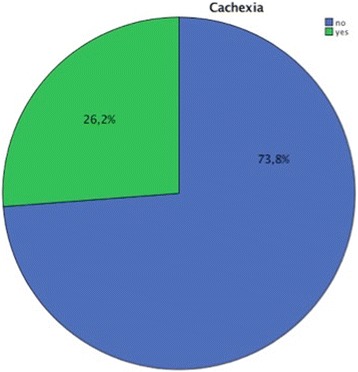
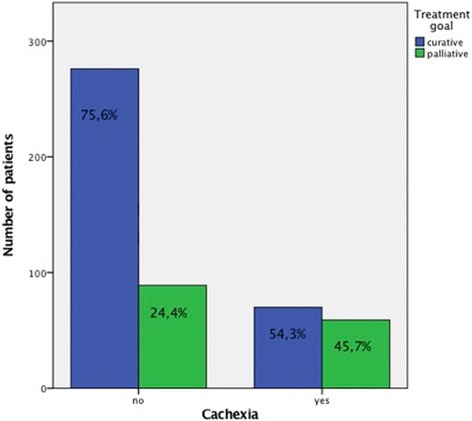
Of 503 patients with cancer, 131 patients (26.0%) were identified as cachectic, 369 (73.4%) as non-cachectic. The change in cachexia were 23% reduced capacity performance (108 Watt for non-cachectic-patients and 83 Watt for cachectic patients) and 12% reduced relative performance (1.53 Watt/kg for non-cachectic and 1.34 Watt/kg for cachectic patients) in ergometry test. 75.6% of non-cachectic and 54.3% of cachectic patients still received curative treatment.
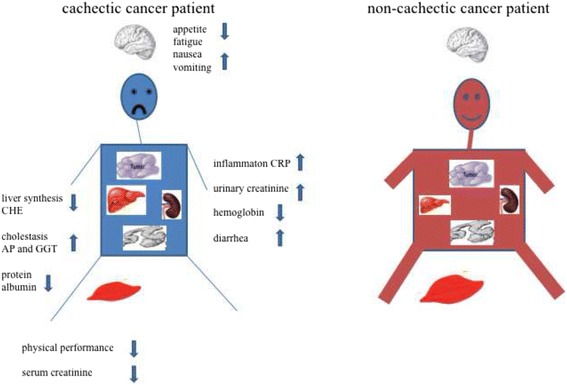
Cancer cachectic patients have multiple symptoms such as anemia, impaired kidney function and impaired liver function with elements of mild cholestasis, lower performance and a poorer quality of life in the EORTC questionnaire. Our study reveals biochemical and clinical specific features of cancer cachectic patients.
尽管我们对癌症恶病质的发病机制有了越来越多的了解,但恶病质患者的完整临床情况仍不明确。我们的目的是评估有或无恶病质的癌症患者的临床特征,以全面了解恶病质患者的情况。
向“伊萨尔河右岸大学诊所”患有胃肠道、妇科、血液系统、肺部及其他一些肿瘤的癌症患者提供参与治疗方案的机会,该方案包括营养干预和根据其能力制定的个性化训练计划。我们现报告2011年3月至2015年10月期间纳入该方案的首批503例患者的情况。我们描述了身体活动、生活质量、临床数据和食物摄入量等临床特征。
在503例癌症患者中,131例(26.0%)被确定为恶病质患者,369例(73.4%)为非恶病质患者。在测力计测试中,恶病质患者的能力表现下降了23%(非恶病质患者为108瓦,恶病质患者为83瓦),相对表现下降了12%(非恶病质患者为1.53瓦/千克,恶病质患者为1.34瓦/千克)。75.6%的非恶病质患者和54.3%的恶病质患者仍在接受根治性治疗。
癌症恶病质患者有多种症状,如贫血、肾功能受损、肝功能受损伴轻度胆汁淤积、体能下降以及在欧洲癌症研究与治疗组织问卷中的生活质量较差。我们的研究揭示了癌症恶病质患者的生化和临床特征。