Park Ji In, Jung Hae Hyuk
Department of Medicine, Kangwon National University Hospital, Kangwon National University School of Medicine, Chuncheon, Gangwon-do, South Korea.
PLoS One. 2017 Feb 14;12(2):e0172001. doi: 10.1371/journal.pone.0172001. eCollection 2017.
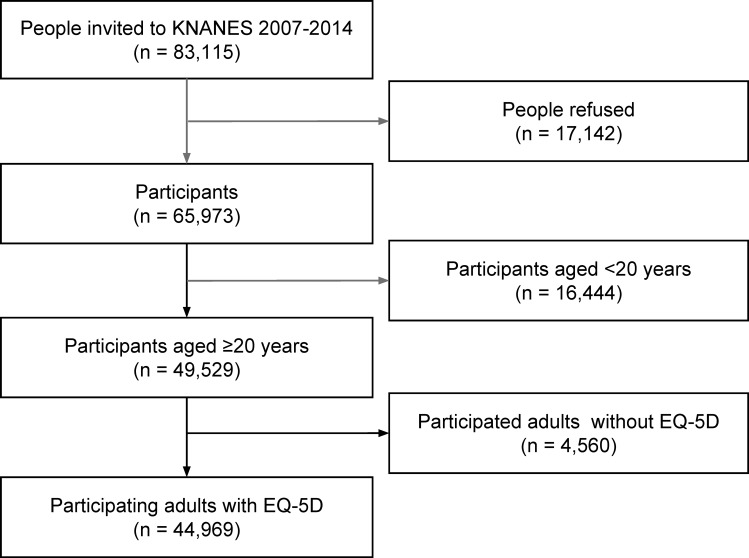
The Global Burden of Disease 2010 and the WHO Global Health Estimates of years lived with disability (YLDs) uses disability-weights obtained from lay health-state descriptions, which cannot fully reflect different disease manifestations, according to severity, treatment, and environment. The aim of this study was to provide population-representative YLDs of noncommunicable diseases and injuries using a prevalence-based approach, with the disability weight measured in subjects with specific diseases or injuries. We included a total of 44969 adults, who completed the EQ-5D questionnaire as participation in the Korea National Health and Nutrition Examination Survey 2007-2014. We estimated the prevalence of each of 40 conditions identified from the noncommunicable diseases and injuries in the WHO list. Modified condition-specific disability-weight was determined from the adjusted mean difference of the EQ-5D index between the condition and reference groups. Condition-specific YLDs were calculated as the condition's prevalence multiplied by the condition's disability-weight. All-cause YLDs, estimated as "number of population × (1 - mean score of EQ-5D)" were 2165 thousands in 39044 thousand adults aged ≥20. The combined YLDs for all 40 conditions accounted for 67.6% of all-cause YLDs, and were 1604, 2126, 8749, and 12847 per 100000 young (age 20-59) males, young females, old (age ≥60) males, and old females, respectively. Back pain/osteoarthritis YLDs were exceptionally large (442/40, 864/146, 2037/836, and 4644/3039 per 100000 young males, young females, old males, and old females, respectively). Back pain, osteoarthritis, depression, diabetes, periodontitis, and stroke accounted for 22.3%, 9.1%, 4.6%, 3.3%, 3.2%, and 2.9% of all-cause YLDs, respectively. In conclusion, this estimation of YLDs using prevalence rates and disability-weights measured in a population-representative survey may form the basis for population-level strategies to prevent age-related worsening of disability.
《2010年全球疾病负担》及世界卫生组织全球健康残疾生存年数(YLDs)估计采用了基于普通健康状况描述得出的残疾权重,而这些权重无法根据严重程度、治疗情况和环境充分反映不同的疾病表现。本研究的目的是采用基于患病率的方法,在患有特定疾病或损伤的受试者中测量残疾权重,从而提供具有人群代表性的非传染性疾病和损伤的YLDs。我们共纳入了44969名成年人,他们作为2007 - 2014年韩国国民健康与营养检查调查的参与者完成了EQ - 5D问卷。我们估计了世界卫生组织清单中确定的40种非传染性疾病和损伤每种疾病的患病率。根据疾病组与参照组之间EQ - 5D指数的校正平均差异确定修正的特定疾病残疾权重。特定疾病的YLDs通过该疾病的患病率乘以其残疾权重来计算。在39044千名年龄≥20岁的成年人中,以“人口数×(1 - EQ - 5D平均得分)”估算的全因YLDs为216.5万。40种疾病的合并YLDs占全因YLDs的67.6%,在每10万年轻(20 - 59岁)男性、年轻女性、老年(≥60岁)男性和老年女性中分别为1604、2126、8749和12847。背痛/骨关节炎的YLDs异常高(每10万年轻男性、年轻女性、老年男性和老年女性中分别为442/40、864/146、2037/836和4644/3039)。背痛、骨关节炎、抑郁症、糖尿病、牙周炎和中风分别占全因YLDs的22.3%、9.1%、4.6%、3.3%、3.2%和2.9%。总之,使用在具有人群代表性的调查中测量的患病率和残疾权重对YLDs进行的这种估计可能构成预防与年龄相关的残疾恶化的人群层面策略的基础。