Department of Surgical Nursing, Faculty of Nursing, Mahidol University, Bangkok, 10700, Thailand.
Department of Biostatistics, Faculty of Public Health, Mahidol University, Bangkok, 10400, Thailand.
BMC Health Serv Res. 2019 Oct 11;19(1):688. doi: 10.1186/s12913-019-4441-2.
The main purpose of health service systems is to improve patients' quality of life (QoL) and to ensure equitable access to health services. However, in reality, nearly half of knee osteoarthritis (OA) patients present to the health system do not have access to health services, and their QoL remains poor. These circumstances raise important questions about what (if any) factors can improve health care accessibility and QoL for knee OA patients.
A multicenter, cross-sectional survey was performed with 618 knee OA patients who received care at 16 hospitals in Thailand. Structural equation modeling (SEM) was conducted to investigate the association of health service factors and patient factors with access to health services and QoL.
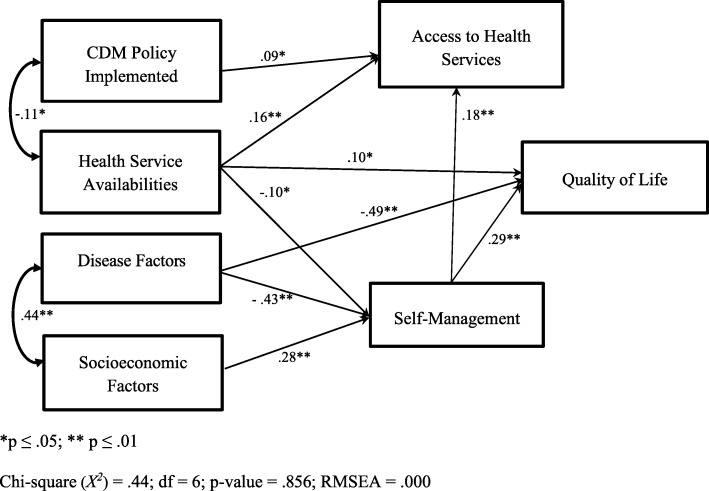
The QoL of knee OA patients was very poor (mean score = 33.8). Only 2.1% of the knee OA patients found it easy to obtain medical care when needed. Approximately 39.4% of them were able to access appropriate interventions before being referred for knee replacement. More than 85% of orthopedic health services had implemented chronic disease management (CDM) policy into practice. However, the implementation was basic, with an average score of 5.9. SEM showed that QoL was determined by both health system factors (β = .10, p = .01) and patient factors (β = .29, p = .00 for self-management and β = -.49, p = .00 for disease factors). Access to health services was determined by self-management (β = .10, p = .01), but it was not significantly associated with QoL (β = .00, p = 1.0).
This study provides compelling information about self-management, access to health services and QoL from the individual and health service system perspectives. Furthermore, it identifies a need to develop health services that are better attuned to the patient's background, such as socioeconomic status, disease severity, and self-management skills.
卫生服务系统的主要目的是提高患者的生活质量(QoL)并确保公平获得卫生服务。然而,实际上,近一半的膝关节骨关节炎(OA)患者无法获得卫生服务,其生活质量仍然较差。这些情况引发了一些重要的问题,即哪些因素(如果有的话)可以改善膝关节 OA 患者的医疗保健可及性和生活质量。
对泰国 16 家医院的 618 名膝关节 OA 患者进行了一项多中心、横断面调查。采用结构方程模型(SEM)研究卫生服务因素和患者因素与获得卫生服务和生活质量的关系。
膝关节 OA 患者的生活质量很差(平均得分=33.8)。只有 2.1%的膝关节 OA 患者在需要时能够轻松获得医疗保健。大约 39.4%的患者在被转诊进行膝关节置换之前能够获得适当的干预措施。超过 85%的骨科卫生服务机构已经将慢性病管理(CDM)政策付诸实践。然而,实施情况基础薄弱,平均得分为 5.9。SEM 显示,生活质量由卫生系统因素(β=0.10,p=0.01)和患者因素(β=自我管理 0.29,p=0.00;β=疾病因素-0.49,p=0.00)共同决定。获得卫生服务由自我管理决定(β=0.10,p=0.01),但与生活质量无关(β=0.00,p=1.0)。
本研究从个体和卫生服务系统的角度提供了有关自我管理、获得卫生服务和生活质量的有说服力的信息。此外,研究还发现需要开发更能适应患者背景的卫生服务,如社会经济地位、疾病严重程度和自我管理技能。