Shahid Muhammad Laiq Ur Rahman, Chitiboi Teodora, Ivanovska Tetyana, Molchanov Vladimir, Völzke Henry, Linsen Lars
Jacobs University, Bremen, Germany.
Fraunhofer MEVIS, Bremen, Germany.
BMC Med Imaging. 2017 Feb 14;17(1):15. doi: 10.1186/s12880-017-0179-7.
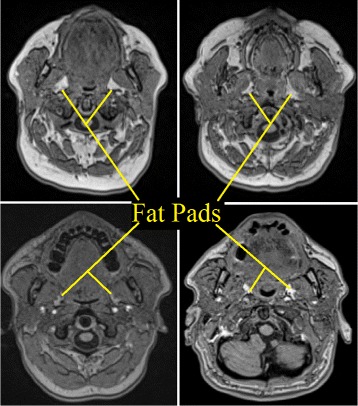
Obstructive sleep apnea (OSA) is a public health problem. Detailed analysis of the para-pharyngeal fat pads can help us to understand the pathogenesis of OSA and may mediate the intervention of this sleeping disorder. A reliable and automatic para-pharyngeal fat pads segmentation technique plays a vital role in investigating larger data bases to identify the anatomic risk factors for the OSA.
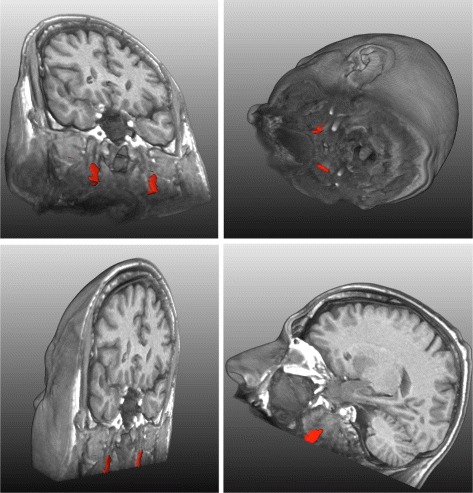
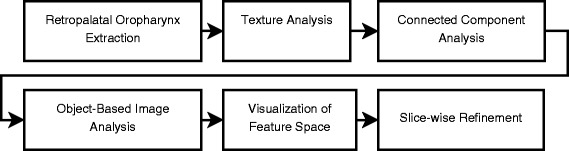
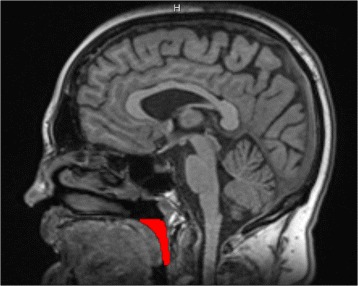
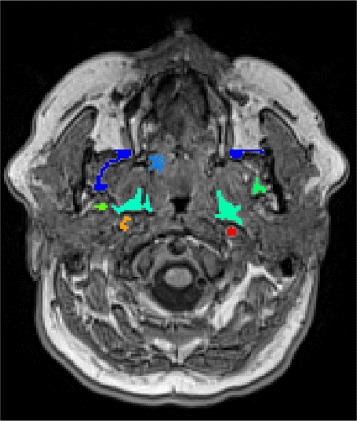
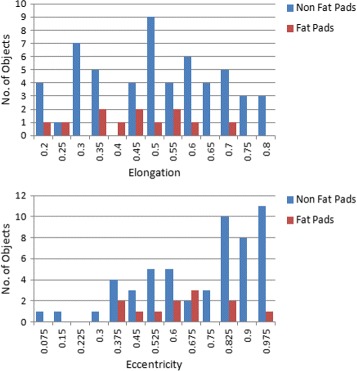
Our research aims to develop a context-based automatic segmentation algorithm to delineate the fat pads from magnetic resonance images in a population-based study. Our segmentation pipeline involves texture analysis, connected component analysis, object-based image analysis, and supervised classification using an interactive visual analysis tool to segregate fat pads from other structures automatically.
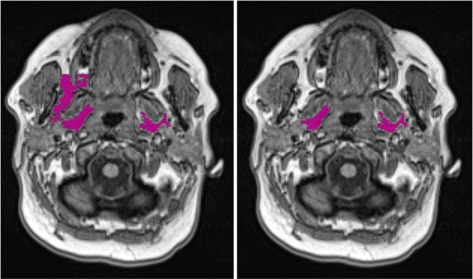
We developed a fully automatic segmentation technique that does not need any user interaction to extract fat pads. Our algorithm is fast enough that we can apply it to population-based epidemiological studies that provide a large amount of data. We evaluated our approach qualitatively on thirty datasets and quantitatively against the ground truths of ten datasets resulting in an average of approximately 78% detected volume fraction and a 79% Dice coefficient, which is within the range of the inter-observer variation of manual segmentation results.
The suggested method produces sufficiently accurate results and has potential to be applied for the study of large data to understand the pathogenesis of the OSA syndrome.
阻塞性睡眠呼吸暂停(OSA)是一个公共卫生问题。对咽旁脂肪垫的详细分析有助于我们理解OSA的发病机制,并可能介导对这种睡眠障碍的干预。一种可靠且自动的咽旁脂肪垫分割技术在研究更大的数据库以识别OSA的解剖学风险因素方面起着至关重要的作用。
我们的研究旨在开发一种基于上下文的自动分割算法,以便在一项基于人群的研究中从磁共振图像中勾勒出脂肪垫。我们的分割流程包括纹理分析、连通分量分析、基于对象的图像分析,以及使用交互式视觉分析工具进行监督分类,以自动将脂肪垫与其他结构区分开来。
我们开发了一种无需任何用户交互即可提取脂肪垫的全自动分割技术。我们的算法速度足够快,能够应用于提供大量数据的基于人群的流行病学研究。我们在30个数据集上对我们的方法进行了定性评估,并针对10个数据集的地面真值进行了定量评估,平均检测体积分数约为78%,骰子系数为79%,这在手动分割结果的观察者间变异范围内。
所建议的方法产生了足够准确的结果,并且有潜力应用于大数据研究以理解OSA综合征的发病机制。