Buono Jessica L, Carson Robyn T, Flores Natalia M
Allergan plc, Jersey City, NJ, USA.
Kantar Health, Foster City, CA, USA.
Health Qual Life Outcomes. 2017 Feb 14;15(1):35. doi: 10.1186/s12955-017-0611-2.
Irritable bowel syndrome (IBS) affects 10-15% of adults in the US, and is associated with significant impairment in health-related quality of life (HRQoL); however, information specific to the diarrhea subtype (IBS-D) is lacking. We assessed the impact of IBS-D on HRQoL, work productivity, and daily activities, and the associated indirect costs, among a sample of the US population.
Respondents (≥18 years) from the 2012 US National Health and Wellness Survey who reported an IBS-D diagnosis by a physician or symptoms consistent with Rome II criteria for IBS-D were identified as having IBS-D. Controls included respondents without IBS-D or inflammatory bowel disease. HRQoL was assessed via the Short Form 36 Health Survey version 2 questionnaire and summarized into Mental and Physical Component Summary (MCS; PCS) scores and a Short Form-6 dimension (SF-6D) utility score. Work and activity impairment were assessed via the Work Productivity and Activity Impairment Questionnaire: General Health version (WPAI:GH), which measures absenteeism, presenteeism, overall work productivity loss, and daily activity impairment. Indirect costs were calculated using unit cost data from the Bureau of Labor Statistics and variables from the WPAI:GH. Generalized linear models were used to examine differences in health outcomes between respondents with IBS-D and controls, controlling for demographic and health characteristics.
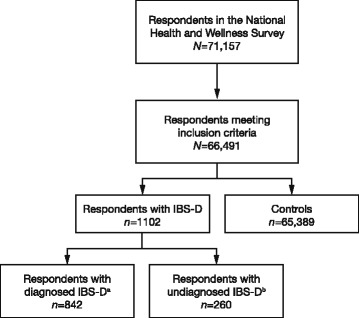
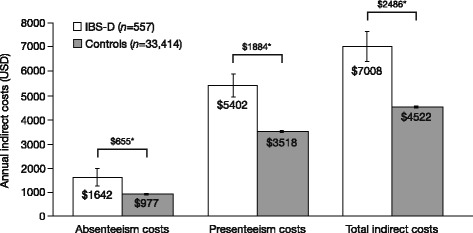
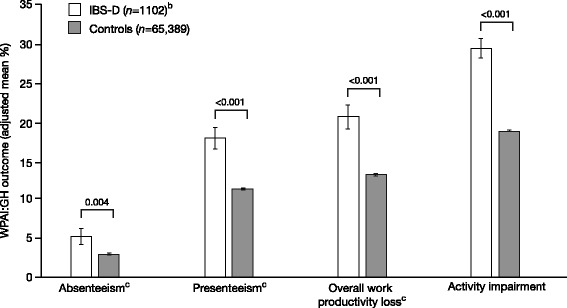
In total, 66,491 respondents (1102 IBS-D; 65,389 controls) were analyzed. Mean age was 48.7 years; 50% were female. Compared with controls, the IBS-D cohort reported significantly lower HRQoL (mean MCS: 45.16 vs. 49.48; p < 0.001; mean PCS: 47.29 vs. 50.67; p < 0.001; mean SF-6D: 0.677 vs. 0.741; p < 0.001) and greater absenteeism (5.1% vs. 2.9%; p = 0.004), presenteeism (17.9% vs. 11.3%; p < 0.001), overall work productivity loss (20.7% vs. 13.2%; p < 0.001), and activity impairment (29.6% vs. 18.9%; p < 0.001). Respondents with IBS-D also incurred an estimated $2486 more in indirect costs ($7008 vs. $4522; p < 0.001).
Compared with controls, IBS-D is associated with significantly lower HRQoL, greater impairments in work and daily activities, and higher indirect costs, imposing a substantial burden on patients and employers. These findings suggest a significant unmet need exists for effective IBS-D treatments.
肠易激综合征(IBS)影响着美国10%至15%的成年人,且与健康相关生活质量(HRQoL)的显著受损有关;然而,缺乏针对腹泻型(IBS-D)的具体信息。我们在美国人群样本中评估了IBS-D对HRQoL、工作生产力和日常活动的影响以及相关间接成本。
从2012年美国国家健康与健康调查中筛选出报告有医生诊断为IBS-D或有符合IBS-D罗马II标准症状的受访者(≥18岁),将其确定为患有IBS-D。对照组包括无IBS-D或炎症性肠病的受访者。通过简短形式36健康调查第2版问卷评估HRQoL,并汇总为心理和身体成分总结(MCS;PCS)分数以及简短形式6维度(SF-6D)效用分数。通过工作生产力和活动受损问卷:一般健康版(WPAI:GH)评估工作和活动受损情况,该问卷测量旷工、出勤主义、总体工作生产力损失和日常活动受损情况。使用美国劳工统计局的单位成本数据和WPAI:GH中的变量计算间接成本。采用广义线性模型来检验IBS-D受访者与对照组在健康结果方面的差异,并对人口统计学和健康特征进行控制。
总共分析了66491名受访者(1102名IBS-D患者;65389名对照组)。平均年龄为48.7岁;50%为女性。与对照组相比,IBS-D队列报告的HRQoL显著更低(平均MCS:45.16对49.48;p<0.001;平均PCS:47.29对50.67;p<0.001;平均SF-6D:0.677对0.741;p<0.001),旷工情况更严重(5.1%对2.9%;p = 0.004),出勤主义情况更严重(17.9%对11.3%;p<0.001),总体工作生产力损失更大(20.7%对13.2%;p<0.001),活动受损情况更严重(29.6%对18.9%;p<0.001)。IBS-D受访者的间接成本估计也高出2486美元(7008美元对4522美元;p<0.001)。
与对照组相比,IBS-D与显著更低的HRQoL、更大的工作和日常活动受损以及更高的间接成本相关,给患者和雇主带来了沉重负担。这些发现表明,对于有效的IBS-D治疗存在重大未满足的需求。