Kuzuyama Tomohisa
Biotechnology Research Center, The University of Tokyo, Tokyo, Japan.
J Antibiot (Tokyo). 2017 Jul;70(7):811-818. doi: 10.1038/ja.2017.12. Epub 2017 Feb 15.
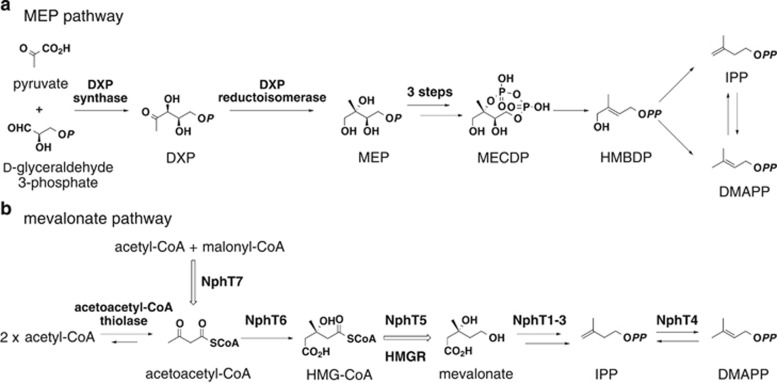
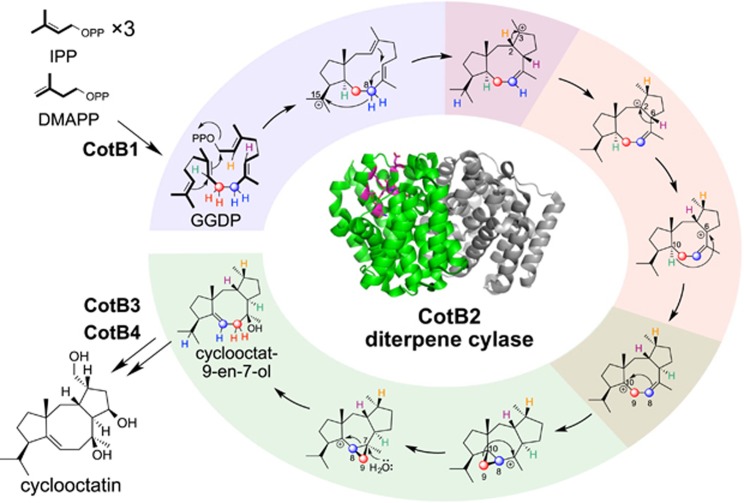
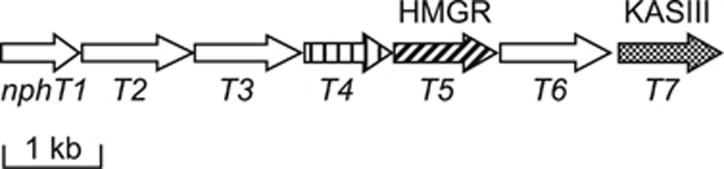
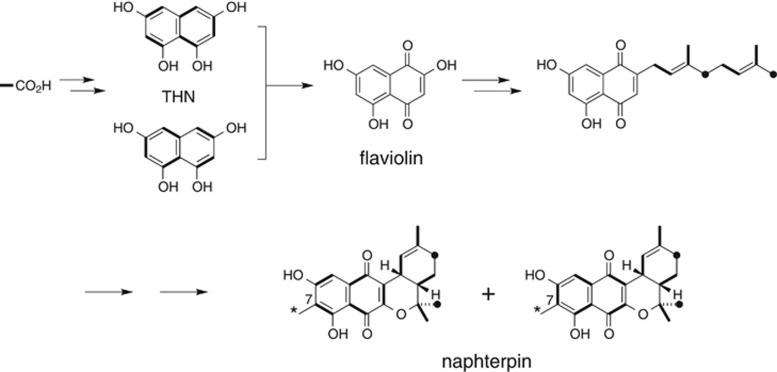
Terpenoids are a large and highly diverse group of natural products. All terpenoids are biosynthesized from isoprenyl diphosphate formed by the consecutive condensation of the five-carbon monomer isopentenyl diphosphate (IPP) to its isomer dimethylallyl diphosphate (DMAPP). Two distinct biosynthetic pathways produce the essential primary metabolites IPP and DMAPP: the 2-C-methylerythritol 4-phosphate pathway and the mevalonate pathway. The isoprenyl substrates can be cyclized by terpene cyclase into single-ring or multi-ring products, which can be further diversified by subsequent modification reactions, such as hydroxylation and glycosylation. This review article describes the biosynthetic pathways of terpenoids produced by Streptomyces and their related novel enzymes.
萜类化合物是一大类高度多样化的天然产物。所有萜类化合物都是由异戊烯基二磷酸生物合成的,异戊烯基二磷酸是由五碳单体异戊烯基二磷酸(IPP)与其异构体二甲基烯丙基二磷酸(DMAPP)连续缩合形成的。两种不同的生物合成途径产生必需的初级代谢产物IPP和DMAPP:2-C-甲基赤藓糖醇4-磷酸途径和甲羟戊酸途径。异戊烯基底物可通过萜烯环化酶环化形成单环或多环产物,这些产物可通过后续的修饰反应(如羟基化和糖基化)进一步多样化。这篇综述文章描述了链霉菌产生的萜类化合物的生物合成途径及其相关的新型酶。