Mehta Ojasvi, Inbaraj Leeberk Raja, Astbury Stuart, Grove Jane I, Norman Gift, Aithal Guruprasad P, Valdes Ana M, Vijay Amrita
Nottingham Digestive Diseases Center, School of Medicine, University of Nottingham, Nottingham, United Kingdom.
National Institute of Health Research (NIHR) Nottingham Biomedical Research Center, Nottingham University Hospitals National Health Service (NHS) Trust and University of Nottingham, Nottingham, United Kingdom.
Front Nutr. 2021 Feb 23;8:595756. doi: 10.3389/fnut.2021.595756. eCollection 2021.
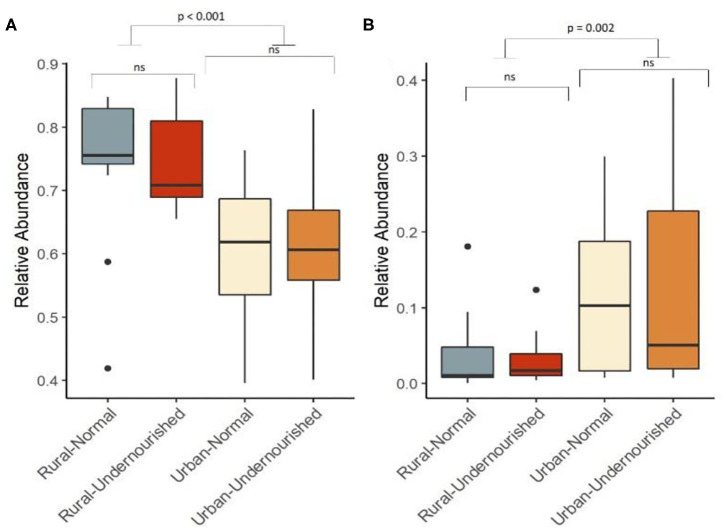
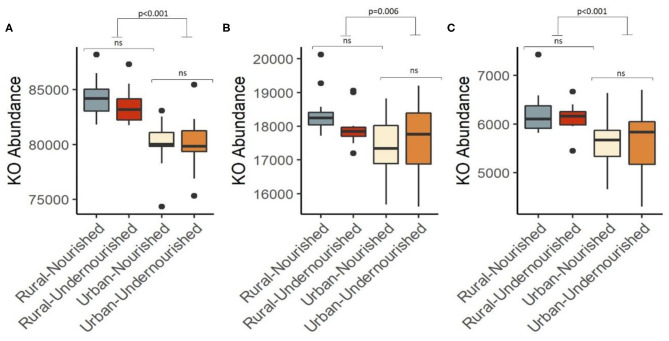
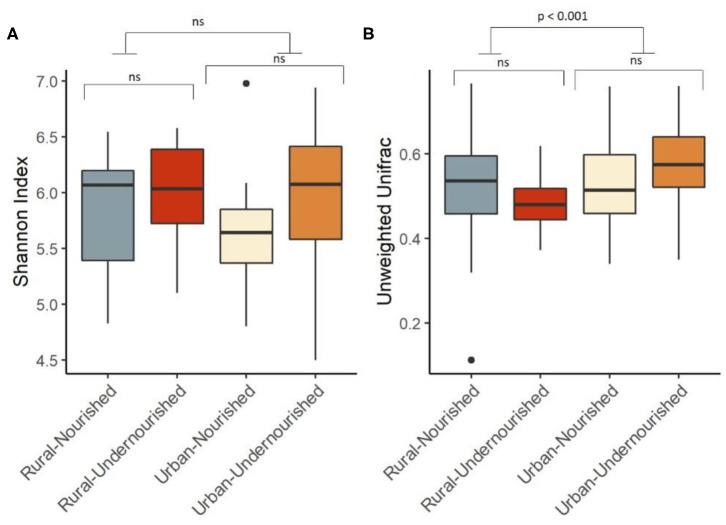
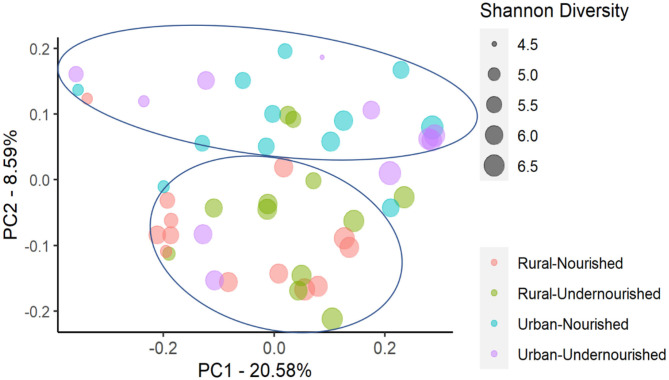
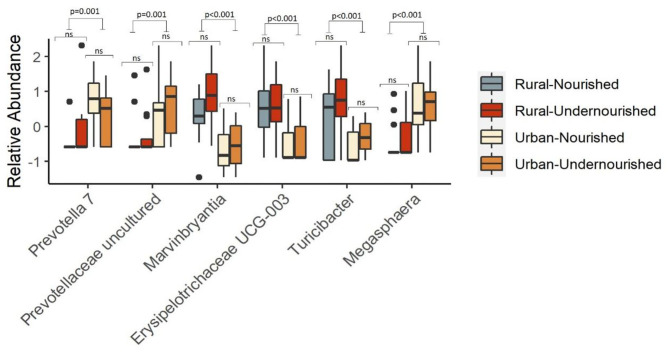
Undernutrition is a leading contributor to disease and disability in people of all ages. Several studies have reported significant association between nutritional status and gut microbiome composition but other factors such as demographic settings may also influence the adult microbiome. The relationship between undernourishment and gut microbiome in adults has not been described to date. In this study, we compared the gut microbiome in fecal samples of 48 individuals, from two demographic settings (rural and urban slum) in Karnataka, India using 16S rRNA sequencing. Nutritional status was assessed based on BMI, with a BMI of < 18.5 kg/m classified as undernourished, and a BMI in the range 18.5-25 kg/m as nourished. We analyzed 25 individuals from rural settings (12 undernourished and 13 nourished) and 23 individuals from urban slum settings (11 undernourished and 12 nourished). We found no significant difference in overall gut microbial diversity (Shannon and Unweighted UniFrac) between undernourished and nourished individuals in either geographical settings, however, microbial taxa at the phylum level (i.e., Firmicutes and Proteobacteria) and beta diversity (unweighted UniFrac) differed significantly between the rural and urban slum settings. By predicting microbial function from 16S data profiling we found significant differences in metabolic pathways present in the gut microbiota from people residing in different settings; specifically, those related to carbohydrate and lipid metabolism. The weighted sum of the KEGG Orthologs associated with carbohydrate metabolism (Spearman's correlation coefficient, ρ = -0.707, < 0.001), lipid metabolism (Spearman's correlation coefficient, ρ = -0.330, < 0.022) and biosynthesis of secondary metabolites (Spearman's correlation coefficient, ρ = -0.507, < 0.001) were decreased in the urban slum group compared to the rural group. In conclusion, we report that the geographical location of residence is associated with differences in gut microbiome composition in adults. We found no significant differences in microbiome composition between nourished and undernourished adults from urban slum or rural settings in India.
营养不良是各年龄段人群疾病和残疾的主要促成因素。多项研究报告了营养状况与肠道微生物群组成之间的显著关联,但其他因素(如人口统计学背景)也可能影响成人微生物群。迄今为止,尚未描述成人营养不良与肠道微生物群之间的关系。在本研究中,我们使用16S rRNA测序比较了印度卡纳塔克邦两个不同人口统计学背景(农村和城市贫民窟)的48名个体粪便样本中的肠道微生物群。根据体重指数(BMI)评估营养状况,BMI<18.5 kg/m²分类为营养不良,BMI在18.5-25 kg/m²范围内为营养良好。我们分析了25名农村个体(12名营养不良和13名营养良好)和23名城市贫民窟个体(11名营养不良和12名营养良好)。我们发现,在任一地理环境中,营养不良和营养良好个体之间的总体肠道微生物多样性(香农指数和非加权UniFrac指数)均无显著差异,然而,在门水平上的微生物分类群(即厚壁菌门和变形菌门)以及农村和城市贫民窟环境之间的β多样性(非加权UniFrac指数)存在显著差异。通过从16S数据图谱预测微生物功能,我们发现居住在不同环境中的人群肠道微生物群中存在的代谢途径存在显著差异;特别是与碳水化合物和脂质代谢相关的途径。与碳水化合物代谢相关的KEGG直系同源物的加权总和(斯皮尔曼相关系数,ρ=-0.707,P<0.001)、脂质代谢(斯皮尔曼相关系数,ρ=-0.330,P<0.022)和次生代谢物生物合成(斯皮尔曼相关系数,ρ=-0.507,P<0.001)在城市贫民窟组中比农村组有所降低。总之,我们报告居住地理位置与成人肠道微生物群组成差异有关。我们发现,来自印度城市贫民窟或农村地区的营养良好和营养不良成年人之间的微生物群组成没有显著差异。